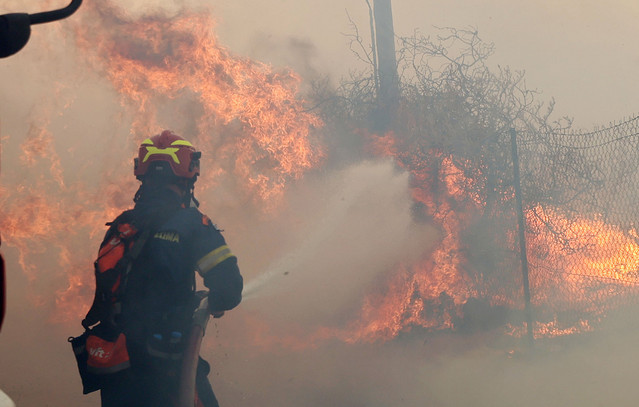
Wildfires and heatwaves sweeping France, Spain and other parts of Europe have already cost more than 3 billion euros this year, according to an analysis by the Financial Times.
Nearly 500,000 hectares have burned in the first two months of the fire season, with the economic cost estimated at 3.1 billion euros across the five eurozone countries hit hardest: France, Spain, Portugal, Greece and Romania. That figure already far exceeds the European Commission's estimate of an average annual impact of 2.5 billion euros for the entire European Union.
Real cost expected to be far higher
The FT's calculations use the same methodology as the Commission's estimates and comparable figures from the French government, covering the cost of restoring burned land to its previous state. The true economic footprint is expected to be much larger, as insurers, households and businesses are still assessing damage to property, crops and tourism in the middle of the summer season. Rising insurance premiums, areas becoming uninsurable, falling tourism and higher firefighting costs will add to the total.
The figures do not fully capture Greece's latest major fires. The Greek government has said crews will move immediately to record damage so state support can reach people who lost property. The effects of drought have also not been fully measured, though falling water levels in the Rhine and Danube are already disrupting freight transport and energy production.
Rivers strain industry and energy supply
In Germany, chemical companies including BASF, Covestro and Evonik have facilities concentrated along the Rhine, leaving them exposed to shipping and supply problems. On the Danube, historically low water levels are driving an energy crisis. Hungary is preparing to shut down the nuclear plant that supplies almost half the country's electricity, while Romania has taken one of the two units at the Cernavodă nuclear plant offline. Both facilities rely on Danube water for cooling.
Sarah Meyer, a climate economics expert at ETH Zurich, said the real economic cost of the fires could far exceed current estimates. She said this year's losses could be more than triple the average annual GDP loss she had calculated for the regional economies of Portugal, Spain, Italy and Greece between 2011 and 2018, warning that costs would be far greater if fires reached cities.
France counts heavy losses in Gironde
In France, the Gironde region has been at the center of the impact. A hub for the defense and aerospace industry, it saw firms including Safran, Dassault Aviation and ArianeGroup temporarily halt production and evacuate workers. Bordeaux's vineyards have largely been spared so far, though it remains uncertain whether smoke will affect the harvest. Oyster farming in the Arcachon basin has also been hit, and tourism, which accounts for 7% of the region's GDP, faces serious disruption. The Gironde Chamber of Commerce and Industry says at least 40,000 businesses have been directly affected, with 19,500 fully closed as of July 30. Between 120,000 and 150,000 workers were on state-subsidized reduced hours as of July 27.
Spain loses homes, crops and businesses
In Spain, fires came within 50 kilometers of Madrid, burning homes, businesses and vehicles in rural areas. The association of small farmers and ranchers recorded preliminary losses across 18,500 hectares of productive land, mostly pasture, with smaller producers around Madrid hit especially hard.
Unmeasured losses
Experts say many of the most significant impacts are not captured in economic figures. Ioannis Kountouris, an associate professor at Imperial College, said costs such as extra hospitalizations from air pollution are usually left out of official calculations. Andrew Kenningham, chief Europe economist at Capital Economics, said natural disasters can have "paradoxically positive" effects on GDP because state aid and insurance payouts boost reconstruction spending. Meyer said that is not growth, but simply the replacement of capital that has already been destroyed.