

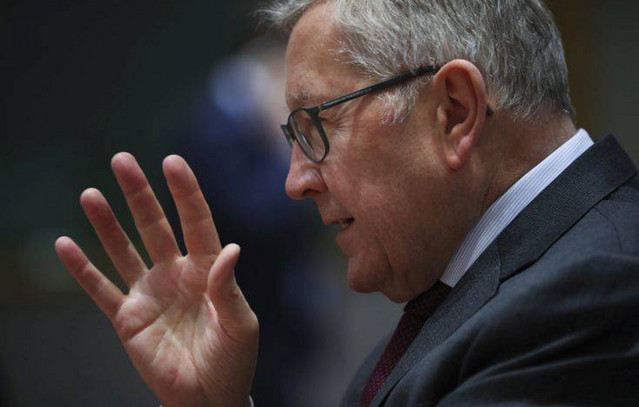
Klaus Regling, the former head of the European Stability Mechanism (ESM) and the European Financial Stability Facility (EFSF), praised Greece's fiscal progress over the past 15 years, saying the country's macroeconomic indicators are now in order and that the doubling of its exports as a share of gross domestic product is highly significant.
Regling made the remarks on a panel at the 3rd Economic Conference organized by the Greek newspaper Imerisia, held on Friday, September 4, 2026, at the Makedonia Palace in Thessaloniki.
He was responding to a request from the panel's moderator, Nikos Vettas, president of the Foundation for Economic and Industrial Research (IOBE), a Greek economic policy institute, who had asked him to offer advice for Greece.
Referring to the coordination of fiscal policy across the European Union through the Stability and Growth Pact, Regling said fiscal sustainability was necessary for every country and that this was now widely understood in Greece. He added that the progress achieved in that area over the past decade was impressive.
The ESM is the eurozone's permanent bailout fund, created in 2012 to provide financial assistance to member states in financial difficulty. Its predecessor, the EFSF, provided emergency loans to Greece during the sovereign debt crisis. Regling led both institutions from the ESM's creation until 2022.
Three challenges Regling called existential
Regling said Europe faces three challenges he described as existential, each more serious than those it has confronted in the past.
The first, he said, is the erosion of the international multilateral order, a development he said poses a particular threat to the EU, which he said has benefited significantly from the functioning of the multilateral international system.
The second is the pressure Europe faces from Russia, China and the United States, each applying pressure in different ways and through different means, according to Regling.
The third is weak growth prospects across Europe as a whole, which he said carry serious consequences for both public finances and the sustainability of social security systems.
Integration through crisis
Regling described the European Union's experience as absolutely remarkable, calling it the most successful model of multilateral cooperation in history. He said European integration has repeatedly advanced through crises, as predicted by Jean Monnet, one of the founding figures of European integration.
He pointed to the creation of new crisis-response institutions and tools after the euro crisis, the establishment of the NextGenerationEU recovery fund in response to the pandemic, and the strengthening of European military cooperation following Russia's invasion of Ukraine.
Single Market and a defence union
To address these challenges, Regling set the completion of the Single Market and the creation of a European Defence Union as key priorities for the EU's future.
Further measures Regling proposed
He also proposed several additional steps to strengthen the EU's effectiveness and international standing.
- Expanding qualified majority voting instead of unanimity in more policy areas, which he said would become even more important with future EU enlargement.
- Better adapting EU competition policy to the needs of industrial policy, so Europe can respond more effectively to unfair trade practices.
- Strengthening cooperation with major economies and strategic partners, including India, Brazil, Indonesia, Canada, South Korea, Japan and Australia.
- Strengthening the international role of the euro, so Europe gains greater independence from American payment systems and shields the eurozone from external financial shocks.
At the national level, Regling said each EU member state must pursue reforms that strengthen competitiveness while maintaining fiscal stability, according to the Athens-Macedonian News Agency (ANA-MPA).
Call for businesses to take more initiative
In a discussion that followed with Vettas, Kriton Hatzimineas, founder and chief executive of Theon and president of EENE, said the European business community needs to take on greater responsibility for boosting competitiveness, while also investing in human capital, artificial intelligence and international outreach.
Hatzimineas said businesses must take more initiative, arguing that strengthening European competitiveness cannot rest solely on governments and EU institutions. He said that alongside political will, there also needs to be business will.
Theon, listed on Euronext Amsterdam, designs and manufactures night-vision and optronics equipment for military and security use.
Hatzimineas placed particular emphasis on investing in human capital and acquiring new skills, especially in artificial intelligence, suggesting that a significant share of available resources be directed toward retraining workers. He pointed to Greece's highly skilled workforce as an important comparative advantage, saying Greek engineers are gold here in Greece, and called on Greek companies to strengthen their international outreach.
About the conference
The 3rd Economic Conference of Imerisia was held in cooperation with OPEN TV and Ethnos, under the auspices of the Ministry of National Economy and Finance, the Ministry of Interior, the Municipality of Thessaloniki, the Hellenic Federation of Enterprises (SEV), the Exporters' Association of Northern Greece (SEVE) and the Thessaloniki Chamber of Commerce and Industry (EBETH). It ran under the title "Greece of Tomorrow: Redefining Growth in Southeast Europe."


