

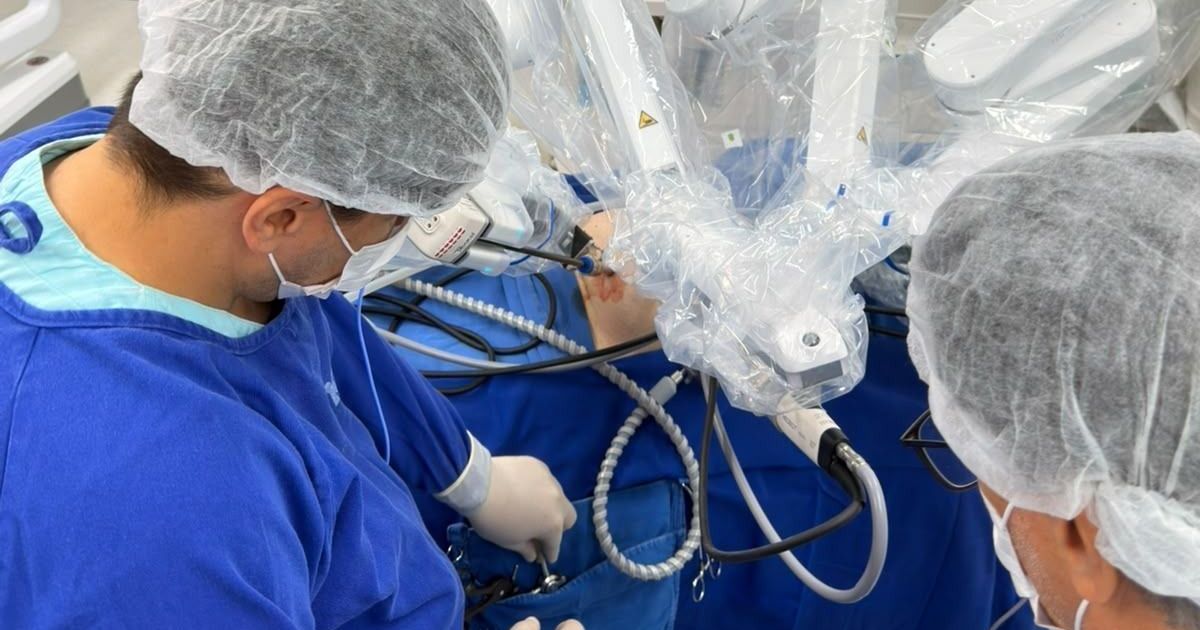
Surgeons in central Brazil have performed a total prostate removal operation on a patient in Goiânia while controlled remotely from Santiago in Chile.
The procedure on Tuesday at Hospital do Rim was the first tele-surgery connecting the state of Goiás to Chile, operating across a distance of approximately 3,000 kilometres.
Doctors carried out a radical prostatectomy, which involves the complete removal of the prostate, a gland in the male reproductive system. The operation serves as the primary treatment for localized prostate cancer, a disease in which malignant cells form within the gland tissue.
In Brazil, the National Cancer Institute, known as Inca, identifies prostate cancer as the second most common cancer among men, making access to effective surgical intervention a major public health priority.

Network redundancy and signal latency
The remote operation required a high-performance communications infrastructure to ensure stability and continuous data transmission throughout the surgical procedure.
Engineers set up two independent fibre optic connections alongside a dedicated virtual private network and back-up redundancy provided by a 5G mobile network.
Maintaining a network latency below 200 milliseconds formed another fundamental technical requirement for the operation. International medical standards consider this threshold essential to guarantee a virtually instantaneous response between the physical movements made by the remote surgeon and the corresponding actions of the robotic platform.
In robotic tele-surgery, minimal lag is necessary to allow the operating physician to make delicate incisions and manage tissue surrounding critical anatomical structures without delay.
Democratising specialist medical care
Eder Mattos, the national manager of education in robotic surgery at Hospcom, said tele-surgery represents one of the largest evolutions in the field of minimally invasive surgery.
Mattos said the capability allows healthcare systems to democratise access to high-complexity medicine by linking specialized doctors with patients located in remote areas or in regions facing a scarcity of highly trained medical professionals.
Minimally invasive techniques generally utilize smaller incisions than traditional open surgeries, reducing physical trauma to surrounding tissues.
The procedure marked three distinct milestones for regional healthcare, representing the first tele-surgery linking Goiás to Chile, the first prostatectomy performed via tele-surgery in Goiás, and the first tele-surgery carried out at Hospital do Rim.
Robotic technology and cost reduction
The medical team performed the operation using the Toumai robotic surgical system, a medical platform developed in China. The system features a single central tower from which multiple surgical arms extend over the operating table.
The platform combines three-dimensional high-definition vision with articulated instruments offering seven degrees of freedom and precise movement controls that mirror the exact physical gestures of the surgeon.
The equipment includes integrated tele-surgery functionality designed specifically for long-distance operations, as well as specialized software built to enhance tactile sensitivity and provide sensory feedback to the practitioner.
Bruno Benigno, a urologist and oncologist at Hospital Oswaldo Cruz and director of the Uro Onco Clinic who tested the technology in Brazil, said the Chinese developers essentially created a machine that serves as a copy of the American Da Vinci robot, but with notable modifications.
Benigno said the Toumai introduces specific improvements, including higher image definition and being the first surgical console manufactured with pre-programmed tele-surgery capabilities.
He added that the platform offers a lower-cost alternative because developers removed non-essential features, which he described as extra accessories on the console, reducing total expenses without compromising safety or usability.
Origins and patient outcomes
Engineers created the Toumai robotic system in 2014. The platform executed its first robotic surgical procedure in Shanghai, China, in 2019, before expanding internationally to become the primary competitor to Da Vinci, the American system that currently dominates the field of robotic surgery.
According to the manufacturing company, patients undergoing procedures with the Toumai platform can experience reduced blood loss during surgery, decreased post-operative pain, and a lower risk of acquiring surgical infections.
The company said patients also benefit from faster overall recovery times and shorter hospital stays compared to standard surgical interventions.


