

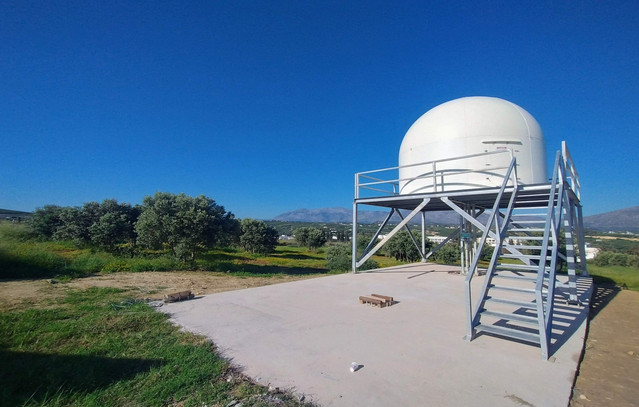
Greece is installing a satellite ground station at the Foundation for Research and Technology in Crete to serve as an operational communication hub for its national microsatellite fleet.
The ground facility will manage satellite telemetry and remote control instructions, while downlinking and processing data gathered in orbit by the country's space assets.
A lease agreement for the installation of the station and related equipment was signed between the Foundation for Research and Technology and the General Secretariat of Telecommunications and Post, a division of the Ministry of Digital Governance and Artificial Intelligence, with an effective start date of November 1, 2025.
The Foundation for Research and Technology, commonly known as FORTH, is one of the largest public research organisations in Greece. Headquartered in Heraklion on the island of Crete, the centre operates multiple specialized institutes focusing on computer science, astrophysics, and technological innovation. The Ministry of Digital Governance oversees state telecommunications policy and public sector technological infrastructure.
National microsatellite programme funding
The new ground station forms a central element of the National Microsatellite Programme, a major space infrastructure initiative executed in partnership with the Hellenic Space Center and the European Space Agency.
The programme carries a total budget of 200 million euros and receives its funding through the European Union Recovery and Resilience Facility.
The European Space Agency, headquartered in Paris, is an intergovernmental organisation of 22 member states, including Greece, dedicated to space research and satellite technology. The Recovery and Resilience Facility serves as the primary funding instrument of NextGenerationEU, created by the European Union to support digital transformation, economic resilience, and green investments across member states.
Ground station construction and facility selection
An industrial consortium led by Open Cosmos Aegean took charge of constructing the ground station. The physical installation was completed by the Libre Space Foundation, a Greek entity specializing in space technology development.
Open Cosmos Aegean operates as a satellite technology firm focusing on mission design and orbital infrastructure. The Libre Space Foundation functions as an independent organisation that develops open-source hardware and software standards for space systems.
State officials selected FORTH to host the satellite ground station due to the institution's extensive research record in space-related disciplines. These academic areas include satellite remote sensing, astrophysics, advanced telecommunications, quantum communications, and space surveillance.
FORTH also jointly operates the Skinakas Observatory alongside the University of Crete. Established as a leading astrophysics research site in Southeastern Europe, the observatory is undergoing expansion to support space surveillance capabilities and secure optical ground-to-space communications using laser technology.
Applications for state services
Dimitris Papastergiou, the Minister of Digital Governance and Artificial Intelligence, said the National Microsatellite Programme creates the required infrastructure for Greece to utilize space data in critical public administration sectors.
Papastergiou highlighted Civil Protection, climate change response, environmental protection, precision agriculture, maritime surveillance, and spatial planning as key areas that will rely on the satellite data stream.
He added that installing the satellite ground station at FORTH links national space policy directly with domestic scientific research and expertise, aiming to establish a stronger domestic ecosystem around space technologies.
Professor Vassilis Charmandaris, the president of FORTH, said the selection of the foundation to host the new facility reinforces its participation in high-technology projects of national significance, making full use of its scientific staff and research infrastructure.
Space Crete centre of excellence
The expansion of space infrastructure on the island coincides with another major investment secured by FORTH. The foundation obtained 35 million euros in funding from the HORIZON-WIDERA-2025 programme to establish the Crete Centre of Excellence in Emerging Space Technologies through the SPACE-Crete project.
The new facility aims to transform Crete into an international hub for research and innovation within the space sector. The HORIZON-WIDERA scheme operates under Horizon Europe, the European Union flagship funding framework created to advance scientific research and strengthen regional innovation capabilities.
Professor Panagiotis Tsakalides, the scientific lead for SPACE-Crete and director of the Institute of Computer Science at FORTH, noted that the launch of the project aligns directly with the operation of the satellite ground station on the campus.
Tsakalides said the research expertise at FORTH will support both the effective operation of the ground station and the analysis of collected satellite data, driving the development of new applications and public services for Crete and the entire nation.


