

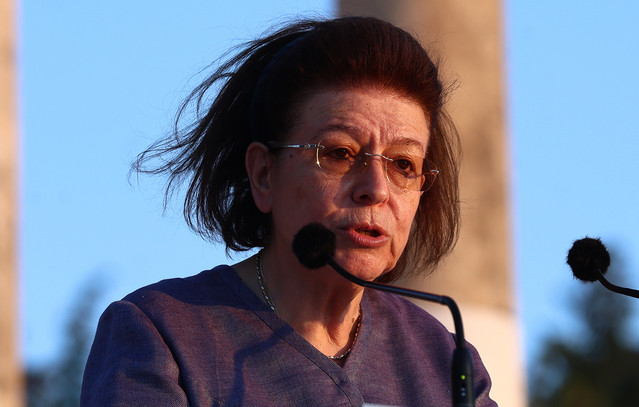
Greek President Konstantinos Tasoulas has formally reopened the ancient site of Nicopolis in Epirus following extensive protection, conservation and restoration projects by the Ministry of Culture. The completion of the work marks a major step in preparing the ancient Roman city for inclusion on the UNESCO World Heritage List, according to a statement released by the ministry on Wednesday.
A preliminary nomination dossier has already been submitted for evaluation to the United Nations cultural agency as part of the formal application process. The ministry confirmed that the site has now been handed back to the local community following an official inauguration ceremony held on Monday, September 28.
A bid for global recognition
Culture Minister Lina Mendoni described the bid to register Nicopolis on the UNESCO list as an objective of national importance. She said Nicopolis represents a monumental ensemble of exceptional significance, capturing the historical transition from the Hellenistic world to the Roman Empire and subsequently into the early Christian era.
Mendoni noted that the surviving Roman and early Christian monuments, together with the exceptionally preserved natural landscape, form a cultural heritage of international standing. She explained that the Ministry of Culture has been implementing a coherent program of protection, restoration and highlighting by drawing on funds from the European Union Recovery and Resilience Facility and the National Strategic Reference Framework.
UNESCO, the United Nations Educational, Scientific and Cultural Organization, awards World Heritage status to sites around the globe that demonstrate outstanding universal value. Mendoni highlighted that over the seven years of Prime Minister Kyriakos Mitsotakis's government, Greece submitted three nominations, the maximum allowed by UNESCO, covering Zagori, the Minoan Palatial Centres of Crete, and Mount Olympus. All three were successfully inscribed on the World Heritage List.
Mendoni added that preparing the application is a long and demanding process that requires national unity, consistency and dedication across political lines. She warned that premature attempts to claim individual political authorship over the nomination could create unnecessary difficulties in a procedure that depends on common effort.
Infrastructure and site integrity
A crucial factor in advancing the UNESCO candidacy was restoring the physical unity and integrity of the archaeological site. According to the ministry statement, the Region of Epirus planned, funded and executed a major infrastructure project to bypass the area, eliminating the section of the National Road that previously cut directly through Nicopolis.
Mendoni expressed her gratitude to the Region of Epirus, Regional Governor Alexandros Kachrimanis, the Ephorate of Antiquities of Preveza and the Municipality of Preveza, as well as all workers involved in preserving and developing the site.
Located in northwestern Greece near the modern town of Preveza, ancient Nicopolis was founded in 31 BC by Octavian, later Emperor Augustus, following his victory over Mark Antony and Cleopatra at the naval Battle of Actium. The name Nicopolis translates from Greek as the city of victory. Spanning hundreds of acres in Epirus, the ancient city developed into a major regional center of commerce and culture across the Roman and Byzantine periods.
Restoration of the Great Theatre
Key among the completed works is Phase B of the project for the protection, conservation and restoration of the Great Theatre of Nicopolis. Financed with a budget of 3,377,693 euros through the 2014 to 2020 Epirus Regional Operational Program under the National Strategic Reference Framework, the work included clearing earth fill, restoring the lower cavea seating infrastructure and masonry, rebuilding retaining walls, and installing temporary metal shoring to stabilize the stage building.
Continued progress on the theatre was secured on April 8, 2026, when Phase C was formally included in the 2021 to 2027 funding cycle with an allocated budget of 3,500,000 euros. This upcoming phase will focus on restoring the main stage building, the flanking paraskenia wings and the central orchestra area, completing the stone seating rows, constructing accessible pathways for people with disabilities, and installing a comprehensive drainage system alongside continued excavation, conservation and documentation work.
Built as part of the original Augustan construction program and extensively renovated during the 2nd century AD, the Great Theatre of Nicopolis was designed to accommodate approximately 8,000 spectators. In classical Roman urban design, large open-air theaters featured a semicircular seating gallery, known as the cavea, set against a raised stage edifice.
Discoveries at the Roman Palace
Restoration was also completed on the Palace building complex, also known as the House of Georgios Ekdikos, supported by a budget of 503,452.02 euros funded through the Recovery and Resilience Facility.
During the course of the works, archaeologists uncovered 36 new rooms and spaces within the complex, restored structural masonry walls, and re-erected two ancient columns. Specialists also conserved the only surviving wall mosaic in Nicopolis, located inside the Small Nymphaeum structure.
Covering an area of approximately 10 stremmata, or roughly one hectare, the palatial complex occupies an entire city block of the ancient Roman town. The multi-level elite residence underwent successive phases of renovation and repair spanning from the 1st century AD through to the 7th century AD.
Early Christian mosaics and climate protection
In addition, the ministry completed a 550,000 euro conservation and display project, funded through the Recovery Fund, focusing on the floor mosaics of Basilica A, associated with Bishop Dometios, and Basilica D. An accessible walking pathway was constructed around Basilica D to assist visitors.
Basilica A is recognized as one of the most prominent early Christian monuments at Nicopolis. Its floor mosaics are noted for high artistic craftsmanship, depicting botanical patterns, animal motifs, hunting scenes and marine life. Ancient inscriptions naming Bishop Dometios embedded in the mosaic floors provide historical records regarding the administration and history of the church.
Looking to the future, Mendoni stated that the Ministry of Culture is planning targeted interventions to protect Nicopolis from the threats posed by climate change. The conservation actions will be developed in collaboration with partner ministries, university faculties and specialized research institutions to ensure long-term site preservation.


