Greece submitted its first official appeal on Cyprus to the United Nations Secretariat on August 20, 1954, demanding equal rights and self-determination for island residents.
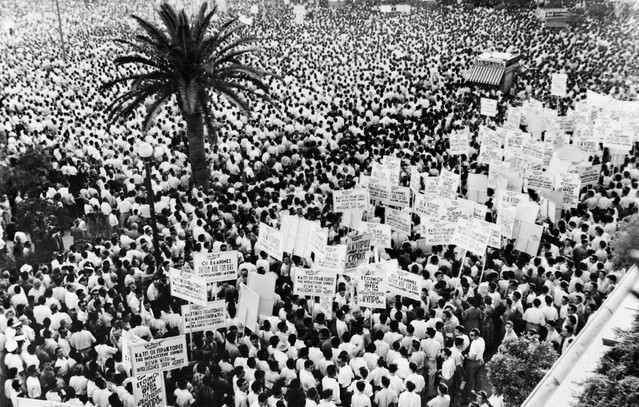
On the same day in Athens, thousands of citizens gathered in Syntagma Square to support uniting the island with Greece, triggering clashes that left dozens injured.
Cyprus, an island in the eastern Mediterranean, was under British colonial administration at the time of the diplomatic filing. The government of Field Marshal Alexandros Papagos, who served as Prime Minister of Greece, did not explicitly demand union with Greece, known as Enosis, but requested that residents decide their political future under United Nations supervision.
Officials in Athens carefully selected the wording to frame the Cyprus issue as a matter of decolonization and international self-determination rather than a direct claim on British territory. Despite the diplomatic framing, most Greek Cypriots linked self-determination directly to union with Greece, having voted over 95 percent in favor of Enosis during an unofficial 1950 referendum organized by the Church of Cyprus.
Greek permanent representative Alexis Kyrou formally submitted UN document A/2703 on August 20, following an August 16 letter sent by Papagos to UN Secretary-General Dag Hammarskjöld. The United Nations Secretariat, which handles administrative duties for the international body in New York, subsequently published the document.
British Rejection and Street Clashes in Athens
The filing followed repeated unsuccessful attempts by Greece to engage in direct bilateral discussions with Britain. Authorities in London viewed Cyprus as a vital military base for operations in the Middle East and argued that governance of the island fell exclusively within British domestic jurisdiction.
British Under-Secretary of State for the Colonies Henry Hopkinson had reinforced London stance on July 28 in the House of Commons, stating that the government could not consider any change of sovereignty for Cyprus. Hopkinson added that certain territories could never expect full independence, a statement that drew intense criticism across Greece and Cyprus.
As the document reached the United Nations, Archbishop Spyridon of Athens, who headed the Pan-Hellenic Committee for the Union of Cyprus, addressed a massive rally in Syntagma Square, the historic central plaza facing the Greek parliament. Clashes erupted when a section of the crowd tried to march toward the British embassy, prompting police forces to respond with batons and water cannons.
Published records of the violence indicate that more than 100 civilians and 24 police officers suffered injuries, while law enforcement officers arrested dozens of demonstrators.
Assembly Outcome and Historical Significance
The United Nations placed the Greek petition on the agenda for the 9th General Assembly session. However, UN delegates decided in December that approving a resolution was not appropriate for the time being, closing debate on the petition without taking substantive action.
Despite the lack of an immediate diplomatic victory, the 1954 recourse marked a fundamental shift by moving Cyprus from a private Anglo-Greek dispute onto the global stage. The international debate exposed deep geopolitical divisions among Greece, Britain, and Turkey that continued to shape regional relations for decades.
Major Historical Events on August 20
August 20 marks several other major historical milestones across ancient and modern history:
- 480 BC: King Leonidas and 300 Spartans, alongside 700 Thespian allies, fought to the death against the invading army of Persian King Xerxes at the Battle of Thermopylae, a coastal pass in central Greece. Their sacrifice became an enduring symbol of resistance and liberty.
- 1824: Editor Georgios Psyllas published the inaugural issue of Efimeris Athinon, the first newspaper of revolutionary Athens, printing the edition on Salamina island due to active military operations.
- 1882: Russian composer Pyotr Tchaikovsky officially premiered his 1812 Overture at the All-Russia Arts and Industrial Exhibition in Moscow, commemorating the Russian victory over Napoleon invading French forces.
- 1897: British physician Ronald Ross identified the malaria parasite inside a mosquito, confirming how the disease transmits to humans and earning the 1902 Nobel Prize in Physiology or Medicine.
- 1968: Soviet-led Warsaw Pact troops invaded Czechoslovakia, forcefully crushing the Prague Spring reform movement led by Alexander Dubcek.
- 1977: NASA launched the Voyager 2 space probe carrying the Golden Record of Earth sounds and images, initiating a mission that explored the outer solar system before entering interstellar space.
- 1982: The Greek government published Law 1272/1982 in the Government Gazette, officially decriminalizing adultery and establishing a legal milestone for personal privacy and gender equality.
Notable Births, Deaths, and Observances
Several prominent cultural figures were born or passed away on this date:
- Robert Plant (born 1948): The English singer and songwriter was born in West Bromwich, England. As the frontman for Led Zeppelin, Plant released eight studio albums with the rock group between 1969 and 1979, co-creating famous tracks such as Stairway to Heaven, Whole Lotta Love, and Kashmir.
- Nikolas Asimos (born 1949): Born in Thessaloniki and raised in Kozani, the Greek rock songwriter and street performer became a prominent figure in the Plaka and Exarcheia music scenes. Known for independent song distribution such as O Xanapes and satirical compositions, he is survived by his daughter Lilian.
- Jerry Lewis (died 2017): The American comedian, actor, director, screenwriter, and singer passed away after a long career in global entertainment. Lewis gained fame alongside Dean Martin in their comedy duo before starring in solo films including The Nutty Professor and The Bellboy.
August 20 is also designated as World Mosquito Day, commemorating the discovery of malaria transmission vectors. In addition, traditional Greek name days celebrated on this date include Theocharis, Theocharia, Theocharoula, and Samuel.