

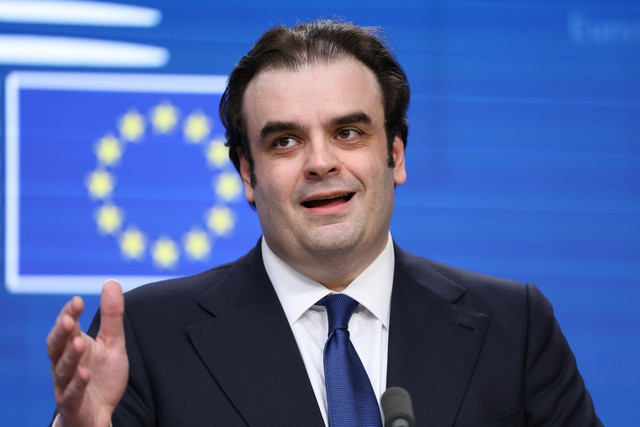
Greek Finance Minister Kyriakos Pierrakakis has been profiled by French news magazine Le Point as a key reformer seeking to energise the European economy. Journalists Emmanuel Berretta and Alexia Kefala traced his political journey from digital modernisation in Athens to his leadership of the eurozone finance ministers.
The extensive profile highlighted his alignment with the economic philosophy of former European Central Bank President Mario Draghi. It portrayed Pierrakakis as an ambitious policymaker attempting to revive growth across the bloc through structural market integration.
The French publication emphasized the symbolic weight of electing a Greek official to head the Eurogroup just a decade after Greece hovered on the brink of exiting the common currency. Pierrakakis took office as Eurogroup president on December 11, 2025, securing a two-and-a-half-year term as the first Greek politician to hold the position.
In his new role, Pierrakakis chairs meetings in the same Brussels room where international creditors once imposed strict bailout programs on Athens. He simultaneously leads the Board of Governors of the European Stability Mechanism, the Luxembourg-based rescue fund created at the height of the debt crisis to finance Greece.
A Single Market for Capital and Telecoms
Pierrakakis has urged European leaders to dismantle national economic barriers and move beyond protecting national champion companies. According to the profile, he advocates building resilient European enterprises capable of competing on a global scale.
Central to his economic program is the completion of the European Capital Markets Union. Pierrakakis argued that pooling the continent's private savings would channel capital into innovative businesses and generate higher-paying jobs. He has also championed banking integration, a longstanding challenge facing resistance from member states intent on shielding domestic lenders.
Le Point described Pierrakakis as a disruptive figure within the traditionally technocratic circle of finance ministers. The magazine noted his ability to combine economic arguments with literary references and concrete policy proposals.
Among his key proposals is a unified European spectrum auction for 5G and 6G telecommunication frequencies, replacing 27 separate national procedures. Pierrakakis also recommended creating a single European telecommunications regulator and directing spectrum auction revenues into the European Union budget.
The magazine connected his European proposals to reform initiatives executed in Greece. Notable examples include the integration of the Athens Exchange into the Euronext stock market network and Italy's UniCredit acquiring a major stake in Alpha Bank.
Digital Reform and Governance in Athens
A significant portion of the profile detailed his previous achievements as Greece's Minister of Digital Governance. Pierrakakis spearheaded the launch of the gov.gr portal in March 2020, shortly before the outbreak of COVID-19 pandemic lockdowns.
The portal expanded rapidly from roughly 500 initial public services to more than 2,250 digital offerings. During the pandemic, while French citizens filled out paper movement certificates, Greek residents received lockdown travel permits instantly via text message.
Pierrakakis established a unified digital infrastructure for the Greek public sector based on the tell us once principle. By ensuring citizens never had to submit the same personal documentation to multiple state departments, the reform saved administrative time and helped curb everyday micro-corruption.
Turning to his current role at the Ministry of Finance, Le Point summarized his core fiscal policy under the doctrine of never again bailouts. Greece has significantly reduced its public debt ratio compared to pandemic levels, completed early repayments of European loans, and achieved a marked decline in unemployment relative to crisis-era peaks.
Bank of Greece Governor Yannis Stournaras offered praise in the profile, telling the magazine that Pierrakakis studies complex policy files in depth, possesses broad expertise, and inspires confidence among international partners.
Demographic Priorities and Family Tax Models
Regarding fiscal policy, Pierrakakis has prioritized economic growth alongside targeted tax reductions. He has identified demographic decline as a vital long-term challenge for Greece, having previously warned about population aging in 2016 during his tenure at the independent Athens think tank diaNEOsis.
To address demographic pressures, he is promoting a tax restructuring model that adjusts tax obligations based on the number of children, age, and place of residence. Pierrakakis described the measure as being directly inspired by the French family tax model.
The profile also offered insight into his personal background and upbringing in Patisia, a central neighborhood in Athens where he attended the historic Leonteios Lyceum. Standing 1.98 metres tall, his friend, author Christos Chomenidis, humorously described him in the article as a Gulliver among Lilliputians.
Pierrakakis displayed a passion for technology from an early age, having dismantled his first computer at nine years old. He went on to study at Harvard University and the Massachusetts Institute of Technology, combining studies in public policy and technology.
Outside politics, Le Point highlighted his fondness for literature and cinema. He frequently cites works such as Dune, Foundation, and the writings of J.R.R. Tolkien, while naming Stanley Kubrick as his favourite film director, with a particular fondness for the movie Barry Lyndon.
Domestic Challenges and the European Stage
Despite macroeconomic progress, the magazine noted that the Greek economy continues to face persistent pressures from inflation and high living costs. Minimum wage levels remain tight, leaving a significant portion of Greek households under financial strain.
As upcoming national elections approach, voters are expected to judge the government on tangible daily living standards rather than primary budget surpluses and fiscal performance metrics.
Le Point concluded that Pierrakakis has successfully projected his domestic reform reputation onto the broader European stage. His next test will be proving whether his proposals for single market integration, capital union, and technological sovereignty can move from theoretical vision into practical implementation.


