

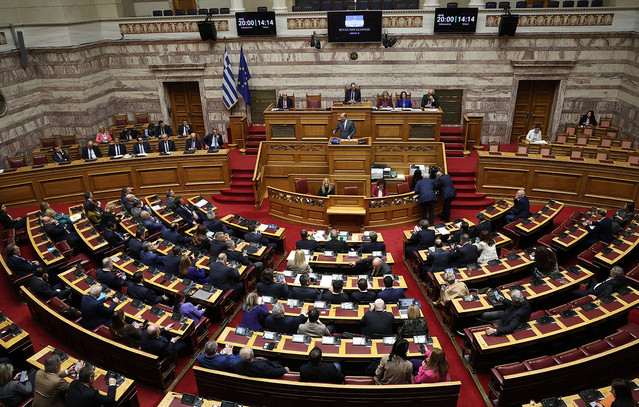
The Greek Parliament will hold a second and final vote on Wednesday, September 16, on 33 constitutional amendments proposed by the ruling New Democracy party, concluding the initial stage of the constitutional revision process.
The plenary session of the 300-seat unicameral legislature in Athens will require lawmakers to take a stand once again on the complete package of proposed constitutional changes, marking the final responsibility of the current proposing parliament. Political alignments indicate no major shifts in party positions since the preliminary vote held last July.
Under Article 110 of the Hellenic Constitution, amending constitutional provisions requires a strict two-stage procedure spanning two consecutive parliamentary terms. If a proposed amendment secures between 151 and 179 votes in the initial proposing parliament, it requires a supermajority of at least 180 votes in the subsequent parliamentary term to achieve final ratification.
Key Proposed Reform Measures
Reaching the required 180-vote supermajority is considered exceptionally difficult, even for several of the most prominent reforms put forward by New Democracy. Among the key measures is the revision of Article 16 to allow the operation of non-state universities across Greece.
Article 16 of the 1975 Greek Constitution established higher education as an exclusive state monopoly, requiring all university-level institutions to operate as public entities. Proposed changes would permit non-state and private higher education institutions to function legally within the country under state regulatory oversight.
The government revision package also includes the constitutional safeguard of performance evaluation within the public sector, as well as an amendment to Article 86 aimed at removing Parliament from investigating the criminal liability of ministers.
Article 86 governs the special legal framework under which lawmakers determine whether to investigate or prosecute current and former cabinet members. Critics have long argued the provision creates unnecessary political delays in legal proceedings involving government officials.
One proposed amendment was withdrawn before reaching the ballot floor following objections raised within the ruling party itself. Lawmakers dropped a measure that would have established an incompatibility between serving as a member of Parliament and holding a cabinet ministry post. However, a proposal to revise Article 30 and institute a single, non-renewable six-year term for the President of the Republic remains part of the voting package.
July Voting Results and Political Division
During the initial vote conducted last July, all 33 proposed amendments passed with between 158 and 161 votes in favor. None of the provisions attained the 180-vote threshold that would allow them to pass with a simple majority of 151 votes in the next parliamentary session.
The proposals passed with the backing of New Democracy lawmakers and select independent members of Parliament, while most opposition parties voted against the measures. New Democracy, a center-right political party led by Prime Minister Kyriakos Mitsotakis, currently holds a parliamentary majority following national elections.
Main opposition party PASOK adopted a different approach during the July ballot by voting present on provisions it believes should undergo revision, while simultaneously submitting its own distinct reform proposal. PASOK, officially known as the Panhellenic Socialist Movement, is Greece's primary center-left opposition party.
The decision by PASOK drew sharp criticism from the ruling majority, which accused the main opposition party of hiding behind a present vote and violating both the spirit and letter of the Constitution.
The July vote also highlighted internal divergence within the ruling party. Dora Bakoyannis, a lawmaker representing Chania in Crete and a former cabinet minister, broke from the New Democracy party line by voting present on the proposed revision to Article 30 regarding the presidential term.
Government Criticism of Opposition Strategy
Prime Minister Kyriakos Mitsotakis addressed the constitutional revision process and criticized PASOK's parliamentary stance during a press conference held on Sunday at the 90th Thessaloniki International Fair, responding to a question submitted by Newsbeast director Viktoras Montzelli.
The Thessaloniki International Fair is an annual economic and political exposition held every September in northern Greece, where Greek prime ministers traditionally outline government policy priorities and field questions from journalists.
Mitsotakis said PASOK's tactical approach assumed New Democracy would finish first in the next national election and secure a single-party parliamentary majority. He stated that the history of Greek constitutional revisions demonstrates that the success of any amendment depends primarily on the attitude of the opposition rather than the governing majority, citing the 2001 constitutional revision as a historical precedent.
Mitsotakis argued that if the opposition fails to engage constructively when qualified majorities are required, achieving meaningful constitutional reform becomes difficult to imagine. He described PASOK's position as inexplicable, claiming the opposition party had indicated it would vote against its own proposal if New Democracy voted in favor of it, simply to avoid agreeing with the government.
Mitsotakis added that PASOK had voted against key proposals, including the emblematic revision of Article 86, the introduction of a fiscal rule, the linking of public sector evaluation to civil service permanence, and the constitutional protection of the national language.
Future Obstacles in the Next Parliament
If political balances remain unchanged during the September 16 session and the proposed amendments gather between 151 and 179 votes, final decisions regarding their content will transfer to the next parliamentary term following future general elections.
The Parliament elected in the next national vote will need a supermajority of at least 180 lawmakers to decide the final wording and approval of those provisions, making cross-party consensus essential for any constitutional change.
Mitsotakis said the government had made a sincere effort to establish communication channels with opposition parties, but claimed opposition leadership had operated under a mindset that automatically rejected government proposals. He noted that achieving 180 votes in the next Parliament will be far more difficult without prior agreement, adding that combined vote totals between New Democracy and PASOK in a future parliament cannot be assumed based on current public opinion polls.


