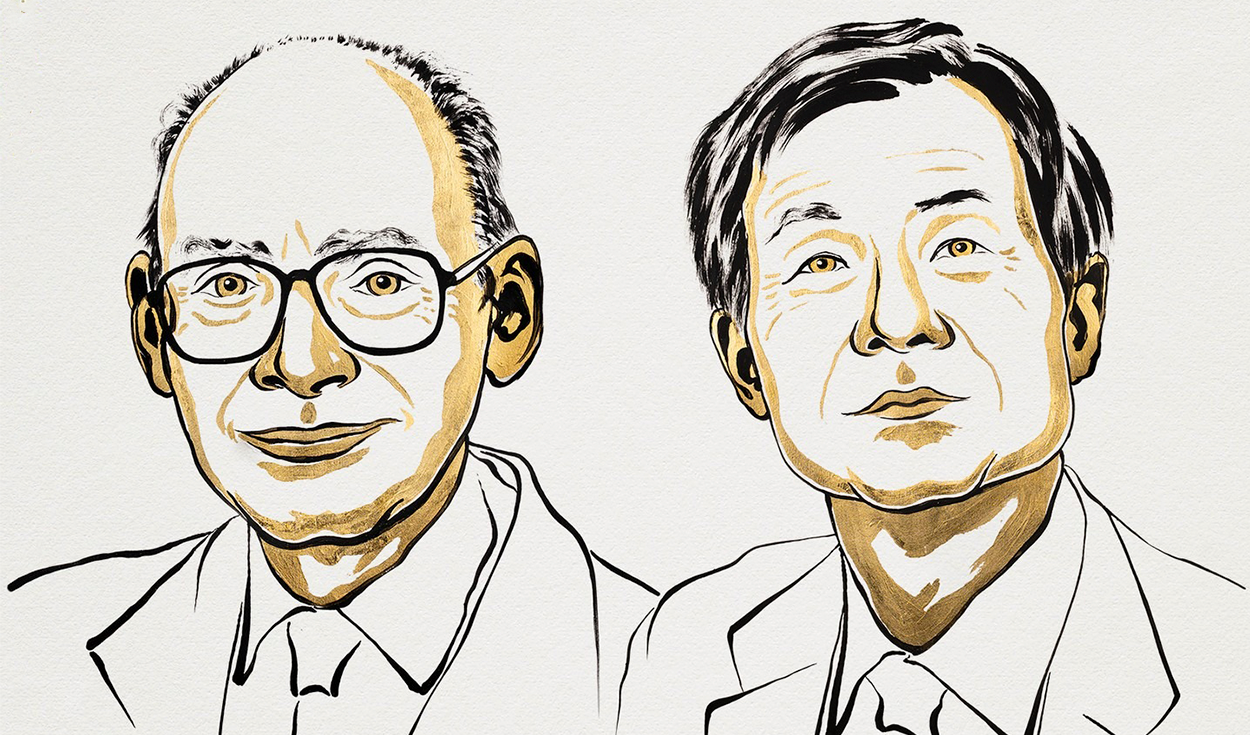
French chemist Henri Kagan and Japanese chemist Kenso Soai have been awarded the 2026 Nobel Prize in Chemistry for their groundbreaking discoveries concerning non-linear effects and autocatalysis in asymmetric organic synthesis.
The Royal Swedish Academy of Sciences in Stockholm awarded the prize for research that explains how chemical reactions can selectively favor one of two mirror-image forms of a molecule, a fundamental process for biological life and drug manufacturing.
Speaking by telephone during the Nobel Prize press conference, Soai said that it was the most exciting day of his life and that he was very happy to share the prize with Professor Henri Kagan, adding that he was out shopping when he received the news.
The mystery of mirror-image molecules
Many chemical compounds exist in two distinct structural versions that mirror each other like human hands, a property known to chemists as chirality, derived from the Greek word for hand. Although these chiral molecules look identical in shape, they cannot be superimposed on one another.
A central mystery in biology is why living organisms almost exclusively select one mirror-image form over the other, a phenomenon known as homochirality. In nature, the amino acids that build proteins belong almost entirely to one spatial orientation, whereas the sugars present in DNA and RNA belong to the opposite orientation.
Biological selection is essential because molecules interact with cellular structures much like a key fits into a lock, where the correct molecular orientation determines whether a compound can successfully bind and fulfill its function inside an organism.
The puzzle of molecular asymmetry dates back more than a century to 19th-century French scientist Louis Pasteur, who first observed that certain organic substances existed in mirror-image forms with differing physical properties. However, scientists struggled for generations to explain how biological systems transitioned from a balanced mixture of both forms to total dominance by a single variant.
The Nobel committee noted that how such chemical asymmetry could arise was long a mystery to chemists attempting to explain the origins of life.
Breakthroughs in chemical asymmetry and autocatalysis
Kagan provided a decisive breakthrough in 1986 when he discovered non-linear effects in asymmetric reactions, demonstrating that the product of a reaction could present higher purity regarding the desired molecular orientation than the catalyst itself used to drive it.
Kagan's discovery opened new possibilities for developing chemical methods capable of selectively producing a single desired version of a chiral molecule from a minor initial imbalance.
Soai approached the problem from another perspective in 1995 when he demonstrated that a reaction product could act as a catalyst for its own formation, a process called autocatalysis, thereby multiplying an initial chemical difference in its favor.
In 2003, Soai carried the principle further by starting from non-chiral substances to achieve a reaction that produced molecules almost exclusively in one of the two mirror-image forms. The Nobel committee clarified that while Soai's experiment serves as a landmark proof of concept, it does not directly prove how homochirality originated on Earth.
Pharmaceutical applications and the lessons of thalidomide
Beyond explaining biological origins, the discoveries of Kagan and Soai carry critical practical applications for the global pharmaceutical industry, where precise control over molecular orientation is essential.
Because a molecule and its mirror image can interact differently with the human body, obtaining the correct enantiomer allows drug manufacturers to target desired therapeutic effects while reducing unnecessary or harmful components.
Peter Somfai, a member of the Nobel Committee for Chemistry, said that the left-handed version of a drug can have one effect while the right-handed version can have another, creating a need for methods to prepare them selectively. Somfai added that the findings of this year's laureates are important for developing such methods because they provided highly valuable tools for the task.
The tragic history of thalidomide in the 1950s and 1960s highlighted the critical danger of molecular chirality in medicine, when the drug prescribed for morning sickness during pregnancy was linked to severe malformations in thousands of babies worldwide.
In the case of thalidomide, one mirror-image form of the molecule could transform into the other inside the human body, demonstrating that physically separating the two forms before administration was not enough to prevent harm.
By honoring Kagan and Soai, the Nobel committee recognized research that not only helps resolve an ancient chemical mystery, but also provides essential tools for controlling the manufacture of useful molecules in modern medicine with higher precision.