

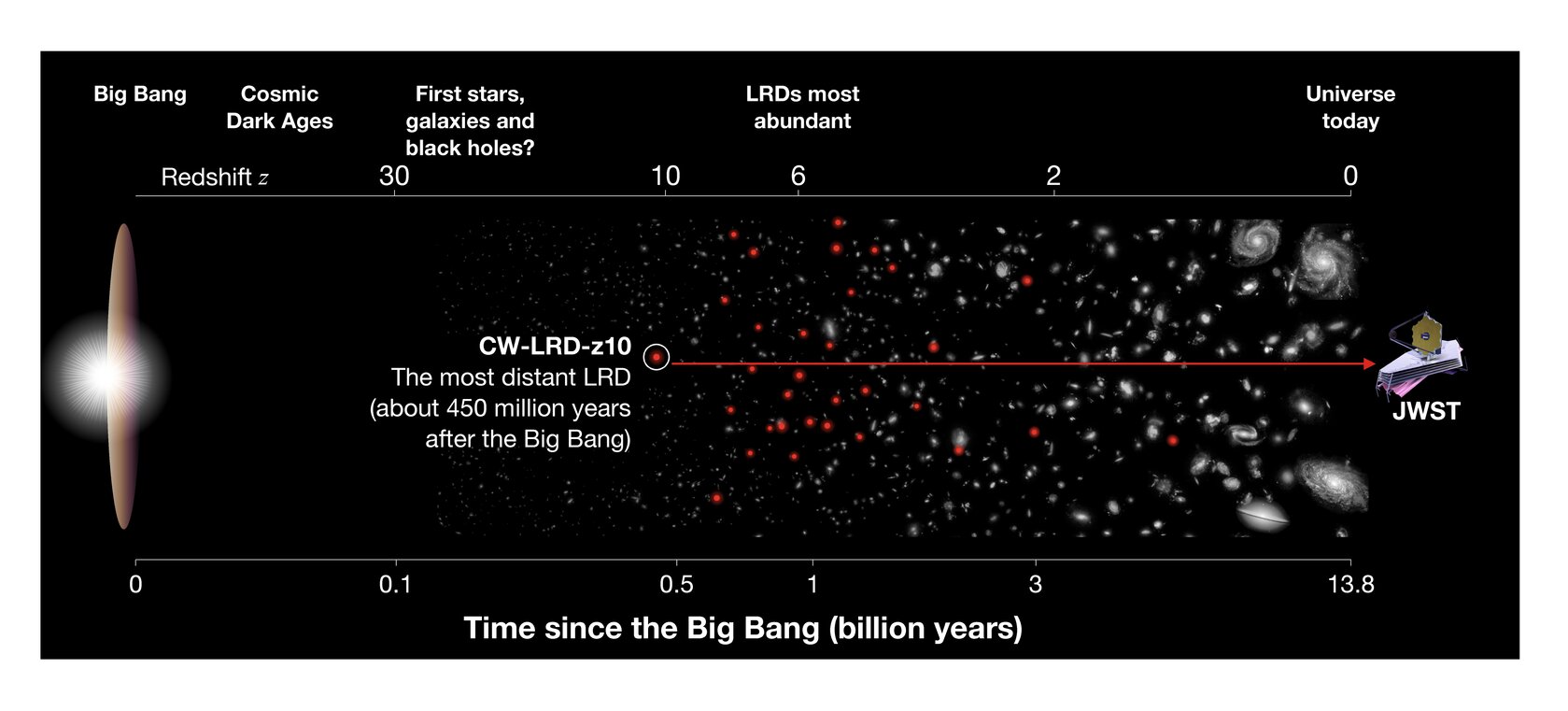
The James Webb Space Telescope has detected the most distant candidate "Little Red Dot" ever found, a compact object designated CW-LRD-z10, astronomers at the University of Tokyo and the Kavli Institute for the Physics and Mathematics of the Universe said in a press release.
The object has a redshift of 10.36, corresponding to a time when the universe was about 450 million years old, the researchers said.
Little Red Dots are a class of small, intensely red objects first identified in James Webb images of the distant universe. Until now, the earliest confirmed examples of the class dated to a period when the universe was between 600 million and 1.5 billion years old, meaning the new discovery pushes the boundary of the class back almost to the universe's earliest days.
How the object was found
The detection was made possible by the Mid-Infrared Instrument, known as MIRI, one of the James Webb telescope's instruments. The telescope's Near-Infrared Camera, NIRCam, could only pick up sources up to a redshift of about 9. CW-LRD-z10 was the only candidate of its kind found in a search of data from the COSMOS-Web survey, one of the telescope's large imaging programs.
The redshift was calculated from a sharp break in the object's spectrum, interpreted as a Lyman break, a feature produced when hydrogen gas absorbs ultraviolet light from a distant source. Roberto Maiolino, a professor at the University of Cambridge who was not involved in the research, said the estimate was quite reliable.
Candidate, not confirmed
Researchers stressed that CW-LRD-z10 should be treated as a candidate Little Red Dot rather than a confirmed member of the class. Three features support the classification: the object is markedly redder in mid-infrared light, its spectrum shows a V-shaped dip characteristic of the class, and the data hint at possible iron emission. Takumi Tanaka, the study's lead author, said none of the three signs was convincing on its own, but together they supported the Little Red Dot interpretation.
The observed data do not show the broad hydrogen lines that typically mark out Little Red Dots, because the relevant part of the spectrum falls outside the wavelengths covered by the observations, according to the researchers. An alternative explanation is that the spectrum instead belongs to a much closer galaxy with a redshift of about 3. Tanaka rejected that reading, saying the object's color is difficult to explain for such a galaxy and that the emission lines expected from one were not observed.
What it could mean
If the possible iron emission is confirmed, it would point to gas near an actively feeding black hole, the researchers said. Little Red Dots are considered potential hosts of rapidly growing black holes, so the discovery could help explain how the universe's first supermassive black holes formed. Tanaka cautioned, however, that the nature of Little Red Dots remains the subject of intense debate and that firm conclusions cannot yet be drawn.
The first paper on the discovery appeared in The Astrophysical Journal on December 2, 2025. A follow-up paper presenting the spectroscopic confirmation was published in The Astrophysical Journal Letters on November 24, 2026.
Test yourself
What is the redshift measured for CW-LRD-z10?
Which instrument allowed Webb to detect the object?
What might Little Red Dots potentially host, according to scientists?
Have your say
Do you think discoveries like CW-LRD-z10 will help explain how the first supermassive black holes formed?
Where it happened
Tokyo, Japan


