

King Felipe VI has presided over the opening of the new academic year for Spain's ten Royal Academies at a formal ceremony in Madrid.
The gathering at the Royal Academy of Jurisprudence and Legislation brought together cabinet ministers, senior judges and leading scholars, with speakers championing institutional independence, constitutional stability and scientific inquiry amid mounting public friction.
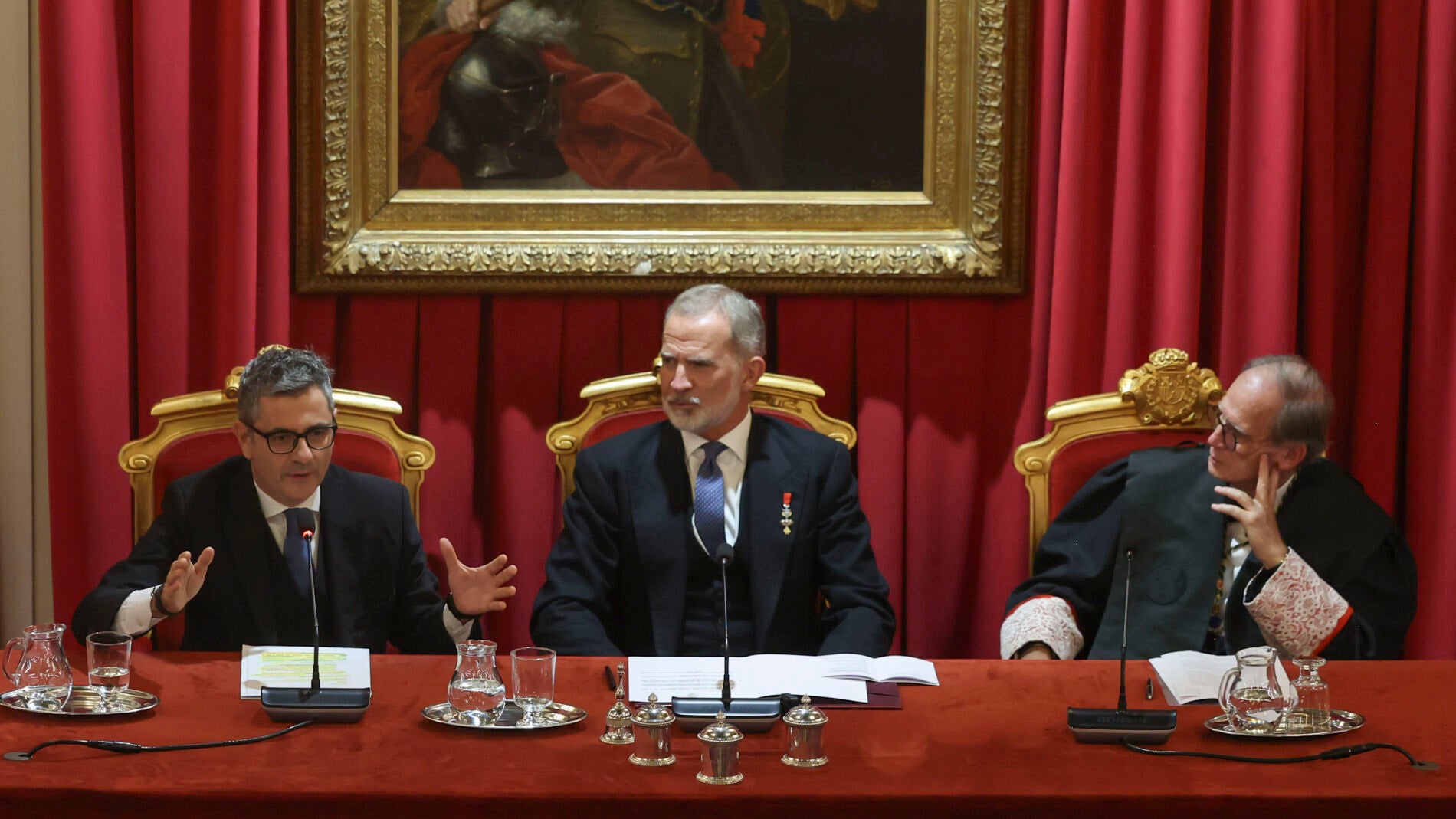
The ceremony marked the start of the 2026/2027 term for the learned societies integrated within the Institute of Spain. Proceedings took place in the assembly hall of the Royal Academy of Jurisprudence and Legislation of Spain, where the year 1730 remains engraved on the wall above an oil portrait of King Carlos III. The Bourbon monarch governed Spain during the era in which the body was established, an institution defined by its current president, Luis Maria Cazorla Prieto, as the house par excellence of law.
Cazorla's own name is inscribed on the granite plaques lining the lateral walls of the assembly hall, joining the historical roster of jurists who have led the organisation since the eighteenth century. The jurisprudence academy serves alongside nine counterpart bodies as a focal point for scholarship and public education across Spain.
Prominent institutional figures attended the proceedings alongside the monarch. The guest list included the Minister of the Presidency, Justice and Relations with the Cortes, Felix Bolaños, the President of the Court of Auditors, Enriqueta Chicano, and State Attorney General Teresa Peramato, who has served in the post since last December. Several magistrates from the Supreme Court attended, as did Inmaculada Montalban, the Vice President of the Constitutional Court.
The ten royal academies
Three centuries after the earliest academy emerged, the Institute of Spain now encompasses ten statutory institutions. The oldest among them, the Royal Spanish Academy, was founded in 1713. Over the subsequent decades and centuries, nine further bodies were established: the Royal Academy of History, the Royal Academy of Fine Arts of San Fernando, the Royal Academy of Exact, Physical and Natural Sciences, the Royal Academy of Moral and Political Sciences, the National Royal Academy of Medicine of Spain, the National Royal Academy of Pharmacy, the Royal Academy of Engineering, the Royal Academy of Economic and Financial Sciences, and the Royal Academy of Jurisprudence and Legislation of Spain.
Each academy maintains its own distinct academic remit, ranging from philology and clinical medicine to civil engineering and public law. Cazorla said that all ten bodies remained indispensable for preserving collective welfare and fostering an educated society equipped with direct access to reliable knowledge. He added that the institutions embodied intellectual excellence placed at the service of a society to which they owed their work, delivering study, research and public activities aligned with social reality.
Constitutional role and royal patronage
Addressing the audience, Cazorla praised King Felipe VI for his personal connection to the legal world, applauding the fact that he was the first King of Spain to complete a law degree at a public university. The monarch pursued his legal studies at Madrid's Autonomous University before undertaking postgraduate training abroad.
Cazorla also reflected on the formal constitutional relationship linking the Crown to the learned societies, referencing an analysis by one of his predecessors in the presidency, the late jurist and politician Landelino Lavilla. Lavilla, who presided over the Congress of Deputies during Spain's transition to democracy, had examined how Article 62 of the 1978 Spanish Constitution explicitly assigns the King the high patronage of the Royal Academies.
Cazorla described this constitutional prerogative as an unusual function when compared with the legal frameworks governing other European monarchies. He said the opening ceremony represented the tangible expression of that royal patronage, demonstrating the Crown's enduring support for scientific research, academic inquiry and the fine arts.
Defending truth against disinformation
Felix Bolaños took the floor to praise what he described as the encyclopedic knowledge conserved within the Royal Academies. The minister emphasised their responsibility to examine future horizons that he characterised as complex, not only in domestic politics, but also across Europe and the wider humanitarian sphere.
Turning to current political tensions, Bolaños maintained that the Spanish Constitution continued to be upheld in every corner of Spain and by all political formations. He urged the audience to adopt an optimistic outlook despite the prevailing social and political divisions.
Bolaños highlighted the urgent role of scholarly bodies in countering the deterioration of public debate online. He said that a lie travels a thousand times faster across social networks than the truth, arguing that rigorous academic activity was becoming increasingly essential to counteract falsehoods and preserve democratic discourse.
International links and artificial intelligence
Ana Fernandez-Tresguerres, the secretary general of the Royal Academy of Jurisprudence and Legislation, presented a summary of the 2025/2026 academic year, describing the collective output of the ten institutions as enormous. Speaking on behalf of the bodies in chronological order of their foundation, Fernandez-Tresguerres highlighted several major initiatives completed over the past twelve months.
She praised the publications produced by the Royal Spanish Academy, noting that the linguistic authority would present the twenty-fourth edition of its flagship dictionary on 30 October. The forthcoming volume represents the primary reference work for the global community of nearly 600 million Spanish speakers.
Fernandez-Tresguerres pointed to growing international cooperation with Latin America as another vital focus. She highlighted an April 2025 bilateral meeting between Spain's Royal Academy of Moral and Political Sciences and its sister academy in Argentina. She also noted conference sessions held in the Argentine city of La Plata by the Pan-Hispanic Network for Clear and Accessible Language, aimed at ensuring that institutional and legal Spanish remains transparent and accessible to ordinary citizens amid technological transformation.
Technological change was also the focus of the newest constituent institution, the Royal Academy of Engineering, which was established in 1994. The engineering body convened a dedicated conference examining the impact and ethical challenges of artificial intelligence.
Cazorla concluded the ceremony by stating that the Royal Academies would continue serving in the coming months as cornerstones of a national character guided by democratic principles. He closed his remarks by invoking the founding Royal Decree of 1714 that established the Royal Spanish Academy, reaffirming its historic charge to advance the public good, the glory of the reign, and the honour of the nation.