Madrid provided almost 80 percent of all money contributed by Spain's wealthier autonomous communities to the regional financing system's interregional leveling pool in 2024, according to a report by the Foundation for Applied Economics Studies.
The study, prepared by Fedea director Angel de la Fuente using official state data on net resource flows, shows that Madrid, Catalonia, and the Balearic Islands were the only regions with positive net contributions to equalizing per-capita funding across Spain. Basque Country and Navarre operate under separate tax systems and are excluded from the common regime.

Madrid allocated 26 percent of its regional tax revenues to interregional redistribution, compared to just 8 percent from Catalonia and 7 percent from the Balearic Islands. All other common-regime regions received more funds from the system than they contributed.
Total financing for common-regime communities at homogeneous competences and equal fiscal effort reached an overall increase of 14.4 billion euros, up 9.45 percent compared to 2023. This expansion far outpaced the 2.8 percent inflation rate recorded during the period, yielding a real-term regional financing gain of approximately 6.5 percentage points, driven largely by a 10.3 percent surge in homogeneous tax collection.
Redistributive flows and regional contributions
The regional financing system provided lower-income communities with nearly 25 billion euros in extra resources above their own tax revenues. This funding came from two primary channels, with the central government contributing slightly over 13.2 billion euros and higher-income communities supplying 11.4 billion euros.
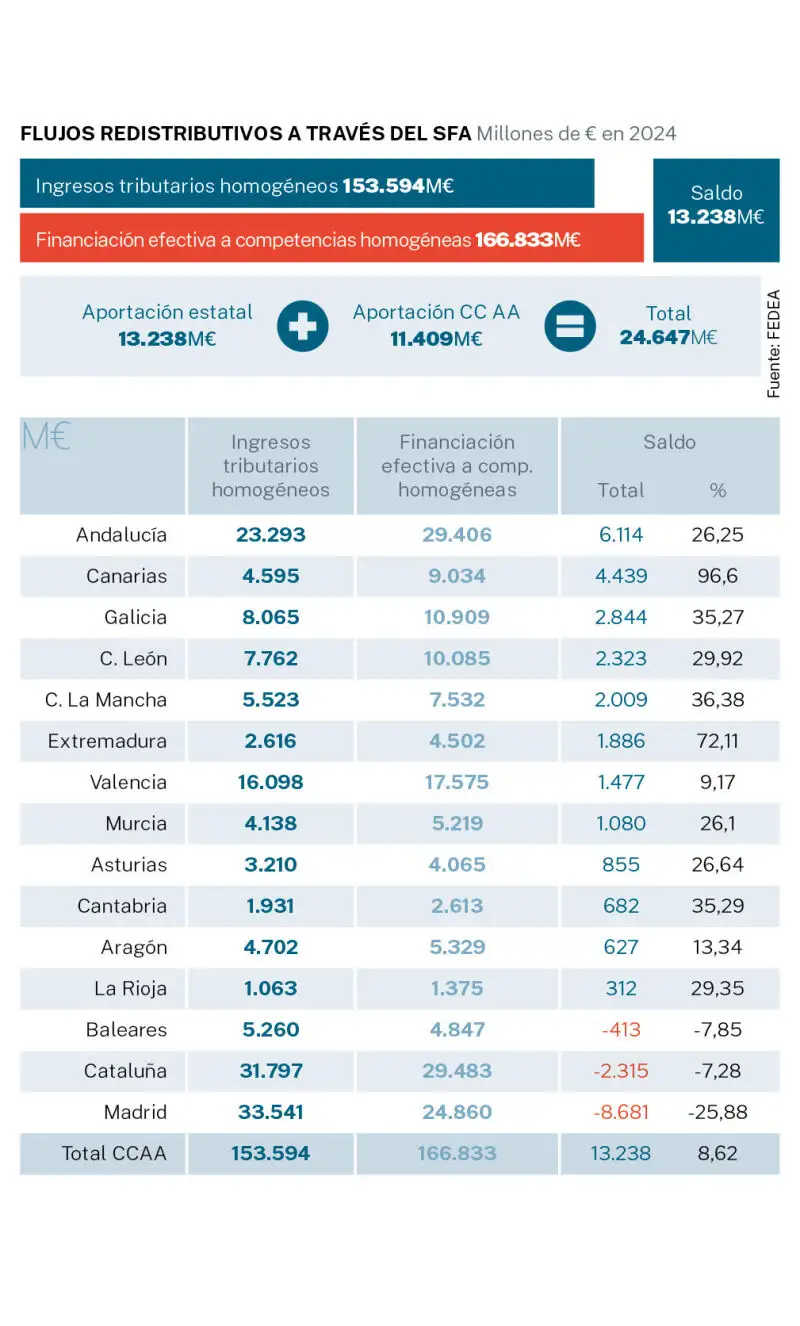
The regional contribution was divided unevenly among the three contributing territories. Madrid supplied 8,681 million euros, accounting for nearly 80 percent of the total regional input, while Catalonia provided 2,315 million euros and the Balearic Islands provided 413 million euros.
For receiving communities, these transfers accounted for a substantial portion of their budgets, exceeding 20 percent of homogeneous tax revenues in ten regions. The transfers proved especially vital in Extremadura and the Canary Islands, where they surpassed 72 percent and 96 percent of revenues from transferred taxes, respectively. Murcia, the Valencian Community, Andalusia, and Castilla-La Mancha remained at the bottom of the effective funding ranking per adjusted inhabitant.
Regional rank shifts and Andalusian complaints
Madrid and Aragon recorded the greatest relative improvements in effective funding per adjusted inhabitant between 2023 and 2024. In contrast, the Balearic Islands lost 3.7 points, while Extremadura and Cantabria lost more than 1.5 points each, and the Canary Islands dropped 1.3 points.
Catalonia registered a slight improvement of 0.6 percent, while Andalusia gained 0.2 percent and the Valencian Community advanced 0.1 percent. Despite its minor gain, sources from the Andalusian regional government criticized the distribution criteria, noting that Andalusia received 1,634 million euros less than average regional financing resources due to the adjusted population calculation.
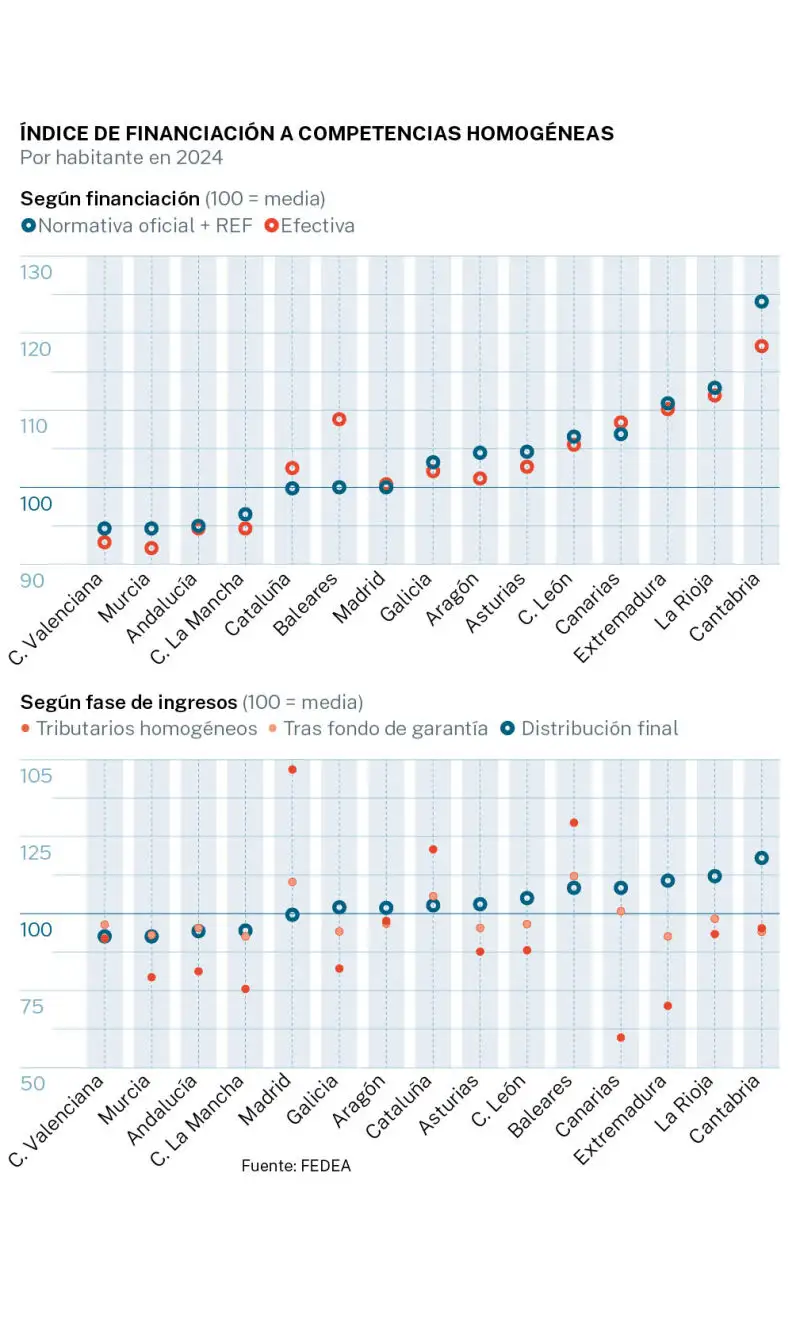
The Andalusian government sources stated that this deficit meant each resident of Andalusia received 193 euros less than the national average per adjusted inhabitant. They added that this amounted to 286 euros less per person than a resident of Catalonia and 876 euros less than a resident of Cantabria.
Funding components and state budget delays
Regional tax revenues constituted the largest component of effective regional financing in 2024, representing 92 percent of total funding for homogeneous competences, an increase of 0.7 percentage points from 2023. However, regional dependence varied sharply, ranging from an index score of 135 in Madrid to 55 in the Canary Islands.
Other specific financial mechanisms altered relative regional positions significantly. The guarantee transfer reduced relative funding for Madrid, Catalonia, and the Balearic Islands by between 6 and 26 points, while boosting the Canary Islands by 45 points and Extremadura by 27 points. The Sufficiency Fund provided positive value for Cantabria, La Rioja, and Extremadura, but negative values for Madrid, Catalonia, the Valencian Community, and the Balearic Islands. The Cooperation Fund added over two points for six regions, exceeding five points in Extremadura and Cantabria, while the Competitiveness Fund added roughly 7 points for the Valencian Community, 10 for the Canary Islands, and 21 for the Balearic Islands.
Looking ahead, financial system resources subject to settlement grew 14.7 percent in 2024 at current prices, but are expected to stagnate with roughly 2.5 percent growth in 2025 before rebounding to growth rates between 7 percent and 9 percent in 2026 and 2027.
Fedea expressed strong criticism of the Ministry of Finance regarding recent reporting transparency. Fedea stated that because the 2023 General State Budgets were extended three times due to legislative difficulties, detailed account advances and settlement forecasts for regional governments were not made available through official channels.
Fedea reported that data had to be gathered from Ministry of Finance press releases following Fiscal and Financial Policy Council meetings rather than verifiable official publications. Consequently, Fedea warned that the figures must be interpreted with caution because they are not calculated at homogeneous competences, omit traditional transferred taxes, and blend revenues from multiple fiscal years.