

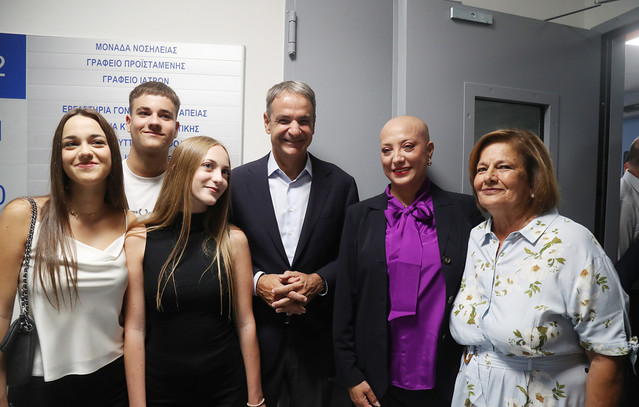
Greek Prime Minister Kyriakos Mitsotakis opened a new hematology center at the "G. Papanikolaou" General Hospital in Thessaloniki on Friday afternoon, calling it the most advanced facility of its kind in Greece and possibly in the Balkans.
The Center for Cell and Gene Therapies and Laboratories, part of the hospital's Hematology Clinic, was built with 13.36 million euros from the European Union's Recovery and Resilience Fund.
Mitsotakis said that not only Thessaloniki but the whole country was gaining the most modern Hematology Center in Greek territory, and perhaps in the entire Balkans. He said science had truly worked miracles in personalized gene and cell therapies, and that he was glad the country could now support its excellent scientific staff with an ultra-modern building equipped with everything needed to meet the needs of Greek patients.
The prime minister, accompanied by Health Minister Adonis Georgiadis, Deputy Health Minister Irini Agapidaki and Deputy Minister of Health Marios Themistokleous, was given a tour of the new building, which covers more than 2,500 square meters, by hospital administrator Nikitas Papadopoulos.
Boosting cell therapy capacity
Officials estimate the center will allow the number of cell therapies used to treat specific blood malignancies such as leukemia and lymphoma to rise by 30% to 50%.
Mitsotakis was also briefed on the hospital's plans to provide cell therapies to patients with multiple myeloma. The development could allow more patients from Northern Greece, the rest of the country and Cyprus to access highly specialized treatment without having to seek care at other centers or abroad.
A hub for research
Particular emphasis was placed on the center's research role. A new Biobank and a dedicated Clinical Studies Laboratory will support research protocols, participation in international studies and the development of new therapeutic approaches, in a field officials described as evolving especially fast. The aim is for the Papanikolaou hospital to be not only a place where modern therapies are applied, but also one that actively contributes to research and to developing the medicine of the future.
Mitsotakis also spoke with doctors, nurses and patients during his visit.
The prime minister's remarks
Mitsotakis thanked the leadership of the Health Ministry for meeting the Recovery Fund's tight deadlines so the building could be delivered within August, noting that Georgiadis had done the same for a series of other projects inaugurated in recent days.
He said the center was the best proof and the best answer to those who wondered where Recovery Fund resources and European Union funds were going, adding that they went toward public health infrastructure so that patients could find the best possible treatments.
He said the center and the scientific staff running it had nothing to envy from any equivalent center in Europe, and that the government remained committed to delivering a National Health System far better than the one it inherited. He added that politics was often harsh, but that being able to leave a legacy while improving citizens' lives was ultimately the mission, which he said gave him both joy and the strength to continue.
Minister recalls funding hurdle
Health Minister Adonis Georgiadis said he felt great emotion and pride in welcoming the prime minister to hand over the new Immunotherapy Center at the Papanikolaou hospital to him and to the Greek people. He said the project had been envisioned by Mitsotakis himself after hearing directly from a patient who described undergoing treatment at the hospital's hematology center.
Georgiadis said that when he took over leadership of the Health Ministry on the prime minister's instructions, the project was at a critical point, as the European Commission had removed it from the funding program because deadlines had not been met, despite the previous ministry leadership's efforts. He said that, following the prime minister's instructions, the ministry passed legislation to issue a permit by derogation so the program's funding would not be lost, and that two years later the project had been completed on time, hitting its milestone.
Georgiadis said no similar center existed anywhere else in Greece, including Athens, and that none had previously existed in the Balkans. He said the ministry had recently passed legislation setting out the terms for producing CAR-T therapies at the Papanikolaou hospital and distributing them to other hospitals, with the aim of lowering the overall cost of such therapies for the National Health System and treating more patients.
Isolation rooms for vulnerable patients
The new building, which covers more than 2,500 square meters, houses the Molecular Hematology Laboratory, the Public Umbilical Cord Blood Bank, the Gene and Cell Therapy Laboratories, the Cytogenetics, Cytomorphology and Flow Cytometry laboratories, the Biobank, clinical study infrastructure, and the new Hematopoietic Stem Cell Transplantation and Cell Therapies Unit.
The new unit has 11 single-occupancy isolation rooms, each fitted with a private bathroom, a dedicated anteroom and an interlocking door system designed to protect immunosuppressed patients who require special safeguards.
Moving the laboratories into the new wing also frees up space in the neighboring "STORGI" building, making it possible to expand the Graft Collection and Processing Laboratory. The building was constructed to modern specifications that also help save energy.


