

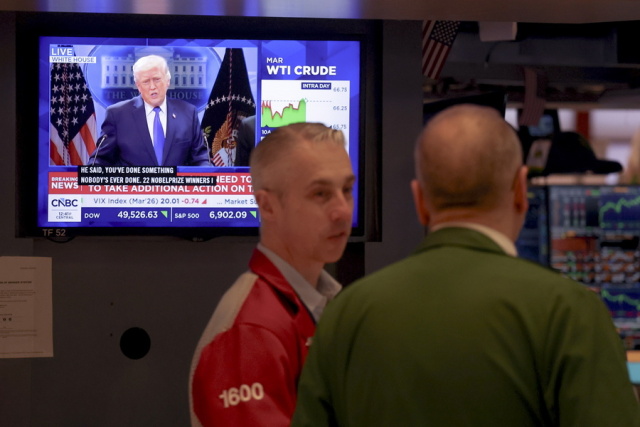
Wall Street stocks and US Treasury bonds fell on Monday as surging oil prices and escalating Middle East tensions stoked fears of renewed inflation.
The benchmark S&P 500 index dropped 0.52 percent to close at 7,745 points, pulling back after crossing the 7,800 threshold for the first time in history last week on strong corporate earnings and a rebound in technology stocks.
The Dow Jones Industrial Average lost 0.51 percent to finish at 53,459 points, while the tech-heavy Nasdaq Composite slipped 0.32 percent to 26,644 points.
Market sentiment deteriorated sharply following fresh military developments in the Middle East, where fighting flared up again in Lebanon while diplomatic efforts stalled.
United States President Donald Trump said in an interview with Fox News that he was in no hurry to end the war with Iran.
President Trump also escalated his rhetoric against Oman, warning that the country would be bombed if it got in the way of American operations.
Speaking later to reporters, Trump reiterated that the United States controls the Strait of Hormuz, a critical maritime chokepoint through which a significant portion of global petroleum passes.
Asked whether Washington was seeking an extension of the memorandum of understanding with Iran, the American president answered negatively.
Tehran also expressed opposition to any extension of the agreement, demanding that Washington meet several conditions before opening the Strait of Hormuz, including an end to hostilities on all fronts and the unfreezing of Iranian assets.
The geopolitical standoff prompted an immediate jump in energy prices, with Brent crude futures surging 2.50 percent to trade back above the $90 a barrel mark following a nearly 6 percent rise the previous week.
Chris Larkin, an analyst at Morgan Stanley's E*Trade, noted that the combination of rising crude prices and the lack of diplomatic progress between the US and Iran keeps the Middle East among the primary sources of market risk.
Treasury Yields and US Fiscal Deficits
Compounding equity losses was a sharp sell-off in the fixed-income market, which pushed long-term US Treasury yields to multi-year highs.
The yield on the benchmark 30-year US Treasury bond rose approximately 5 basis points to 5.31 percent, reaching its highest level since 2007.
Meanwhile, the 10-year Treasury yield rose above 4.72 percent, and the 2-year yield traded around 4.18 percent.
The gap between 2-year and 30-year yields widened to 114 basis points, reaching its broadest level since last April as investors demanded a higher premium to fund long-term US government borrowing.
Market participants cited growing anxieties over massive fiscal deficits, expanding US national debt, a flood of new government bond issues, and heavy corporate borrowing needed to finance investments in artificial intelligence.
Rising oil prices added further pressure by reinforcing fears that inflation will remain persistent, potentially forcing the Federal Reserve to keep interest rates high or raise them further.
Anthony Saglimbene, market strategist at Ameriprise, said investors are increasingly focused on and concerned about growing American debt and the lack of fiscal discipline.
Saglimbene noted that frequent and large Treasury auctions give the market an opportunity to express reservations about the deteriorating fiscal path by demanding higher yields to absorb new issuances.
He explained that for buyers of long-dated securities, financing expanding government debt at current yields is becoming increasingly difficult.
If investors demand even greater compensation in upcoming auctions, Saglimbene said, corporate earnings resilience and continued artificial intelligence momentum will be crucial for stocks to withstand higher interest rates for longer.
Federal Reserve Rate Expectations
Beyond geopolitical and fiscal concerns, investors are seeking clues regarding Federal Reserve policy from the minutes of the July Federal Open Market Committee meeting, scheduled for release on Wednesday hours before Wall Street closes.
The minutes will be scrutinised after three regional Fed governors dissented from the central bank's decision to keep benchmark interest rates unchanged at that meeting.
Artificial Intelligence Investments and Corporate News
Despite general market weakness, artificial intelligence continued to provide fundamental support to the technology sector.
AI company Anthropic PBC informed prospective investors that its second-quarter revenue surged at least 14-fold compared to a year earlier, reigniting optimism surrounding commercial artificial intelligence returns.
In another major industry deal, Nvidia Corp. agreed to allocate up to $105 billion to support a massive new data center complex in Ohio, which is to be leased by OpenAI.
The deal further strengthens ties between Nvidia and OpenAI, two of the central players driving the boom in artificial intelligence infrastructure.
Defense Sector Management and Contracts
In the defense sector, L3Harris Technologies Inc. unexpectedly replaced chief executive officer Christopher Kubasik following an investigation into his conduct, marking a major leadership transition at the defense contractor.
Meanwhile, defense giant RTX Corp. secured a contract valued at approximately $23 billion from the US Navy to accelerate the production of more than 7,000 Tomahawk missiles.
The procurement comes as American missile stockpiles have faced significant strain during the military conflict involving Iran.
Berkshire Hathaway and Retail Earnings Outlook
In financial markets, Berkshire Hathaway Inc. expanded its stock portfolio by increasing its stakes in Delta Air Lines Inc. and Google parent company Alphabet Inc.
The investments represent early moves by Greg Abel as he begins deploying the conglomerate's massive cash holdings.
Wall Street attention is also turning to earnings reports from major US retail chains this week, which will offer insight into American consumer health.
Home Depot, the world's largest home improvement retailer, reports results on Tuesday and is expected to show improved revenue despite consumer uncertainty, high housing costs, and elevated mortgage rates.
Walmart, the world's second-largest retailer, reports on Thursday, with investors tracking whether the company continues to attract higher-income households seeking lower-cost options.
Other major retail chains scheduled to publish quarterly financial results this week include Target and Lowe's.


