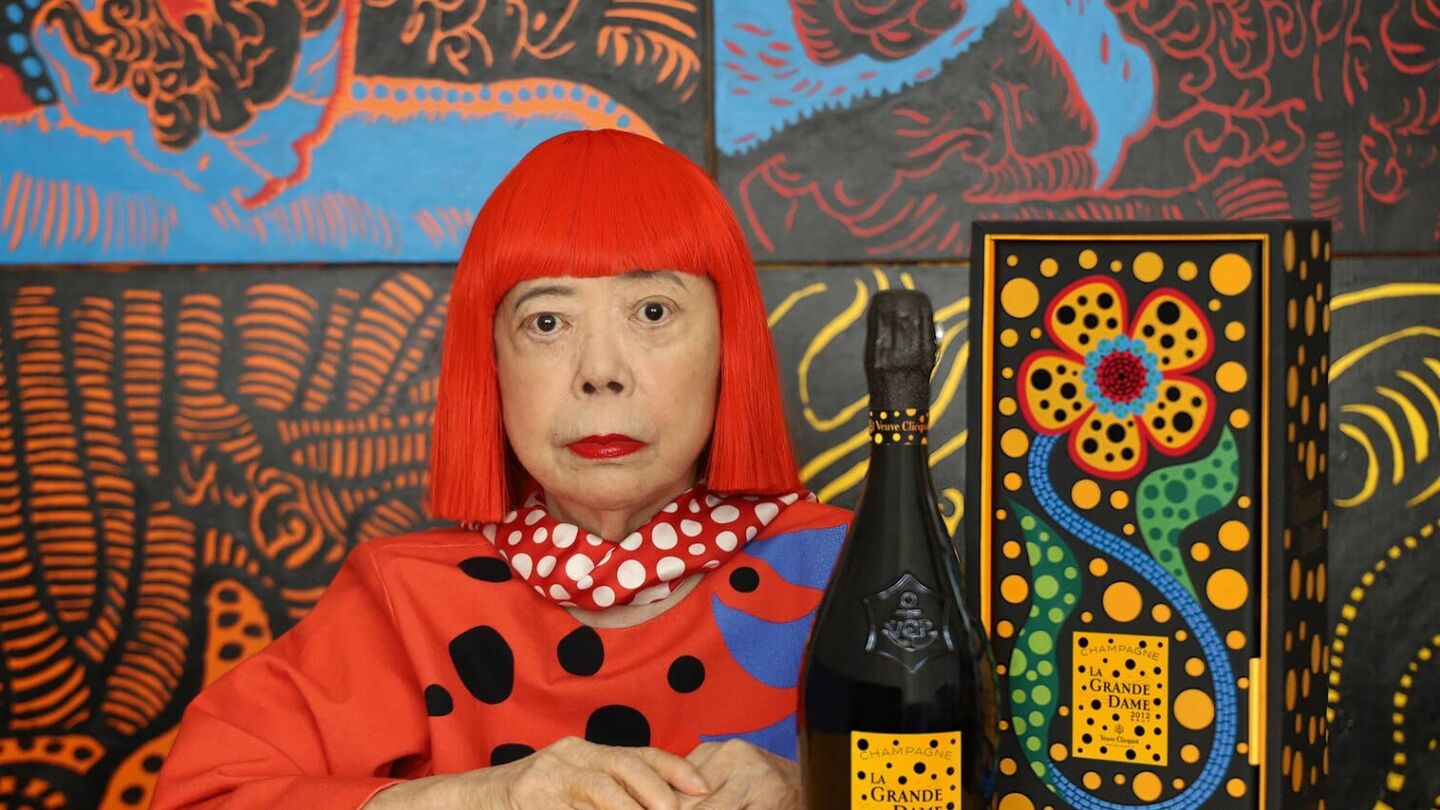
Japanese artist Yayoi Kusama, who transformed her lifelong hallucinations into globally recognized polka-dot art, died on August 14 at a Tokyo hospital aged 97.
Her death was announced in a statement on her official website, as reported by news agency journalist Maria Roldan. The publication did not provide further details regarding the cause of death.
The statement on her website noted that Kusama continued painting until her final days without setting down her brush, while continuing to explore eternal love and the immortal soul.
Kusama was considered one of the most significant figures in contemporary art over the past century. She became a leading exponent of global psychedelia, turning the recurring polka dots from her visions into her signature artistic style.
Early life and childhood trauma
Born in the city of Matsumoto in the mountainous region of Nagano, northwest of Tokyo, on March 22, 1929, Kusama grew up in a wealthy merchant family.
She began painting around the age of ten, depicting obsessive repetitions of polka dots, nets, and arches in watercolours, pastels, and oil paints.
From childhood, Kusama suffered from hallucinations and obsessive-compulsive disorder accompanied by suicidal tendencies. She confessed on multiple occasions that she endured physical and psychological abuse from her mother.
Her mother frequently destroyed her artwork and forced her to spy on her unfaithful father. Kusama channeled these experiences into her creative work, using art as a vital mode of survival and therapy.
World War II also deeply affected her psyche. Kusama was 16 years old when atomic bombs were dropped on the Japanese cities of Hiroshima and Nagasaki in 1945 at the end of the conflict.
Artistic training and move to the United States
Kusama trained in Nihonga, a traditional Japanese painting style defined in the late 19th century, at the Kyoto Municipal School of Arts and Crafts in western Japan.
In the late 1950s, she emigrated to the United States, leaving behind the rigid formalisms of Japan to build a reputation among artistic avant-gardes.
Based in New York City, Kusama began exploring her signature immersive installations. She exhibited large-format paintings and created sculptures incorporating mirrors and electric light.
She also experimented with body painting, fashion design, filmmaking, and mass media during her time in America.
Her style was characterized early on by tendencies toward pop art, performance, contemporary art, abstract work, and feminist perspectives delivered with a distinctly avant-garde approach.
Anti-war activism and influence in New York
While in New York, Kusama staged public art events in prominent locations, including Central Park, to protest against the Vietnam War.
Her anti-war activism was well known during that period. Her work made a strong impact on American contemporaries, influencing Pop art figures such as Andy Warhol and Claes Oldenburg.
Return to Japan and voluntary hospitalisation
Despite her success in the United States, Kusama returned to Japan in 1973 after her mental health problems worsened.
In 1990, she voluntarily checked into a mental institution in Tokyo. She continued to live and work from the facility, creating art across various media formats.
Alongside her visual art, Kusama maintained a literary career, publishing several novels and poetry anthologies.
Major artworks and global exhibitions
Kusama created numerous iconic works throughout her career, including Narcissus Garden in 1966 and Gleaming Lights of the Soul in 2008.
Her major collections and series include Phallic Girl from 1967, Tulips of Shangri-la from 2004, Dots Obsession from 2008, A Bouquet of Love I Saw in the Universe from 2012, Ascension of Polka Dots from 2013, and Repetitive Vision from 2017.
Her longest-running painting series, My Eternal Soul, spanned from 2009 to 2021 and comprised approximately 900 individual works.
One of her most recognizable installations, an enormous spotted pumpkin situated near the coast at the Benesse Art Site on Naoshima island, remains a premier contemporary art landmark in Japan.
Her works have been showcased in major museums across the world, including the Venice Biennale, the Museum of Modern Art in New York, and the National Museum of Modern Art in Tokyo.
Other institutions that hosted her exhibitions include the Museum of Contemporary Art in Sydney, Australia, the Tate Modern in London, the Museo Nacional Centro de Arte Reina Sofía in Madrid, and the Centre Pompidou in Paris.
Design projects, museum, and major awards
In addition to her art and literature, Kusama designed the exterior of the Louis Vuitton corporate building in New York in 2012 as a collaborative work.
In 2014, she established her own museum, the Yayoi Kusama Museum, located in Tokyo.
Over her lifetime, Kusama received numerous major accolades, including the Asahi Prize, the Order of Arts and Letters of Japan, and the National Lifetime Achievement Award of the Order of the Rising Sun.
In 2006, she became the first woman to receive the Praemium Imperiale from the Japan Art Association, one of the world's most prestigious international art prizes.
Japan honored her with the country's Order of Culture in 2016, celebrating her enduring contributions to global modern art.