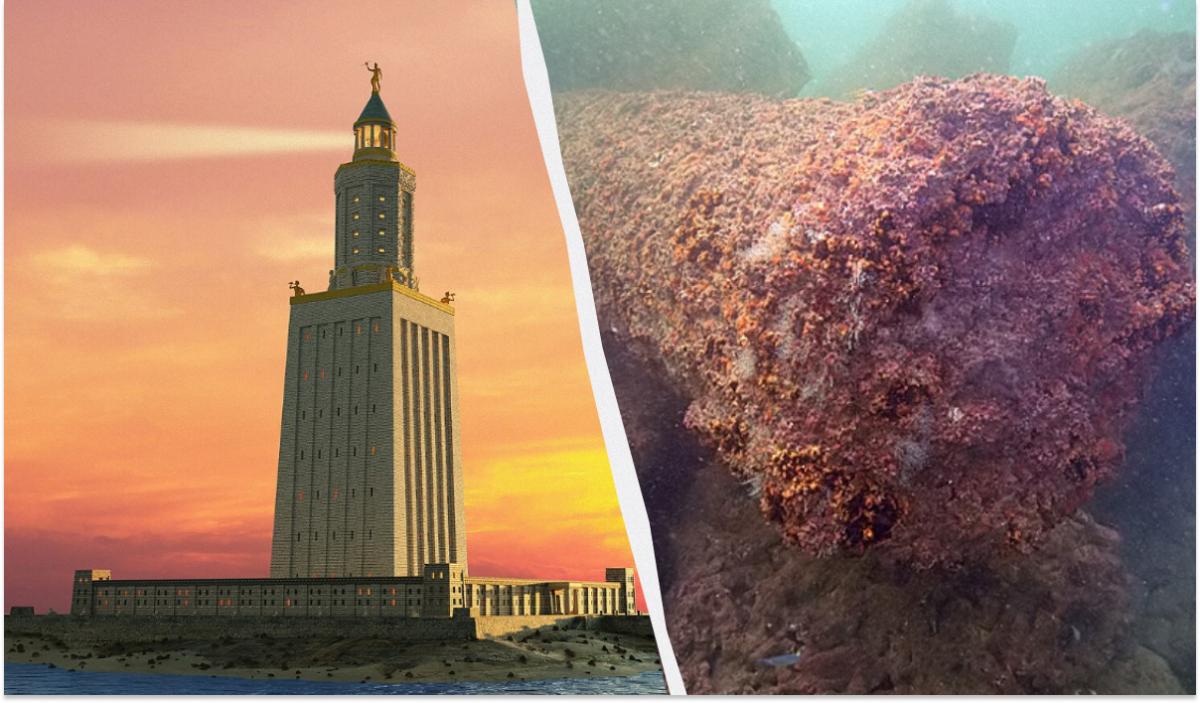
Researchers off the coast of Alexandria, Egypt, have raised 22 massive stone blocks weighing between 70 and 80 tons from the seabed. According to a report by Daily Galaxy, scientists state that the recovery marks a major milestone toward creating a digital 3D reconstruction of the Lighthouse of Alexandria, one of the seven wonders of the ancient world.
Crews deployed a specialized barge and a powerful crane to extract the massive stones from the Mediterranean waters. The retrieved artifacts include large door lintels, doorjambs, a threshold, and base slabs that once supported the structure.
The operation also uncovered a previously unseen gate constructed in a traditional Egyptian style. Researchers believe these architectural components originally formed the main entrance to the lighthouse, representing a historic point where Egyptian and Greek building styles merged.
The newly raised blocks will undergo detailed physical examination and high-resolution scanning. Over the past decade, maritime archaeologists have inspected and catalogued more than 100 similar stone blocks beneath the surface.
Archaeologists photograph each retrieved block from every angle to generate a precise computer-built 3D model. This digital rendering allows engineers to rotate and inspect the heavy stones on computer screens without physical handling.
Digital reconstruction under the PHAROS project
The excavation forms part of the broader PHAROS project, an international scientific initiative aimed at documenting the ancient structure. As part of the project, researchers are gathering historical drawings and written records ranging from the construction of the lighthouse to its ultimate destruction.
Engineers use specialized software to fit each scanned stone into a digital assembly like pieces of a giant puzzle. The ultimate objective is to create an accurate digital copy of the lighthouse that will allow people to take virtual tours of the ancient monument.
Maritime surveys have documented ruins on the seabed near Alexandria since 1968. Teams conducted a detailed survey and cataloguing of the underwater site in 1995.
An earlier survey in 1994 recorded more than 3,300 individual artifacts on the sea floor. Those items included granite blocks, architectural columns, and carved sphinxes scattered across the site.
History of the ancient Pharos lighthouse
The lighthouse was commissioned before the common era by Ptolemy I, the ruler of Egypt. Built on Pharos Island off the Alexandria coastline, the structure rose over 100 metres high and stood as one of the tallest man-made structures of its era.
The Dassault Systèmes foundation has described the monument as the first skyscraper in human history. For more than a thousand years, its beacon guided merchant ships and mariners safely into port.
Repeated earthquakes gradually weakened the structure over the centuries, with a catastrophic earthquake in 1303 dealing irreparable damage. Workers later dismantled the standing masonry to reuse as building materials for a coastal fortress, while stones that fell into the sea remained preserved underwater for hundreds of years.
Additional scientific historical findings
In separate scientific findings reported by the source, historians recently re-analyzed fragments of a long-lost letter written by Pope Alexander II that was preserved in the Vatican archives. The analysis revealed that the decision to support William the Conqueror in 1066 may have been influenced not only by the struggle for the English throne, but also by a fierce power struggle inside Rome itself.
Researchers state that official endorsement from Pope Alexander II helped legitimize the Norman invasion of England as a just war against the Pope's domestic rivals.
In another study, scientists analyzed volcanic ash from the ancient Roman city of Pompeii to identify household scents used 2,000 years ago. Researchers examined the contents of domestic incense burners preserved after the eruption of Mount Vesuvius.
The investigation revealed that residents burned local Mediterranean plants alongside exotic aromatic resins imported from Asia and Africa through the extensive trade network of the Roman Empire.