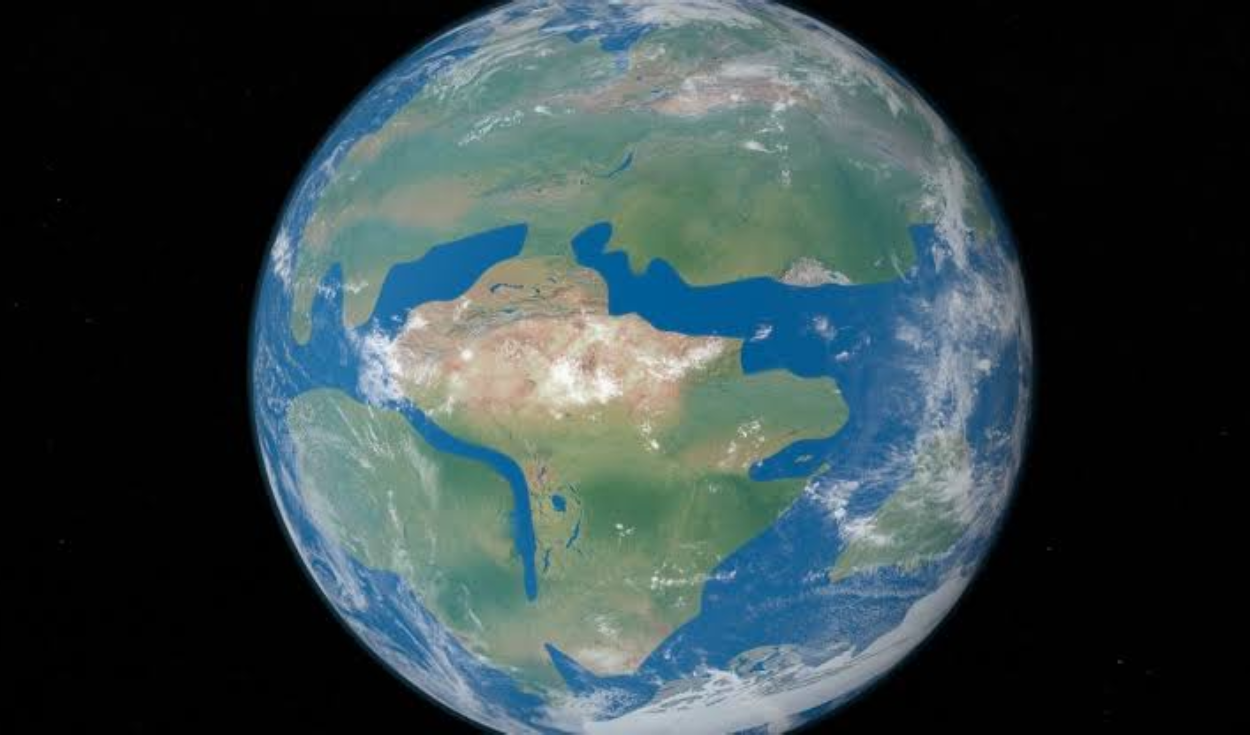
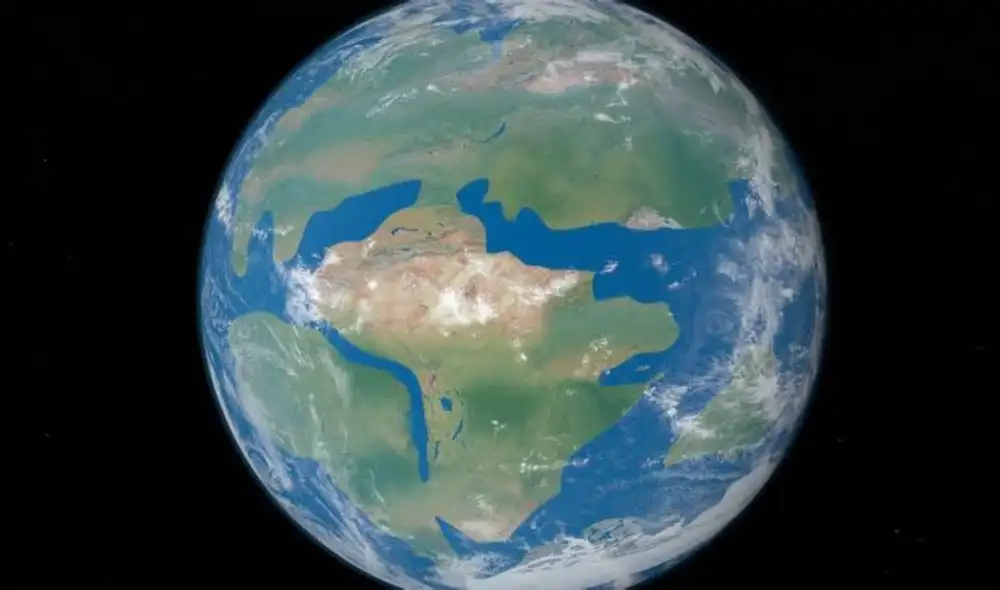
A new study published in the journal Science Advances has found that Gondwana, one of the largest continental landmasses in Earth's history, covered at least 80% of the planet's dry land, a far larger share than the previous estimate of 64%.
The findings come from an analysis of more than 25,000 ancient rocks, which allowed researchers to reconstruct the supercontinent's boundaries with far greater precision than earlier studies had achieved.
The new reconstruction also changes the scientific understanding of several regions in Asia. Fragments stretching from India and Southeast Asia to China and Kazakhstan appear to have Gondwanan origins, even though scientists had for decades classified part of that territory as ancient ocean floor dotted with volcanic island chains. The discovery confirms that Gondwana reached the scale needed to be classified as a supercontinent.
How researchers identified Gondwana's original fragments
The international team behind the study, working with the Deep-time Digital Earth program, built a global database containing thousands of samples of magmatic rock, the type of rock formed when molten material from deep within the Earth cools and solidifies. Using modern techniques and artificial intelligence tools, the researchers determined when and where those materials originally formed, tracing signals capable of linking present-day rocks to ancient continental blocks.
One key clue came from isotopes of samarium and neodymium, two rare-earth elements whose composition acts as a geochemical fingerprint. These signals remained embedded within younger rocks despite the enormous displacements caused by plate tectonics over hundreds of millions of years.
Bill Collins, a researcher at Curtin University in Australia and a co-author of the study, said maps of these isotopes function like a kind of time machine, because they allow scientists to identify the spatial character of a continental mass that existed hundreds of millions of years ago.
The analysis also identified granites between 20 million and 50 million years old in the Himalayas, the mountain range formed by the collision of the Indian and Eurasian tectonic plates, whose origin points to an ancient block of Gondwana. Including those rocks allowed the team to incorporate a large continental section that had not previously been part of traditional reconstructions.
Collins said the researchers had traced the original fragments of Gondwana from India and Southeast Asia, through much of China, all the way to Kazakhstan, in comments he made to The Conversation.
What Gondwana was and who studied it
Gondwana was a vast supercontinent that assembled hundreds of millions of years ago and later broke apart into landmasses that today include Africa, South America, Australia, Antarctica and India. Deep-time Digital Earth is an international research initiative that compiles geological data to map how Earth's continents and life have changed over time. Curtin University, where Collins is based, is located in Perth, Australia.
Gondwana's link to the rise of complex life
The formation of this enormous supercontinent coincided with a period of profound geological and climatic transformation. The assembly of Gondwana reorganized tectonic plates and helped create an extensive volcanic arc, a precursor to today's Pacific Ring of Fire, the belt of volcanoes and earthquake zones that circles much of the Pacific Ocean.
That volcanic activity released large quantities of gases, including carbon dioxide and water vapor, which researchers say contributed to warming a planet that had previously endured very cold conditions. The study's authors propose that these environmental changes were linked to Earth's transformation during the Ediacaran period and to the conditions that preceded the Cambrian explosion, roughly 538 million years ago, a period associated with the rapid diversification of complex life forms.