

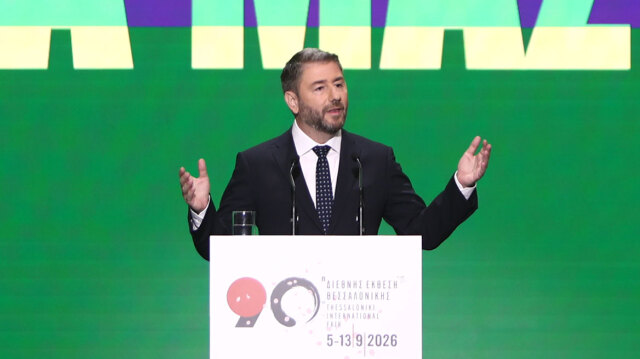
Nikos Androulakis, leader of Greece's PASOK party, presented his party's governance programme in a speech at the Thessaloniki International Fair, promising tax cuts, higher pensions, a 13th salary payment, incentives for a four-day working week and the repeal of several existing laws.
The fair, known in Greece by its initials ΔΕΘ, is traditionally the venue where party leaders and the prime minister set out their annual policy programmes. Speaking with an eye on the ballot box and against a backdrop of low poll ratings for PASOK, Androulakis said now was the time for big decisions and launched a sharp attack on the government and Prime Minister Kyriakos Mitsotakis, while avoiding direct reference to the new party recently formed by former Prime Minister Alexis Tsipras.
He said that if PASOK took office, it would push through seven "flagship legislative interventions" within its first six months in government.
Seven priorities for the first six months
- Tackling high prices and imposing strict market rules
- A modern production model to create investment, jobs and real added value
- Better wages, stronger labour rights and decent pensions
- A fair solution for private debt
- Affordable housing, family support and a full response to the demographic decline
- A revival of public health and education
- A state built on meritocracy, transparency and accountability
Androulakis said these seven interventions were the starting point for the political change the country needed and declared PASOK ready, arguing it was the only party with a credible plan, political independence and capable officials. He accused the government of presenting a democratic change of power as a national threat and told New Democracy officials they should feel some shame. He also referred to Tsipras's new party by its acronym, ELAS, saying the country needed a new direction rather than more managers of stagnation.
Tax cuts, pensions and a four-day week
Androulakis's economic package centred on cutting direct taxes, including scrapping presumptive taxation and the professional activity fee, alongside raising pensions and reinstating a 13th-month payment for public employees. He pledged to abolish the 13-hour working day and pilot a four-day week on full pay at larger companies and in knowledge-intensive roles, backed by tax incentives.
PASOK has previously presented 17 measures for pensioners, including a gradual reintroduction of the 13th pension under a costed plan, a new low-income pensioner support scheme, an average 20% cut to the pensioners' solidarity contribution, and unfreezing supplementary pensions. The plan also raises the VAT exemption threshold for small businesses and the self-employed to 20,000 euros and gradually cuts advance tax payments to 50% within four years.
Economy, agriculture and the state
Androulakis proposed a new, stronger Competition and Market Authority with responsibility for both protecting competition and protecting consumers, plus an ombudsman for small and medium suppliers and traders. He pledged an emergency windfall tax mechanism for oligopolies, triggered by findings from independent authorities, and a temporary, targeted cut to VAT on basic goods and to fuel excise duty. On energy, he promised a 20% cut in the average household electricity price in 2027, rising to 30% by the end of a four-year term.
He also pledged to end Golden Visa residency permits used as a tool for real estate speculation, tying residence permits to genuine productive investment instead. On agriculture, PASOK proposes a National Agricultural Land Bank, tax-free diesel for farmers and a revised regulatory framework for the ELGA farm insurance body, which Androulakis said New Democracy had failed to reform in seven years. The party's state reform plan is named after Anastasis Peponis and includes a new, merit-based ASEP civil service appointments system.
Housing, debt and family policy
To protect family homes, PASOK would introduce a legal framework modelled on law 3869/2010, impose rules on funds and loan servicers, and make creditor participation in the out-of-court debt settlement mechanism compulsory. It would offer repayment plans of up to 120 instalments for debts to the tax office and social security funds, with interest and surcharges reduced, plus a solution for borrowers with Swiss franc loans.
The party's GenRent housing plan envisages 40,000 social housing units created from public property and renovated buildings, prioritising young people, the economically vulnerable, teachers, doctors and other public employees who struggle to find housing on islands and in the regions where they serve. It would cap annual rent increases in areas of high housing pressure and limit short-term rentals where pressure has become excessive. Family measures include free universal nursery and pre-school care, zero VAT on basic baby products, a monthly payment of 200 euros for certified expenses for each child up to age three, subject to income criteria, and a 75% cut in the ENFIA property tax calculation on the first 100 square metres for large families.
Health, education and justice
Androulakis promised to rebuild the National Health System, reorganising primary care and expanding free preventive screening for cancer, cardiovascular disease and chronic conditions, with higher pay for doctors, nurses and health staff. For people with disabilities, he pledged to restore the retirement age for parents of children with disabilities to 55 and reinstate the full national pension for pensioners with a disability rating above 67%.
On education, he proposed a genuinely all-day public school with reinforcement teaching, school meals and permanent psychologists, plus a New Lyceum and a National Apolytirio leaving certificate with a new university entry system. He said that after a revision of the constitution, PASOK would introduce a new legal framework for genuinely non-state, non-profit universities of high academic standing, arguing New Democracy had misleadingly labelled existing colleges as universities to serve specific interests. On justice, he pledged to change Article 86 of the constitution so ministers' criminal liability would be handled by special judicial bodies rather than requiring approval from a parliamentary majority, along with a new, executive-independent system for appointing judicial leadership.
Turkey, Cyprus and the Aegean
On foreign policy, Androulakis proposed a new national strategy for European Union-Turkey relations, describing it as a new Helsinki. He challenged the government directly, asking whether Turkey's "Blue Homeland" theory and its declared intention to enshrine it in law amounted to calm waters, and whether the same could be said of Turkey's insistence on the division of Cyprus and unilateral actions in the Aegean and eastern Mediterranean. He called on the prime minister to raise the issue of sanctions against Turkey at the European Council and set out what he called PASOK's red line: good neighbourly relations without respect for international law, the law of the sea and Greece's sovereign rights were not possible.
Closing message and attendees
Closing his speech, having set out a programme the government has described as uncosted, Androulakis told the audience that PASOK could turn its vision into action because it had a plan free of outside dependencies, credibility and a genuinely democratic approach to exercising power. He said political independence was neither a party obsession nor a slogan but a condition of democracy and a precondition for real change.
PASOK officials and MPs attended the speech at Thessaloniki's Vellideio Conference Centre, along with former Prime Minister George Papandreou. Two independent MPs who had left SYRIZA, Evangelos Apostolakis and Alexandros Avlonitis, were also present, signalling their expected move into PASOK.


