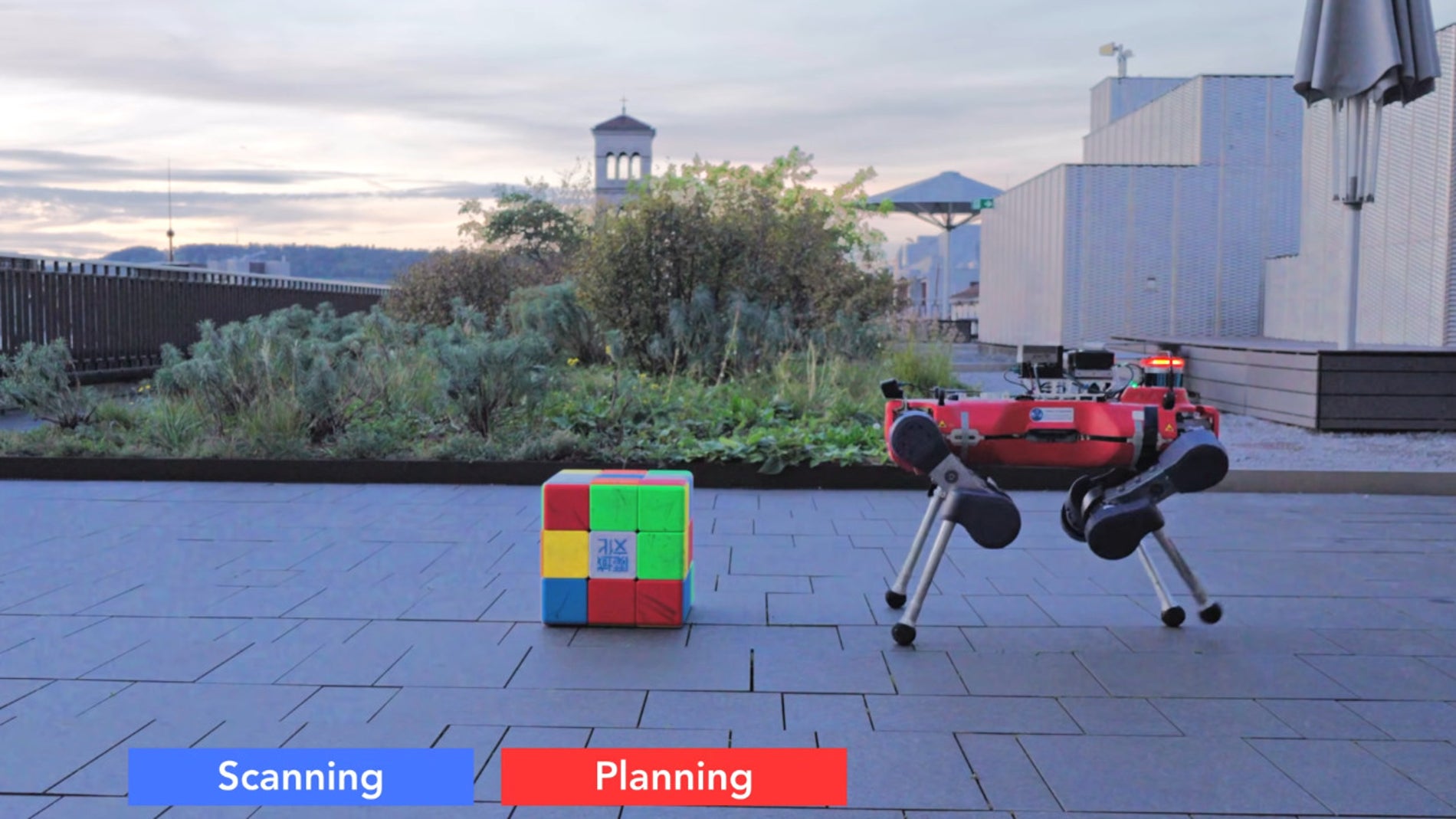
ANYmal, a four-legged robot developed by Swiss researchers, has solved a giant Rubik's cube using only its limbs to manipulate the puzzle.
Engineers at the Robotic Systems Lab at ETH Zurich achieved the feat by teaching the quadruped machine to coordinate both static and dynamic balance while handling the 4.6-kilogram object without hands or articulated grasping appendages.
The project, highlighted by the engineering publication Interesting Engineering, demonstrates how autonomous quadruped platforms can carry out complex mechanical manipulation entirely on their own feet.
The trial centered on a Rubik's cube whose dimensions far exceeded conventional standards. Rather than a pocket-sized handheld toy, the canine-like robotic unit confronted an oversized structure measuring 40 centimetres along each edge and weighing 4.6 kilograms.
Physical demands of the puzzle
Manipulating such a heavy puzzle created substantial mechanical hurdles. Rotating a section or shifting the block required the robot to continuously manage changing weight distributions and adapt its points of contact against the ground to counter the forces generated during each movement.
For human puzzle solvers, turning a face of a Rubik's cube is the simplest physical action, with the mental challenge focused on obtaining colour uniformity across one section without undoing previously solved faces. For a quadruped robot, however, the primary difficulty lay in executing physical movements while understanding the balance shifts that came with turning each layer.
Certain stages of the task also required flipping the entire cube over. The slightest miscalculation in limb placement or weight distribution risked causing the machine to stumble or lose its footing, which would have ended the trial in failure.
Computer vision and reinforcement learning
To overcome the challenge, the ANYmal robot relies on onboard cameras to scan and register the geometric configuration of the cube. The system maps the location of every coloured square from partial perspectives gathered as the robot walks and repositions itself around the puzzle.
With the visual data collected from all six faces, a motion-planning algorithm determines the sequence of rotations required to complete the puzzle. The software directs each successive step, guiding the machine through the full solution.
Executing those planned actions required an extensive reinforcement learning regime. The Swiss research team described the process as teacher-student training, which functioned as an artificial muscle memory resource for the quadruped unit.
Limb mechanics and balance control
Those learned motor patterns allowed the machine to coordinate two limbs simultaneously for distinct physical tasks. One leg pinned the body of the cube firmly against the floor while another limb applied the exact torque required to rotate layers or tilt the frame without external human assistance.
ETH Zurich, known formally as the Swiss Federal Institute of Technology in Zurich, has long been a pioneer in legged robotics research. Its Robotic Systems Lab focuses on developing autonomous machines capable of operating in unstructured, hazardous environments where wheeled devices cannot travel.
While automated systems and robotic arms have previously solved Rubik's cubes at high speeds, those demonstrations typically relied on specialized grippers or multi-jointed fingers. Teaching a walking machine to use its load-bearing legs as manipulative tools addresses a major frontier in robotics known as loco-manipulation, where an automaton must balance its own weight while simultaneously executing delicate physical work.
Industrial inspection and real-world deployment
The engineering team behind ANYmal stated that their broader objective is to offer a functional quadruped platform capable of operating with greater autonomy in complex operational settings where mechanical elements must be manipulated.
The researchers highlighted industrial inspection, search and rescue missions in challenging conditions, and the routine maintenance of critical infrastructure as key areas where such legged robots could prove most valuable.
The Zurich experiment reflects a broader expansion of both humanoid and zoomorphic robots across multiple industries. Robotic platforms have increasingly moved from theatrical displays to operational assignments, ranging from acrobatic demonstrations by Unitree Robotics with its H2-X automaton to practical field work.
Quadruped robotic dogs were previously deployed as surveillance and security units during the football World Cup hosted across Canada, Mexico, and the United States, showing how mobile legged machines are transitioning into active public and commercial roles.
By demonstrating that a quadruped can manipulate heavy objects with its feet without toppling, the researchers at ETH Zurich have shown that future field robots may not require separate mechanical arms to interact with their physical environment.