

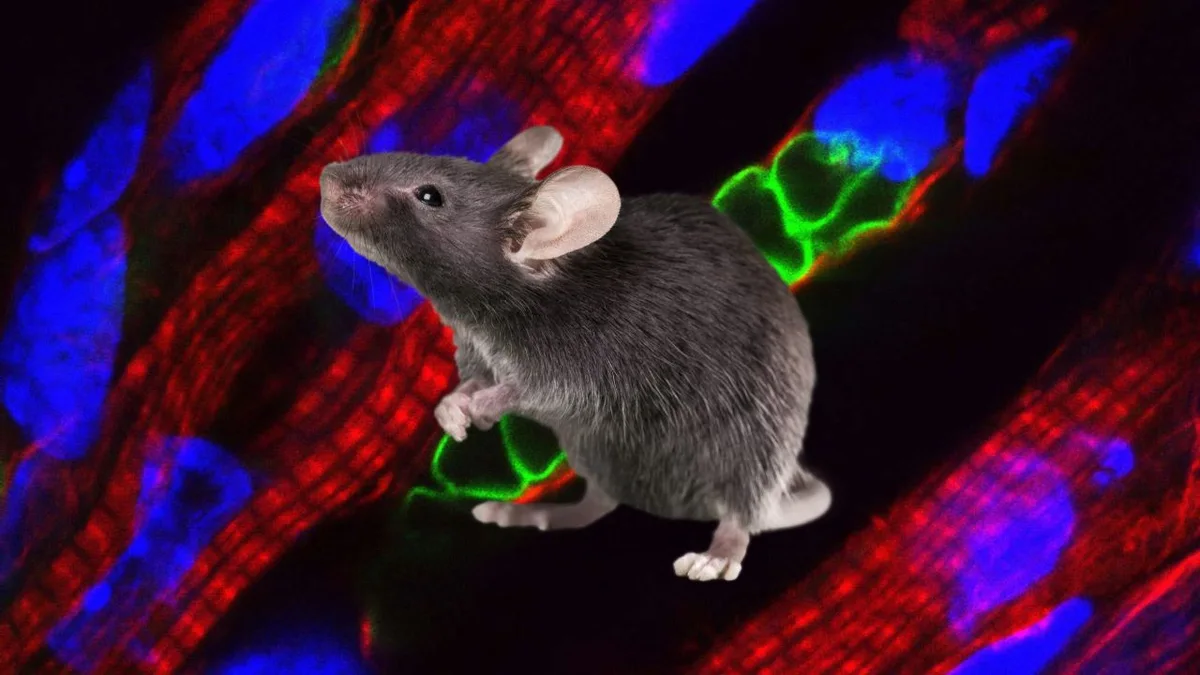
Researchers at ETH Zurich have created biohybrid robots powered by lab-grown mouse muscle that can jump, swim, walk across surfaces and grip objects.
The miniature machines combine living skeletal muscle tissue with a flexible hydrogel skeleton, delivering a range of motion up to 11 times greater than earlier systems with comparable amounts of muscle, according to the researchers. In laboratory tests, a single muscular contraction propelled an actuator five millimetres into the air, clearing a third of its own body length.
The team described the findings in a study published in the journal Nature Communications, presenting the bioactuators as a step toward robotic systems that move in a more natural way.
Each bioactuator measures roughly 1.5 centimetres in length and flexes with enough strength that its movements are clearly visible to the naked eye. While the devices can walk, swim and grasp objects, researchers were particularly struck by their ability to jump, an unusual motion that demands a sharp and abrupt change in shape.
Computer simulation and xolography printing
Previous efforts to build robots with lab-grown skeletal muscle struggled with movement, as the tissue often produced contractions so weak that they could barely be detected. The Swiss team solved this limitation by designing the living muscle and the artificial scaffold together as a single integrated system.
To determine where to place the muscle cells and how the hydrogel skeleton should bend, the researchers turned to computer simulations before conducting bench experiments. An optimization algorithm tested different layouts to identify shapes where a muscle contraction would generate the greatest possible movement across the entire device.
Aiste Balciunaite, a doctoral student at the Soft Robotics Laboratory at ETH Zurich, said that rather than choosing a fixed geometry for the muscle, the team set out to design the complete system from scratch on the computer.
Once the digital design was complete, the team fabricated the support scaffolds in the laboratory using xolography, an advanced volumetric three-dimensional printing technique that uses light to solidify structures. The printing process required approximately one minute per scaffold.
Soft robotics and biohybrid engineering
The project was conducted at the Soft Robotics Laboratory directed by Professor Robert Katzschmann at ETH Zurich, formally known as the Swiss Federal Institute of Technology Zurich. The public research university is recognized internationally for its work in engineering and robotics.
Biohybrid robotics seeks to merge biological materials, such as living cells or muscular tissue, with synthetic materials to create machines that replicate the flexibility and energy efficiency of living organisms. Hydrogels are synthetic, water-rich polymers that stretch and flex in much the same way as biological tissue, making them suitable scaffolds for living muscle cells.
The mouse muscle cells used in the project form skeletal muscle tissue capable of rapid physical response. By pairing these cells with an elastic hydrogel structure tailored to their pull, the researchers achieved contractions strong enough to lift the actuator off the floor of a laboratory dish.
Mouse biology and robotic muscle
Although mice are often portrayed in popular culture as round or clumsy, their musculature is remarkably light, agile and packed with fast-twitch muscle fibers. These biological fibers specialize in rapid, explosive force, making them an effective model for driving mechanical motion in soft robots.
Mice also share substantial genetic and biological traits with human beings, which has long made them central to experimental science. Their small physical size and rapid breeding cycles have established them as standard laboratory animals across biomedical research worldwide.
Musophobia and human history
Despite their scientific value, mice frequently trigger disgust and fear in humans. The psychological fear of mice and rats is known as musophobia, or muridophobia, and is estimated to affect roughly 4.7 percent of the general population among specific animal phobias.
The American Psychiatric Association classifies the condition in the Diagnostic and Statistical Manual of Mental Disorders, known as the DSM-5, as an anxiety disorder. It is defined by a persistent, disproportionate and irrational fear of rodents, triggered largely by their appearance and sudden, darting movements.
Scientists attribute this reaction to evolutionary conditioning. The human brain developed over thousands of years to stay alert to small creatures that move rapidly and unpredictably, particularly those appearing without warning underfoot.
That wariness deepened during the Neolithic period when human societies abandoned nomadic lifestyles, took up settled farming and began storing grain. Rodents quickly became agricultural pests and household competitors. Over centuries, rodents also became linked to filth and lethal disease, most famously the Black Death plague that devastated Europe in the Middle Ages.