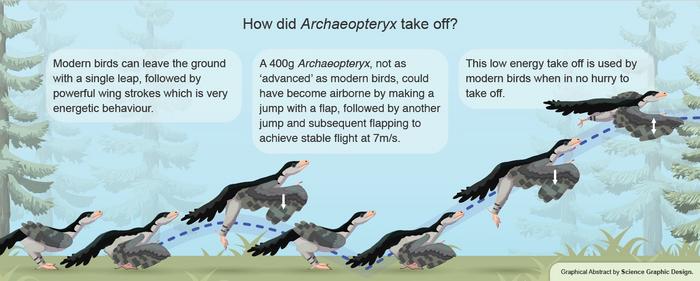
Archaeopteryx reached takeoff speed by making two or three consecutive hops across the ground rather than launching directly into the air, according to a computer modeling study by researchers at the University of Southampton.
Calculations showed that a specimen weighing 400 grams could attain seven meters per second, the minimum velocity required to remain airborne, through successive jumps combined with wing movements.
Under the identified mechanism, the prehistoric creature relied on its legs to perform the initial workload. Its wings engaged only after the animal was practically in the air, offering a practical solution for a dinosaur that lacked the flight anatomy of modern birds.
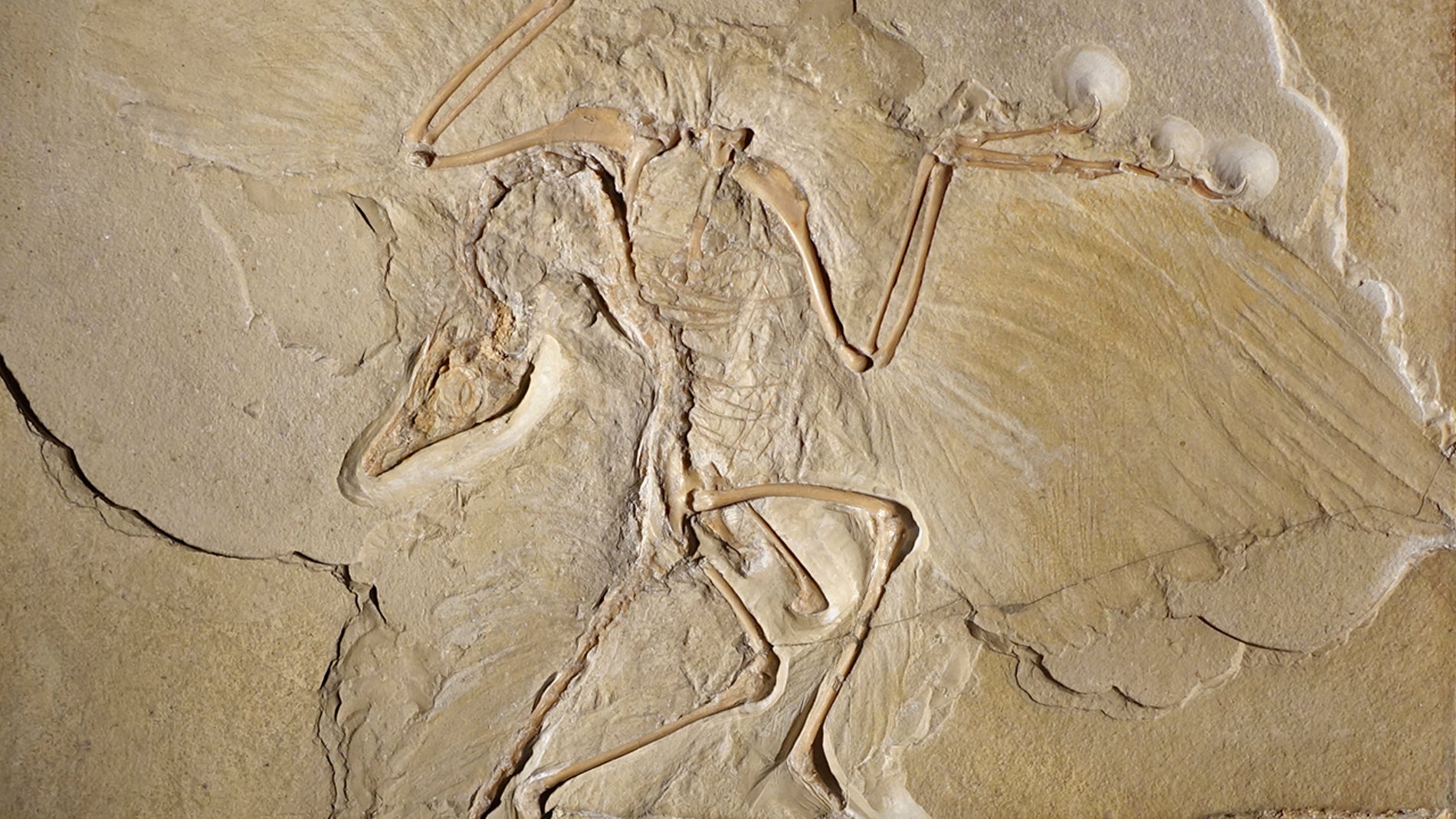
Archaeopteryx lived approximately 150 million years ago during the Jurassic period and remains one of the most famous creatures in paleontology. Although the animal possessed feathered wings, it retained classic dinosaurian traits including teeth, claws on its fingers, and a long bony tail.
As an intermediate form between ground-dwelling dinosaurs and modern birds, Archaeopteryx occupies a landmark position in evolutionary science. First discovered in 19th-century German limestone quarries, its fossils provided early physical evidence connecting avian species to theropod dinosaurs.
However, the physical structure of Archaeopteryx imposed significant movement constraints. Its shoulder joints did not permit raising the wings above its back, ruling out the overhead flapping motion used by modern birds to generate lift from a standstill.
The creature also lacked a keeled sternum, the ridged breastbone structure in contemporary birds where powerful flight muscles anchor. Without this specialized skeletal feature, Archaeopteryx could not produce the muscular force required for a sudden leap and immediate flapping flight.
Computer modeling of avian movement
To determine how Archaeopteryx overcame these physical limitations to achieve flight, researchers at the University of Southampton analyzed the movement patterns of living birds, including gulls, crows, magpies, and finches.
The research team transferred movement data from these modern species into a computer model tailored to the skeletal structure and body mass of Archaeopteryx. The simulation paid particular attention to the mechanical forces that the dinosaur's hips, knees, and ankles could generate on the ground.
Computer modeling in biomechanics allows paleontologists to test the physical capabilities of extinct animals by applying principles of robotics, physics, and anatomy to fossil data. The University of Southampton, located in southern England, frequently uses computational modeling to study prehistoric animal locomotion.
The calculations revealed that a 400-gram Archaeopteryx could reach the minimum takeoff speed of seven meters per second by executing three consecutive hops. The model also demonstrated that the animal could achieve takeoff speed in two hops if it executed a single downward wing stroke between bounds to gain additional momentum.
Evolutionary links to modern birds
The study notes that Archaeopteryx established an early takeoff strategy that remains visible in nature today. Crows, magpies, and gulls still execute several preparatory hops across the ground before taking flight when they are not rushed.
While other prehistoric creatures evolved alternative launch methods, such as the quadrupedal launch strategies identified in fossil studies of pterosaurs, leg propulsion remains essential to bird flight. Pterosaurs were flying reptiles of the order Pterosauria that lived alongside dinosaurs but evolved powered flight independently.
The researchers emphasized that their model does not prove Archaeopteryx exclusively took off using consecutive hops, because fossilized remains do not preserve soft tissue structures such as muscle strength.
However, the findings confirm that the hopping mechanism was physically possible. The results reinforce the broader scientific consensus that avian flight evolved gradually by adapting locomotive movements that prehistoric creatures were already performing on the ground.