

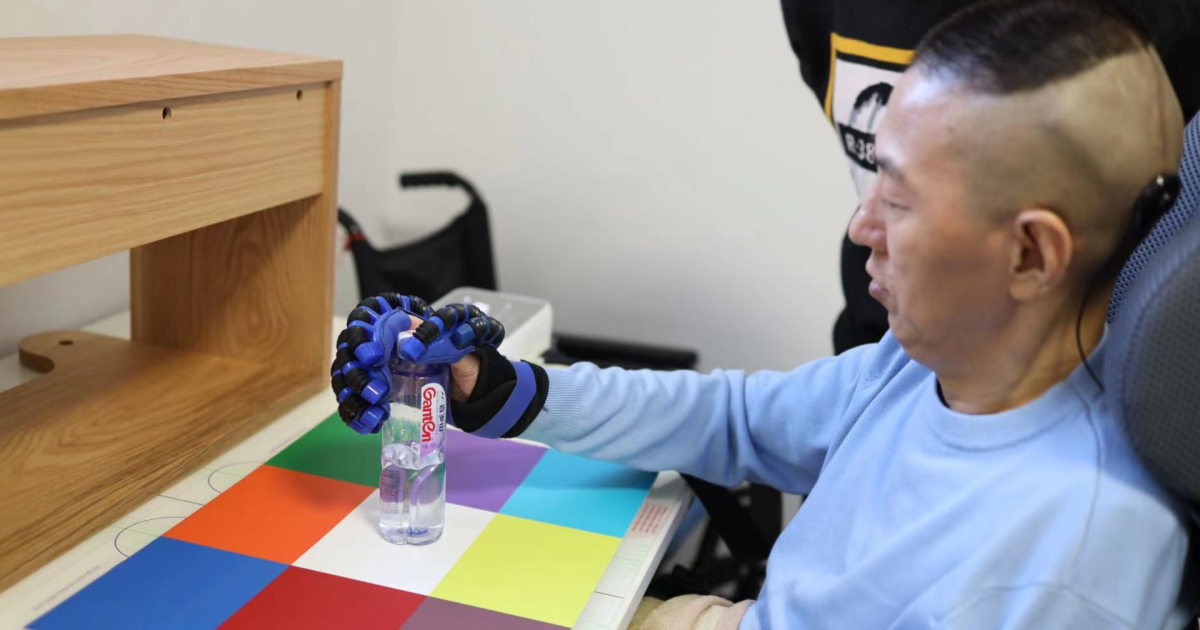
Researchers at Tsinghua University in Beijing have developed a brain-computer interface capable of restoring hand motor functions in patients with tetraplegia, following regulatory approval by Chinese authorities in March for commercial sale of the device.
The decision marks the first commercial approval anywhere in the world for a brain-computer interface, or BCI, system designed for medical treatment. The implant is manufactured by Borui Kang Medical Technology, a medical device firm based in Shanghai, and is engineered to restore physical movement and communication for individuals suffering from severe paralysis.
The technology specifically targets patients who have lost function in all four limbs due to cervical spinal cord injuries, which affect the neck region of the spine. By transmitting signals to an external motorized glove, the system enables users to grip and hold objects again.
Wireless epidural design
Known as the Neural Electronic Opportunity, or NEO, the system relies on a dual-component architecture comprising an internal implant inserted into the skull and an external processing unit worn on the head. Power is delivered remotely using high-frequency inductive coils, while epidural electrocorticogram signals, known as ECoG, travel wirelessly via Bluetooth to a receiver mounted outside the scalp.

Unlike intracranial brain implants that penetrate delicate brain tissue, the NEO system uses epidural electrode arrays placed over the dura mater, the tough protective membrane surrounding the brain. This positioning allows the device to record local field potential signals while preserving neural structures underneath. The combination of wireless power induction and Bluetooth transmission eliminates cables passing through the scalp, reducing infection risks for patients.
Data processing is managed by a decoder based on Riemannian geometry, a mathematical framework used to analyze complex multidimensional signals. The software identifies user movement intentions with high accuracy while filtering out background physiological noise, such as muscle signals produced when chewing meals.
Clinical trial results
The NEO system translates mental intention into physical action through a pneumatic glove worn on the patient's hand. When a user visualizes the act of grasping or releasing an item, the device decodes the neural activity and triggers the motorized glove almost instantly.
Clinical testing demonstrated significant functional gains in human participants. The first patient enrolled in the trial had been paralyzed for 14 years following a motor vehicle accident. Before receiving the implant, the patient achieved a 35 percent success rate in object movement tasks, but reached a 100 percent success rate when assisted by the BCI device.
With the assistance of the system, the patient was able to perform daily tasks independently at home, including eating and drinking. Over a nine-month period of using the BCI, the patient experienced neurological and functional recovery even without receiving external electrical stimulation.
Clinical assessments showed a 5-point improvement on the motor scale of the International Standards for Neurological Classification of Spinal Cord Injury, as well as an 8-point gain on its sensory scale. On the Action Research Arm Test, a standard measure of hand impairment, the patient improved by 16 points in the right hand and 11 points in the left hand. Somatosensory evoked potential tests confirmed that neural pathways connecting the limbs to the brain through the spinal cord had strengthened during the trial period.
Decade of development
Tsinghua University stated that ongoing refinement of the platform will eventually allow patients to recover multiple hand movements and complex motor tasks. Research on the technology began in 2013 when Professor Bo Hong, who led the research team, proposed the principle of a low-invasiveness epidural implant.
Over ten years of engineering, the research team reduced the size of the implantable component to a diameter of 25 millimeters, approximately the size of a coin. Early validation trials took place in white pigs, proving that the implant could maintain stable, long-term ECoG recordings without causing damage to cortical neurons.
Regulatory authorities granted authorization for human clinical trials in early 2023. Surgeons completed the first human surgical implantation of the NEO device on Oct 24, 2023, at Beijing Xuanwu Hospital, and performed a second procedure on Dec 19, 2023, at Beijing Tiantan Hospital.
Tsinghua University stated that the NEO system validated a novel medical approach by balancing high performance intracranial BCI capabilities with reduced invasiveness to ensure patient safety over time. A leading BCI expert stated that brain-computer interface technology could enter practical public use in China within three to five years as products mature. The commercial rollout comes as China competes with American neurotechnology startups, including Elon Musk's Neuralink.
Patient eligibility rules
Chinese health regulators established specific criteria for patients seeking the commercial implant. Candidates must be between 18 and 60 years old and suffer from a specific type of cervical spinal cord injury. Their diagnosis must be at least one year old, and their condition must have remained stable for six months following standard medical care. Eligible patients must be unable to grasp objects with their hands while retaining partial arm movement.
The regulatory authority stated that data from clinical trials showed significant improvements in hand grasping abilities among participants, adding that the physical gains helped improve patient quality of life.


