Researchers at the American Museum of Natural History and Princeton University found that competition with small mammals stopped dinosaurs from evolving tiny body sizes. In a study published in the journal Evolution, scientists used a mathematical model of vertebrate body size to analyze why dinosaurs never shrank to the size of a mouse.
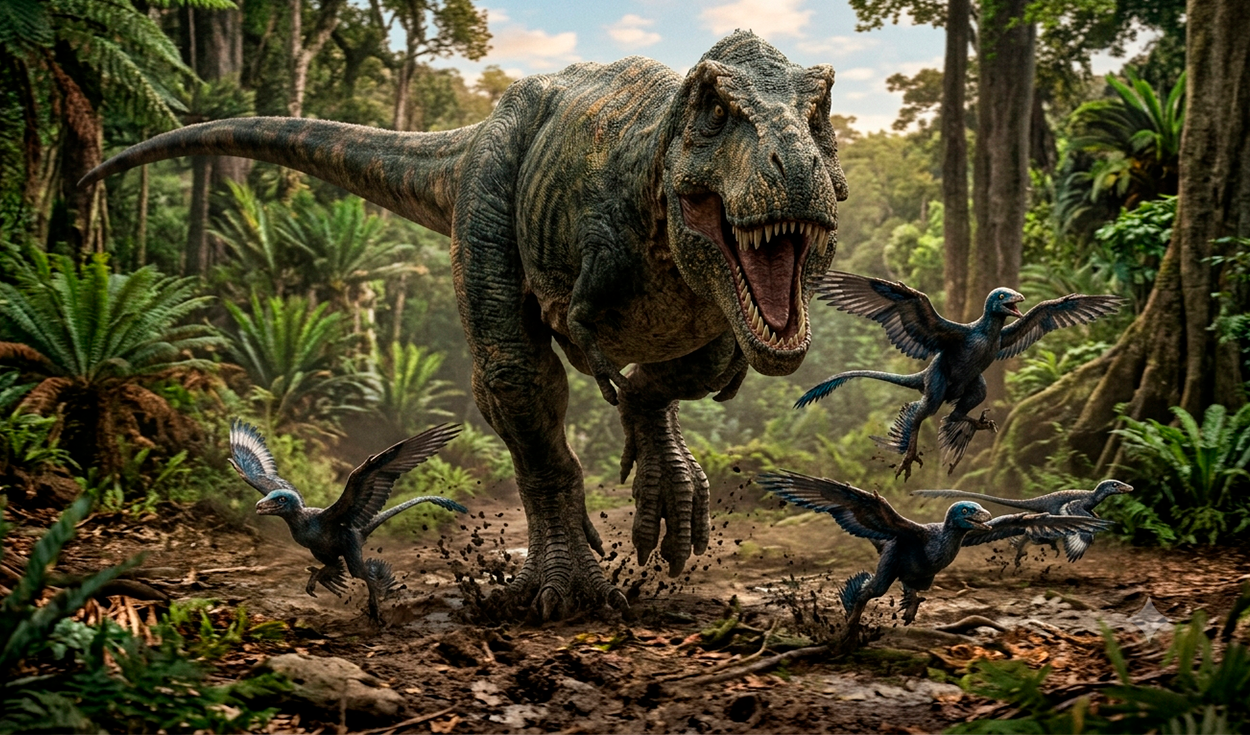
Dinosaurs are often remembered as giants, with sauropods like Brontosaurus, Brachiosaurus, and Diplodocus growing to massive sizes across dozens of lineages. Other species grew only to the size of a cow or a fox, but even the smallest known dinosaurs remained relatively large. Microraptors, feathered predators that lived during the Early Cretaceous period starting about 145 million years ago, weighed roughly half a kilogram, similar to a large rabbit or urban pigeon.
According to the study, these smallest dinosaurs weighed at least 400 grams, making them 200 times heavier than the smallest modern animals. The world's smallest modern bird, the bee hummingbird (Mellisuga helenae), weighs 1.75 grams, while the smallest mammal, the Etruscan shrew (Suncus etruscus), weighs about 1.8 grams.
Mathematical model of dinosaur body size
The research team studied vertebrate evolution using a mathematical model built on energetic factors. The model describes the body size at which an animal can reproduce with the highest energy efficiency. While the model accurately predicts the observed sizes of modern mammals, birds, and turtles, it fails to explain the size distribution of dinosaurs.
Calculations showed that the theoretical optimal size for dinosaurs should have been only three kilograms. However, the actual modal size observed in the fossil record is about 180 kilograms. The authors noted that the model also fails for modern lizards and modern flightless island birds, suggesting ecological constraints alter size distribution in those groups.

Competition with small mammals
Researchers suspect that competition with small mammals for resources prevented dinosaurs from occupying tiny ecological niches. Co-author Roger Benson said scientists already knew dinosaurs kept mammals from evolving into large animals prior to the mass extinction at the end of the Cretaceous period. He suggested that mammals in turn prevented dinosaurs from evolving into small animals.
The study addressed whether mini-dinosaurs existed but remain undiscovered. The authors acknowledged that fossil discoveries favor larger bones, but called missing tiny dinosaurs unlikely. Fossil sites that preserve dinosaurs frequently contain much smaller fossilized animals, such as lizards and amphibians. If mini-dinosaurs had existed, researchers expect they would have appeared in the fossil record at some point.

Lead author Stephanie Lechki said small animals dominate all habitats on Earth today. She noted that understanding how modern biodiversity emerged requires figuring out why tiny dinosaurs were apparently absent.
Benson said researchers face an unusual situation because dinosaur ancestors and living avian descendants could both be tiny, yet dinosaurs themselves seemed forbidden from reaching tiny sizes. He stated that scientists do not yet fully understand the constraint, but must continue investigating it to understand dinosaur biology.