Researchers at the University of California, San Diego have disproved the traditional belief that one dog year equals seven human years, showing that canine aging follows a rapid logarithmic curve rather than a constant linear rate. Led by bioengineering and genetics researchers Trey Ideker and Tina Wang, the team analyzed DNA methylation patterns in 104 Labrador retrievers to establish a biological clock comparing canine maturation directly with human aging.
The study, published in the scientific journal Cell Systems, reveals that dogs undergo rapid molecular aging during their first months and years of life before their development slows down significantly in adulthood. According to the research team, a one-year-old dog has already reached the biological equivalent of a 30 to 31-year-old human adult.

For generations, pet owners and veterinarians relied on a simple rule of thumb that multiplied a dog's calendar years by seven to gauge the age of family pets and guard dogs. However, scientific analysis has now debunked this linear model, demonstrating that canine maturation possesses distinct biological features that cannot be calculated through basic multiplication.
The biological data highlights a sharp contrast between canine and human early development. An eight-week-old puppy is biologically equivalent to a nine-month-old human infant, reflecting intense cellular activity during early growth. By four years of age, a dog reaches a biological maturity equivalent to a 52 or 53-year-old human.
As dogs grow older, their rate of molecular aging decelerates dramatically. By the time a canine reaches 12 years of age, its biological equivalence sits at 71 human years. This flattening curve explains why senior dogs can remain in late middle age for extended periods despite aging so rapidly during puppyhood.
DNA Methylation and the Biological Clock
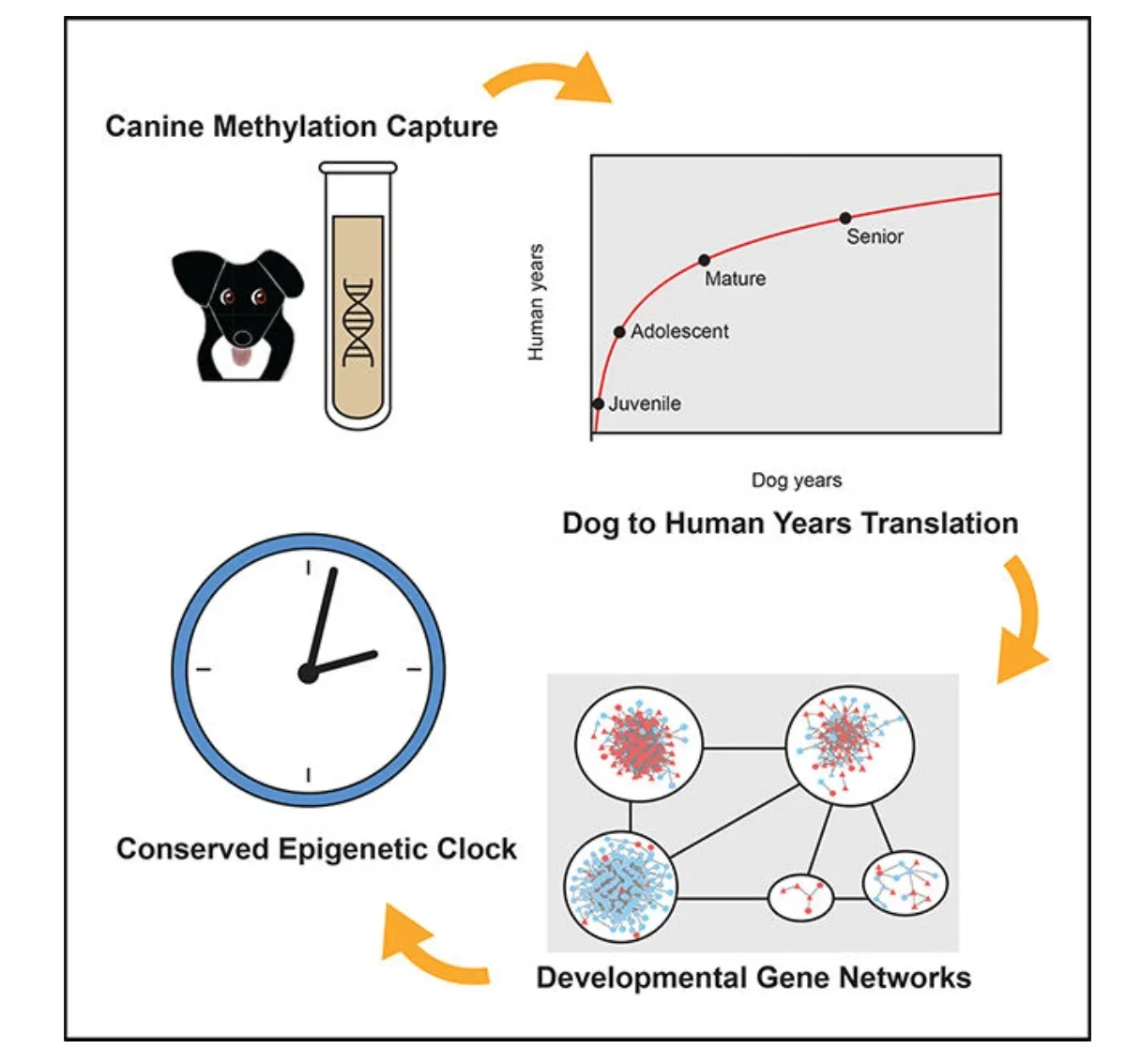
To map the true biological scale of canine aging, the researchers examined chemical modifications across the genomes of the test animals. They focused on DNA methylation, a process where chemical tags called methyl groups attach to DNA molecules to regulate gene expression without altering the underlying genetic sequence. Epigenetic markers such as methylation act as an internal molecular clock, allowing scientists to track biological age and cellular decline across different species.
The investigators compared genomic data from the 104 Labrador retrievers against reference genetic samples collected from hundreds of human subjects spanning different ages. By tracking matching methylation patterns on equivalent genomic regions, the researchers aligned key biological milestones in dogs with corresponding stages of human life.
The Logarithmic Formula for Canine Age
The study established that calculating a dog's true biological age requires a logarithmic equation based on genome methylation rather than linear multiplication. The formula determined by the researchers sets a dog's human-equivalent age equal to 16 multiplied by the natural logarithm of the dog's age in years, plus 31.
In mathematics and biology, a logarithmic scale represents processes that undergo rapid initial changes before leveling off into a plateau. In the natural logarithm calculation, represented as ln, the initial year of a dog's life produces a large numerical shift, accounting for how a canine reaches full physical and reproductive maturity in its first year while continuing to live for over a decade in adult maturity.
Breed Variations and Research Limitations
The authors emphasized that their study focused exclusively on a single canine breed, the Labrador retriever. In veterinary science, canine life expectancy varies significantly according to animal morphology and body mass. Smaller breeds, such as toy poodles and chihuahuas, generally demonstrate longer lifespans than larger breeds like retrievers or Great Danes.
The researchers noted that other biological factors, including surgical sterilization through spaying or neutering and crossbreeding between different dog lines, also influence the rate of cellular aging. As a result, applying this mathematical model precisely to all dogs will require detailed analyses across other specific breeds to calibrate the equation for different sizes and genetics.