

The Dominican Republic's Central Electoral Board (JCE) spent $529,438.19 (32.2 million Dominican pesos) on international flights and per diems for its members in a period of just over a year and a half.
According to data released to Diario Libre under a public information request, board members undertook 71 official missions between January 2025 and July 24, 2026. The trips totalled 472 days abroad and took representatives to 23 countries and territories in the Americas, Europe and Asia: the United States, Canada, Honduras, Guatemala, Costa Rica, El Salvador, Panama, Puerto Rico, Curacao, Sint Maarten, Ecuador, Chile, Uruguay, Paraguay, Bolivia, Peru, Colombia, Spain, Germany, Italy, Switzerland, the Netherlands and the Philippines.
The total expenditure included $343,600 (20.9 million pesos) for per diems and pocket money, and $185,838.19 (11.3 million pesos) for airfare.
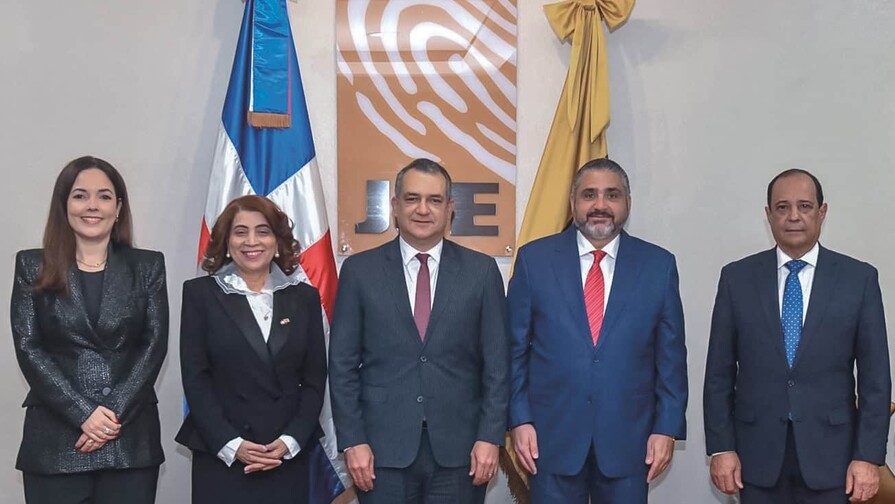
The five titular members of the JCE plenary accounted for 96.9 per cent of the total, spending $512,838.06 (31.2 million pesos). Three alternate members spent the remaining $16,600.13 (1.0 million pesos) on official missions during the same period.
Business class and $800 per diems
Almost all the money spent on air travel went toward business class tickets. The JCE paid $180,950.56 (11.0 million pesos) for 62 business class flights or mixed-class routes dominated by business class, accounting for 97.3 per cent of the flight budget.
Only eight flights were booked in economy class at a cost of $4,887.63 (298,145.43 pesos), despite an ongoing government austerity campaign for state institutions. Another eight economy flights were covered by host countries or organisations and cost the board nothing.
Per diems accounted for the bulk of the expenditure, with board members typically receiving $800 (48,800 pesos) a day for technical, training and supervision missions. For some electoral observation missions, such as trips to Mexico and Colombia, the daily allowance dropped to $300 (18,300 pesos).
The largest individual per diem payouts were the $12,000 (732,000 pesos) collected by both Hirayda Fernández and Samir Chami for a 15-day stay in León, Spain, to attend a cybersecurity summer bootcamp.
This was followed by a 14-day technical tour through Switzerland, Italy, the Netherlands and Spain, which generated $11,200 (683,200 pesos) each in per diems for Fernández and Chami. A 12-day mission to the Philippines and the US resulted in $9,600 (585,600 pesos) for JCE President Román Jáquez and Fernández, while an eight-day trip to Germany paid out $6,400 (390,400 pesos) per person.
Top spenders and most expensive flights
Hirayda Fernández recorded the highest total expenditure on the board, spending $153,316.27 (9,352,292.47 pesos) across 17 missions and 127 days abroad. Jáquez followed with $129,681.03 (7,910,542.83 pesos) over 13 missions and 93 days, and Chami ranked third with $116,855.06 (7,128,158.66 pesos) over 16 missions and 104 days.
Dolores Fernández spent $60,755.90 (3,706,109.90 pesos) over 11 missions and 67 days, and Rafael Vallejo recorded $52,229.80 (3,186,017.80 pesos) over 10 missions and 60 days.
The most expensive ticket in the board's records was a $9,599.58 (585,574.38 pesos) business class flight for Jáquez on a route from Washington to Madrid and back to Santo Domingo. Jáquez and Hirayda Fernández also each flew on $9,550.71 (582,593.31 pesos) tickets from Santo Domingo to Manila via New York for the Philippines mission.
Other high-cost flights included a $6,971.66 (425,271.26 pesos) ticket to Munich, Germany, for Jáquez, and a $6,855.46 (418,183.06 pesos) ticket covering Washington, Atlanta and Los Angeles for Hirayda Fernández.
Election monitoring and new ID cards
Electoral observation and international representation accounted for 30 of the 71 participations. Board members travelled to observe elections in Honduras, Ecuador, Mexico, Bolivia, Colombia and the Philippines. These included missions for the Inter-American Union of Electoral Organizations (Uniore), the Organization of American States (OAS), the Association of Electoral Magistrates of the Americas, and the Commission on Elections (Comelec).
Another 16 trips were dedicated to integrating electoral logistics coordination offices (Oclee) abroad, which involved gathering proposals from citizens in Zurich, Milan, Amsterdam, Barcelona, Madrid and Boston.
The rollout of a new identity card required four participations. Representatives travelled to Germany to approve the final design and begin production, to Guatemala to receive an international award for the new identity document, and to the US to coordinate its implementation for Dominican expatriates.
Another 20 participations involved training, conferences and strategic agreements. The board signed agreements with the OAS and the International Foundation for Electoral Systems in Washington, and participated in activities covering cybersecurity, artificial intelligence and electoral management in Spain.
One mission was dedicated entirely to inspecting overseas service offices (OSE), while eight other trips included supervision of offices in the US, Spain and Chile as a secondary activity.


