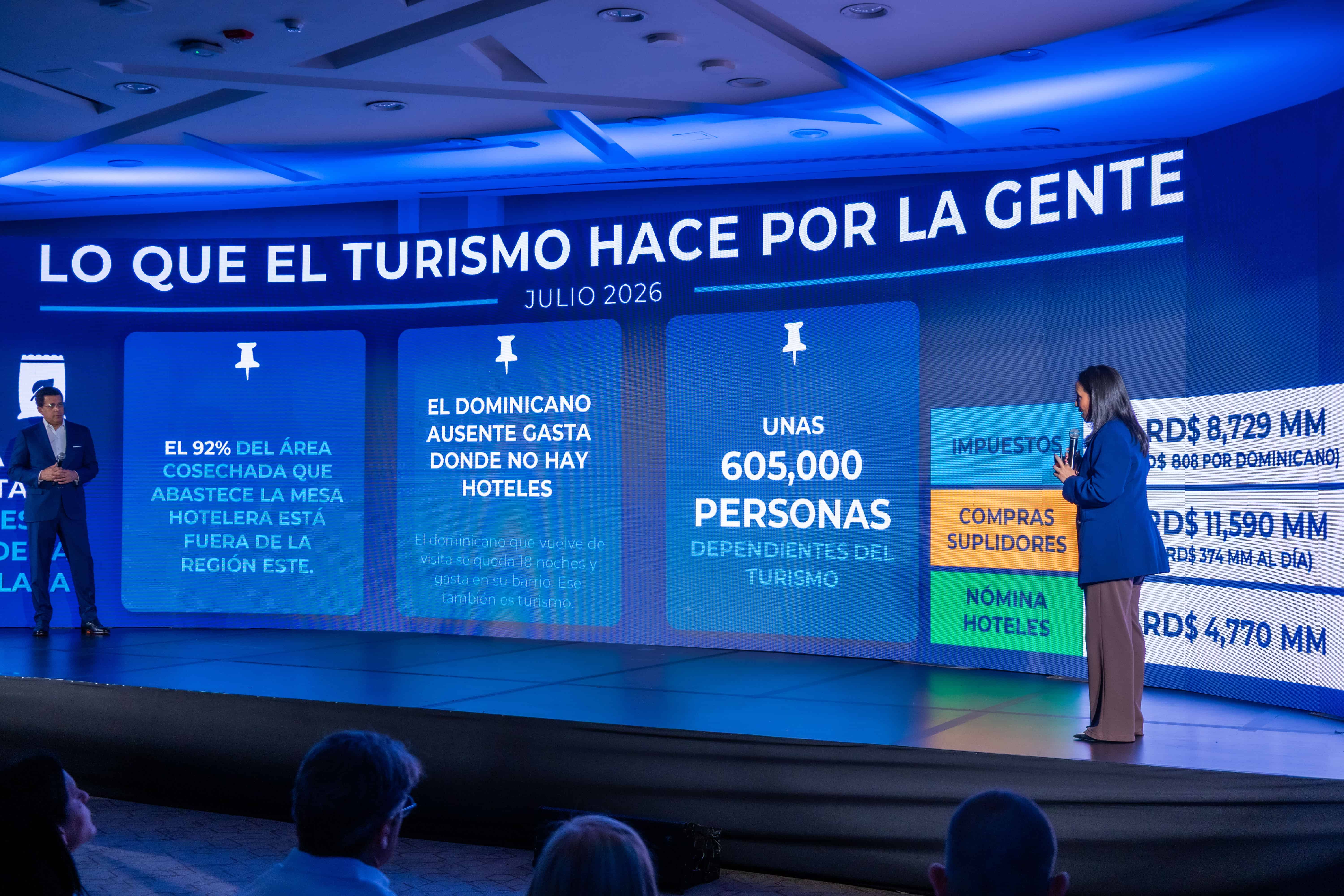
Up to 605,000 people in the Dominican Republic depended directly on tourism activity to maintain themselves economically as of July 2026, according to estimates released by the Ministry of Tourism. Every traveler arriving for the first time or returning to the country created an economic ripple effect that multiplied jobs, domestic sales, tax revenues, and foreign exchange earnings.
Hotels provided more than 183,000 direct jobs in July, making the resort sector the largest employer in the industry. Kitchen operations supported the highest number of personnel, providing 42,460 positions across resort complexes.
Yanira Eusebio, a merchant selling drinks to vacationers at Guayacanes beach, spoke on Tuesday at a Ministry of Tourism press conference after being invited alongside a group of tour guides, merchants, and tourist transport workers. Eusebio said intervention by the ministry provided her with a remodeled stand and customer service training, which changed her life by raising her income and helping cover schooling for her youngest daughter.
Eusebio said it was reassuring to wake up without wondering where to go or worrying about getting wet when it rains, adding that vendors now operate dignified businesses ready to welcome any tourist. She said merchants can now call themselves entrepreneurs.

Hotel employment breakdown
Tourism Minister David Collado detailed the value added by tourism during Tuesday's press conference, noting that hotel payrolls alone reached 4.77 billion pesos in July. Collado said that behind every occupied hotel room, two people are working.
Beyond kitchen staff, occupations such as busboys, waiters, and stewards accounted for approximately 26,500 direct jobs in July. Infrastructure maintenance workers, including electricians, plumbers, and carpenters, held about 12,500 jobs across hotel properties.
Cleaning staff held 11,415 positions, while spa and beauty services accounted for 7,935 jobs, and security personnel made up 5,673 positions. The industry also supported self-employed workers who have provided services to tourists for decades.
Ángel Morfa, president of the Guías Coloniales de Santo Domingo union, said he has maintained himself through the profession his whole life but had never been able to organize as many tour groups as he does now. Morfa explained that while he previously had to wait up to three days to conduct a single tour, he is currently overwhelmed with tours and must enlist colleagues to help him, citing increased security in the Zona Colonial as a fundamental factor for his routes.
Visitor arrivals and supply chains
Dominican tourism welcomed 7,700,118 visitors between January and July 2026, representing a 7.0 percent growth compared to the 7.1 million visitors recorded in the same period of 2025. That total reflects an increase of more than half a million visitors over the previous year.
Collado credited the surge to strong sector momentum in July, which drew 1,083,448 visitors. He described July as the second best monthly performance of the year behind the peak season air and sea arrivals recorded at the start of 2026.
Purchases from hotel and restaurant suppliers reached 11.59 billion pesos in July, translating to more than 374 million pesos per day. Technical Vice Minister of Tourism Jacqueline Mora noted that agricultural purchases add to those totals, pointing out that while people often view tourism's impact as concentrated in Punta Cana, the farmland feeding tourists is far from the beach.
Mora explained that 92 percent of the harvested land supplying hotel dining tables is located outside the eastern region, distributing the multiplier effect of tourism nationwide.
Tax revenues and currency impact
Foreign exchange generated by tourism helped the Dominican peso appreciate 7 percent against the U.S. dollar over the last seven months. The exchange rate moved from an average of 62.90 pesos per dollar on January 1, 2026, to an average of 58.60 pesos per dollar during July.
Mora said every dollar brought in by tourism is a dollar that does not need to be borrowed. She noted that visitor arrivals contributed approximately 1.4 billion U.S. dollars monthly, amounting to roughly 45.1 million dollars per day and up to 1.9 million dollars every hour.
Tourism also added approximately 8.729 billion pesos to the public treasury through tax payments in July. Officials emphasized that these metrics demonstrate the expanding role of tourism in the Dominican economy as the country targets over 12 million visitors by the end of 2026.