Scientists at the National Institute of Standards and Technology have transmitted entangled light particles over 62 kilometres of outdoor utility pole cables.
The research team, led by Thomas Gerrit, successfully delivered the quantum signals between institute facilities and the University of Maryland using standard optical fiber cables suspended above public streets.
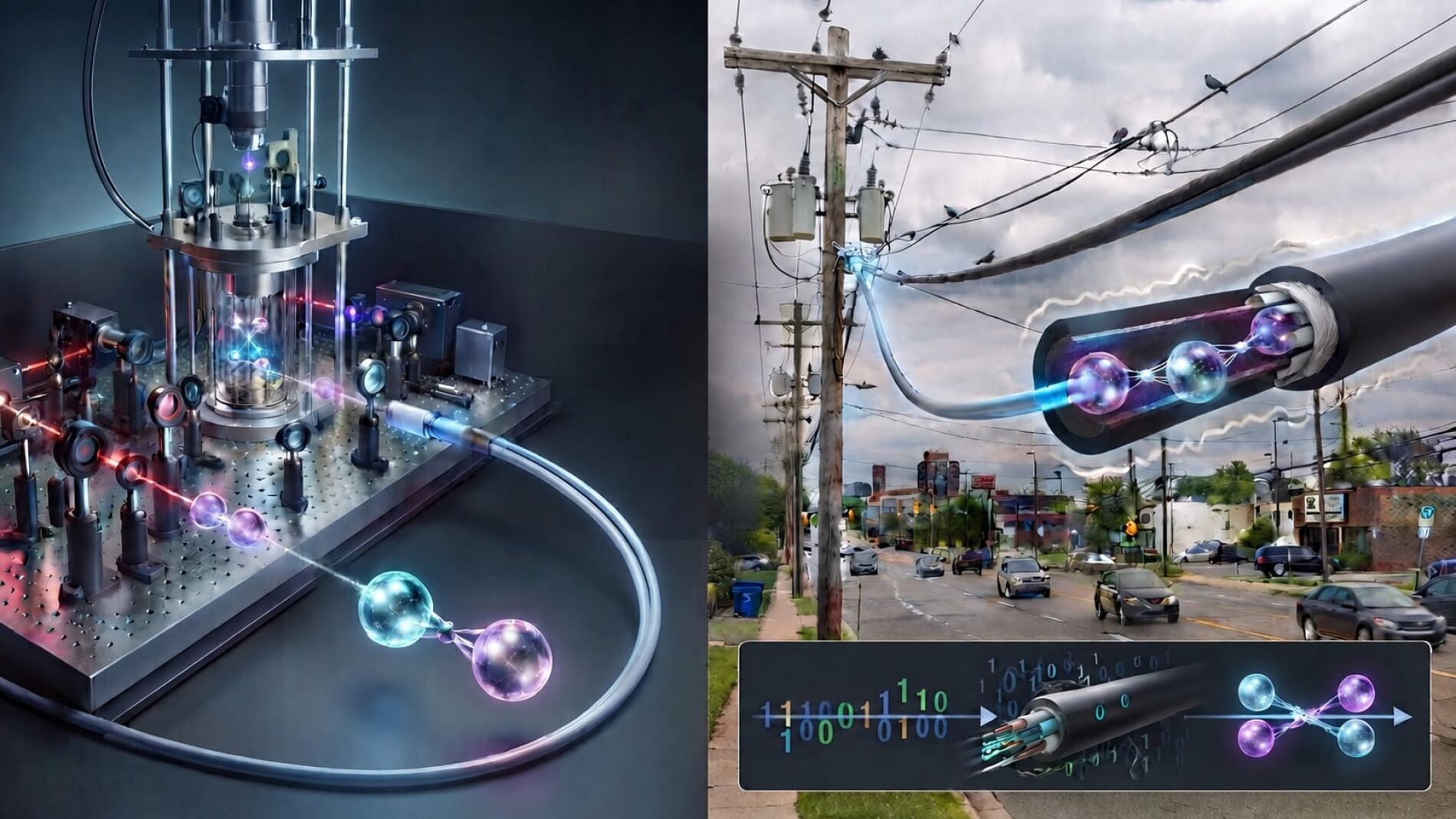
Details of the real-world trial were published in the Journal of Optical Communications and Networking, marking a major step toward practical quantum communications outside controlled laboratory settings.
The National Institute of Standards and Technology, a federal physical science laboratory operating under the United States Department of Commerce, conducts research across advanced measurement standards and network technologies. The University of Maryland is a public research institution located in College Park, Maryland.
Overhead fiber transmission
Unlike conventional internet cables buried beneath roads, the optical fiber line used in the experiment ran outdoors on utility poles along public thoroughfares. This exposed the delicate light signals to everyday environmental noise, including wind, temperature changes, traffic vibrations, and mechanical movement caused by perching birds.
Study co-author Yicheng Shi said that the trial served as a stress test for quantum network systems. He noted that the team subjected the apparatus to an extremely noisy environment and that the system still functioned successfully.
While Chinese researchers previously achieved longer distances using quantum entanglement via satellite in a controlled space environment, the American experiment represents one of the most significant demonstrations of transmitting quantum data across existing ground infrastructure.
Quantum security vs classical internet
The conventional internet transmits physical data as ones and zeros through optical fiber cables. This traditional method resembles sending physical letters, which leaves communications vulnerable to interception and copying by hackers.
In contrast, a quantum network uses quantum physics to teleport the states of entangled light particles, known as qubits. Information does not travel along an intermediate physical path between endpoints.
Security is inherent to the quantum mechanism. If an intruder attempts to spy on a transmission, the entangled particles alter their state immediately, destroying the transmitted data and rendering the communication unhackable.
Overcoming environmental noise
Transmitting quantum data over aerial cables presents severe technical obstacles. Photons carrying quantum information are extraordinarily delicate, and slight environmental changes can disrupt their quantum states.
Conventional internet signals pass through optical fibers without disruption from minor vibrations or light polarization shifts. However, quantum information in the NIST experiment was encoded in photon polarization, which represents the orientation of the electric field of light.
As aerial cables sway in the wind or change temperature, the polarization shifts. Researchers described the challenge as similar to keeping a compass needle perfectly aligned while someone constantly shakes the underlying table.
While classical binary bits learned to operate despite environmental noise decades ago, the team led by Gerrit has now shown that qubits can withstand similar real-world interference.
Future applications and quantum networks
Quantum entanglement creates a fundamental link between two particles so that their quantum states remain correlated even across physical distances. Measuring one particle instantly provides corresponding details about the second particle.
Entanglement does not allow instantaneous messaging and does not violate the speed of light. Instead, it provides a method to share quantum states between separate locations.
A quantum internet is not designed to replace traditional online activities such as video streaming, email transmission, or video calling. Its primary purpose is to connect quantum computers, quantum sensors, and specialized hardware.
Key applications include distributing cryptographic keys whose security is guaranteed by physical laws. The technology could also link geographically separated quantum computers into unified processing systems or connect distant astronomical telescopes to conduct coordinated scientific measurements.