

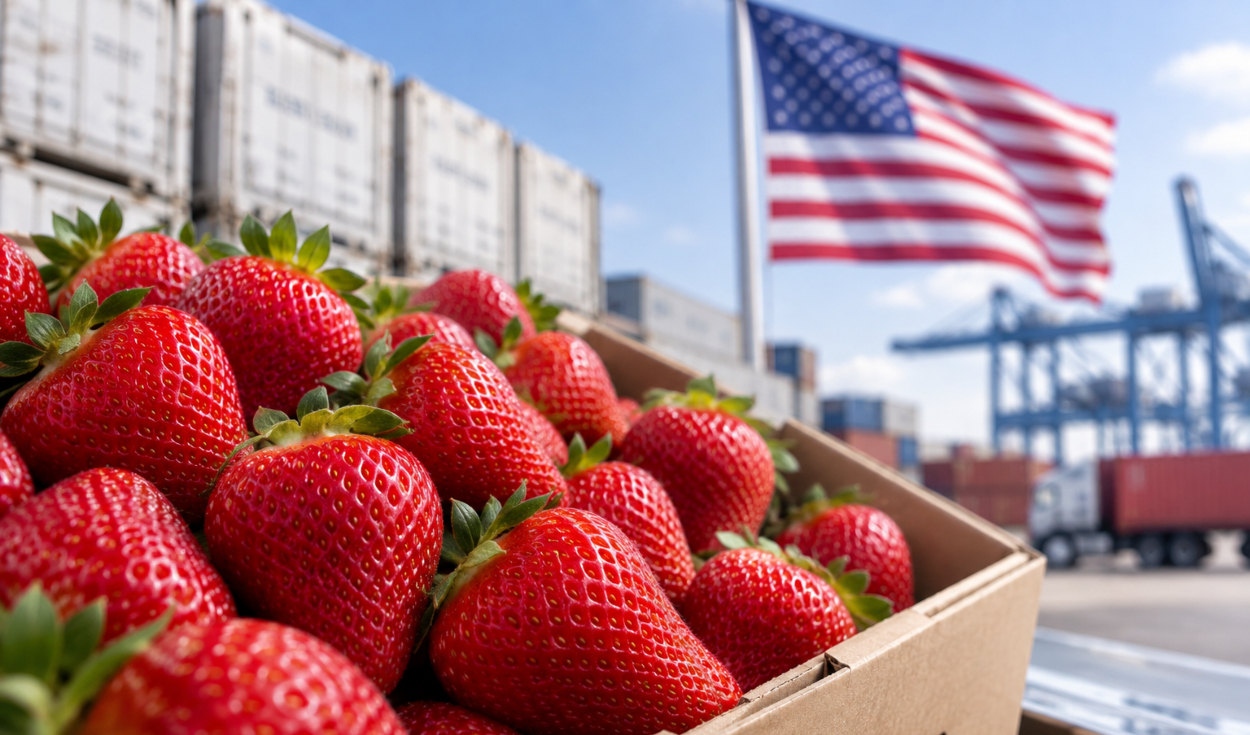
Peruvian strawberry exports surged 35.5 percent to $21.027 million in the first half of 2026, fueled by almost double U.S. orders, trade data shows.
Shipments to the United States nearly doubled between January and June, rising 96 percent to $11 million from $5.616 million in the same period of 2025, according to figures from the Global Business and Economics Research Center of the Association of Exporters (CIEN-ADEX).
American buyers accounted for 52.3 percent of Peru's total strawberry export earnings during the six-month period, generating more than half of all international revenues for the crop.
United States leads export destinations
The sharp increase in U.S. purchases positioned the country far ahead of other international destinations. Canada ranked second among export markets, purchasing $4.628 million in Peruvian strawberries during the first half of the year.
Japan imported $2.419 million worth of strawberries from Peru, followed by Guatemala at $1.034 million and South Korea at $823,000. Trade analysts noted that while U.S. demand remains the primary catalyst for current growth, Peru maintains a diversified portfolio of international buyers across North America, Asia, and Central America.
Cold chain fuels frozen strawberry shipments
The vast majority of Peru's strawberry exports leave the country as frozen produce. Frozen strawberries, shipped either whole or sliced in pieces, accounted for $20.377 million of the $21 million total through June, representing 97 percent of all exports.
Freezing provides a key commercial advantage by extending product shelf life and enabling long-distance transport to remote markets without the strict timeline constraints of fresh fruit sales. Cold chain logistics allow Peruvian exporters to operate with a much wider commercial window abroad.
In addition to frozen whole fruit and pieces, Peru exported smaller volumes of dehydrated strawberries, fresh strawberries, and frozen pulp or puree during the first half of 2026.
Lima and coastal regions drive production
Strawberry production for international markets relies heavily on agricultural hubs along Peru's Pacific coast. The Lima region led national exports with $9.991 million in shipments, followed by La Libertad at $4.254 million and Ancash at $3.569 million.
Callao, home to Peru's primary seaport adjacent to the capital city of Lima, recorded $2.153 million in exports. The southern coastal region of Ica generated $640,000, while the northern region of Piura contributed $415,000.
Peru ranks among top global suppliers
The strong performance in 2026 extends a growth trend established in 2025. During the previous year, Peru exported more than $60 million in strawberries, representing a 32.4 percent increase compared to 2024. A total of 35 domestic exporting companies shipped the fruit to 28 international markets.
Between 2021 and 2025, Peruvian strawberry exports expanded at an average annual growth rate of 11.5 percent. That sustained expansion elevated Peru to 16th place among the world's top strawberry suppliers in 2025.
The global strawberry trade reached approximately $6.3 billion in 2025. The United States, Germany, and Canada were the largest global importers, while Spain, Egypt, and Mexico stood out as the principal exporting nations.
Industry leaders prepare for Huacho forum
To build on this international expansion, the Association of Exporters (ADEX) announced that it will hold the First International Strawberry Forum on September 10 and 11 in Huacho, a coastal agricultural center in the Lima region.
The conference will bring together government authorities, business executives, and agricultural producers. Organizers said the main objective is converting recent U.S. demand growth into sustained long-term expansion for an agricultural product that now generates over $60 million annually.


