US President Donald Trump has approved the Trump Class warship program, a proposed 41,000-ton nuclear-powered vessel that would mark the largest surface combatant built by the US Navy since World War II.
The giant warship is planned to measure nearly 270 meters in length and feature a nuclear propulsion system capable of powering advanced future weapons systems while operating for years without refueling.
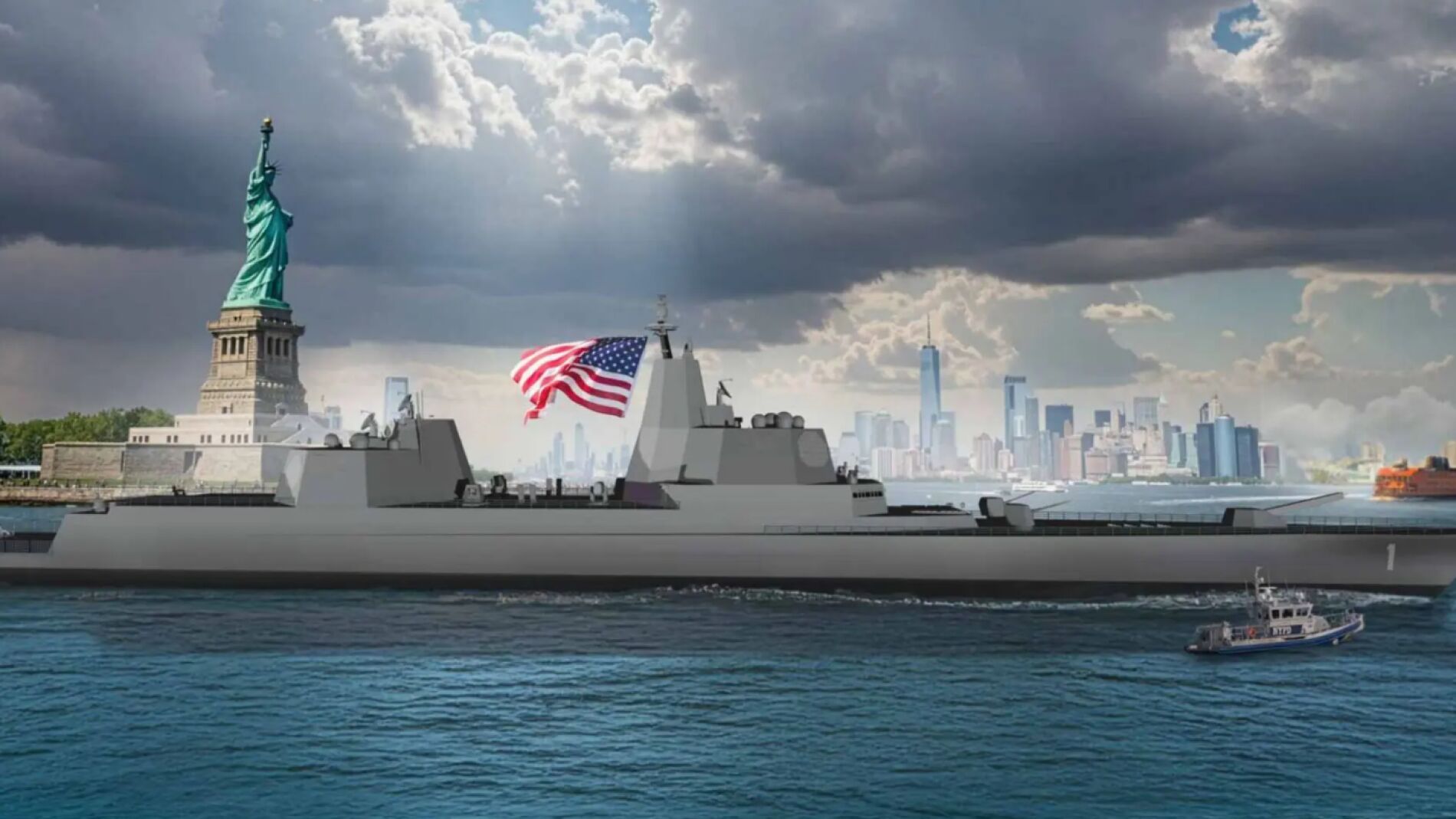
According to concepts published by Naval Sea Systems Command and the US Naval Institute, the long-term vision for the Trump Class program involves constructing 30 of these heavy combatants over a 15-year period.
Naval Sea Systems Command is the organization responsible for engineering, building, and maintaining warships and combat systems for the US Navy, while the US Naval Institute is an independent professional association providing naval analysis.
Advanced command and heavy missile payload
Although the project is occasionally compared to a destroyer, the US Navy naval plan establishes a completely distinct operational category for the Trump Class. The vessel is not intended to replace existing Arleigh Burke-class guided-missile destroyers, which form the backbone of the American surface fleet.
Instead, the ship is designed to function as an advanced command center and a high-capacity launch platform for large quantities of long-range missiles. Its nuclear reactor system would generate the massive electrical output needed for next-generation combat gear, including offensive laser systems and electromagnetic railguns.
Nuclear propulsion represents an unusual choice for a surface combatant. The US Navy has historically restricted nuclear power almost exclusively to its fleet of supercarriers and strategic submarines due to high technical complexity and construction costs.
Dimensions and capabilities of the USS Defiant
The Congressional Budget Office analyzed the design specifications for the lead ship of the project, designated as the USS Defiant. Under the study published by the nonpartisan legislative oversight agency, the vessel would far surpass any current destroyer in service.
With a planned displacement of up to 41,000 tons and an overall length of around 268 meters, the USS Defiant would rival the physical dimensions of light aircraft carriers. Its displacement would be more than four times the approximately 10,000 tons of an Arleigh Burke destroyer and more than double that of a Zumwalt-class stealth destroyer.
Naval planners designed the immense internal hull volume for tactical flexibility rather than mere scale. The expanded capacity allows the warship to house larger inventories of long-range missiles, advanced radar arrays, digital sensors, and electronic warfare suites, while preserving dedicated space for modular technologies currently under development.
Controversial fleet costs and shipyard constraints
The futuristic design and unprecedented scale of the program have triggered substantial controversy over its financial viability. Estimates produced by the Congressional Budget Office indicate that acquiring a fleet of 15 Trump Class vessels could cost up to $275 billion, nearly double the early internal estimates prepared by the US Navy.
Building the lead vessel USS Defiant alone is projected to cost approximately $23 billion. That figure exceeds the total annual national defense budget of numerous sovereign countries.
Beyond monetary expense, analysts at the budget office warned that domestic shipyards would need to undertake major industrial expansions to build vessels of this size. Furthermore, the naval nuclear manufacturing infrastructure is already operating near maximum capacity due to simultaneous construction commitments for strategic ballistic missile submarines and Ford-class aircraft carriers.
Drones and the strategic super-battleship debate
The proposal has reignited a fundamental debate over warship design in an era dominated by uncrewed systems, hypersonic missiles, and long-range precision strikes. Critics question whether concentrating immense firepower into a single super-battleship remains sound naval doctrine.
Supporters of the Defiant model maintain that a ship of 41,000 tons can carry unprecedented missile volume, absorb significant combat damage, and deliver the electrical power required to operate advanced directed-energy weapons expected to define future ocean warfare.
Opponents contend that consolidating so much military value into one platform creates an unacceptably high risk. They argue that a multi-billion-dollar ship would instantly become a primary target for adversary drone swarms and high-speed hypersonic missiles.
Historical parallels and changing naval doctrine
During much of the 20th century, heavily armored battleships represented the ultimate expression of naval strength, firing artillery shells weighing over a ton across vast distances. The historical peak of battleship construction occurred with Japan's flagship Yamato, commissioned in 1941 with a full-load displacement of 72,000 tons, before carrier-based naval aviation and guided missiles rendered massive gun platforms obsolete.
For decades following World War II, US naval strategy prioritized building larger numbers of versatile, medium-sized surface combatants. The Trump Class marks a potential shift back toward concentrating firepower on a small number of massive surface platforms equipped with hundreds of digital missile cells and directed-energy weapons rather than heavy naval guns.
Whether or not the Trump Class moves into full production, the project highlights an ongoing strategic question for modern militaries: how surface warships must evolve as control of the seas moves away from traditional naval guns and toward integrated electronics, autonomous swarms, and long-range missile platforms.