Mainland Spain will experience its first total solar eclipse in 114 years on August 12, marking an event that no living peninsular resident has ever witnessed in the country.
The oldest living person in Spain, Teresa Fernández Casado, is currently slightly over 113 years old. Because the last total solar eclipse on the Spanish mainland occurred more than a century ago, ten out of ten peninsular Spaniards will be watching their first total eclipse of the Sun.
Unlike space exploration milestones such as the Orion capsule orbiting the Moon during NASA's Artemis mission, observers across Spain will be able to watch the event directly from the ground without telescopes or binoculars.
Thirteen government ministries are coordinating public safety and logistics for the event, which is expected to gather millions of people in sparsely populated rural regions known as empty Spain. The State Meteorological Agency, known as AEMET, has published specialized weather forecasts for the day, while transport officials monitor expected road traffic.
Orbital tilt and solar alignment
The Moon completes a full orbit around Earth approximately every 27 days. While that timing might suggest a solar eclipse should occur every month, the lunar orbit is tilted by about five degrees relative to the plane in which Earth orbits the Sun.
Because of that slight angle, the Moon usually passes slightly above or slightly below the Sun from the perspective of observers on Earth. A solar eclipse takes place only when a new moon coincides with one of the two intersection points where both orbital planes cross, known as nodes. As a result, Earth experiences between two and five solar eclipses each year, with most being partial eclipses.
Dangers of using telescopes with eclipse glasses
Certified eclipse glasses are manufactured for direct solar viewing with the naked eye, but safety guidelines state they must never be worn while looking through the eyepiece of a telescope or binoculars. Optical devices concentrate enormous amounts of light and heat into a focused point, functioning in the same manner as a magnifying glass lighting paper.
That concentrated thermal energy can damage or destroy a glasses filter within seconds. If a filter ruptures while an observer looks through the eyepiece, intense solar radiation enters the eye directly, causing potential vision loss. Solar filters intended for optical instruments must always be mounted in front of the objective lens rather than behind the eyepiece.
How Christopher Columbus used an eclipse in Jamaica
Astronomical records have influenced major historical events. In 1504, during his fourth voyage across the Atlantic Ocean, Italian navigator Christopher Columbus became stranded on the island of Jamaica when his ships were rendered unusable.
Relations between the Spanish crew and the indigenous population deteriorated rapidly, leading local inhabitants to stop providing food to the expedition. Columbus consulted an astronomical almanac that listed an upcoming total lunar eclipse.
He warned the local population that his God would remove the Moon from the sky as punishment if they continued to withhold assistance. When the lunar eclipse began, the local inhabitants immediately offered aid. Shortly before the eclipse ended, Columbus announced that God had accepted their apology, and the Moon regained its light as food supplies resumed.
The mystery of solar corona temperatures
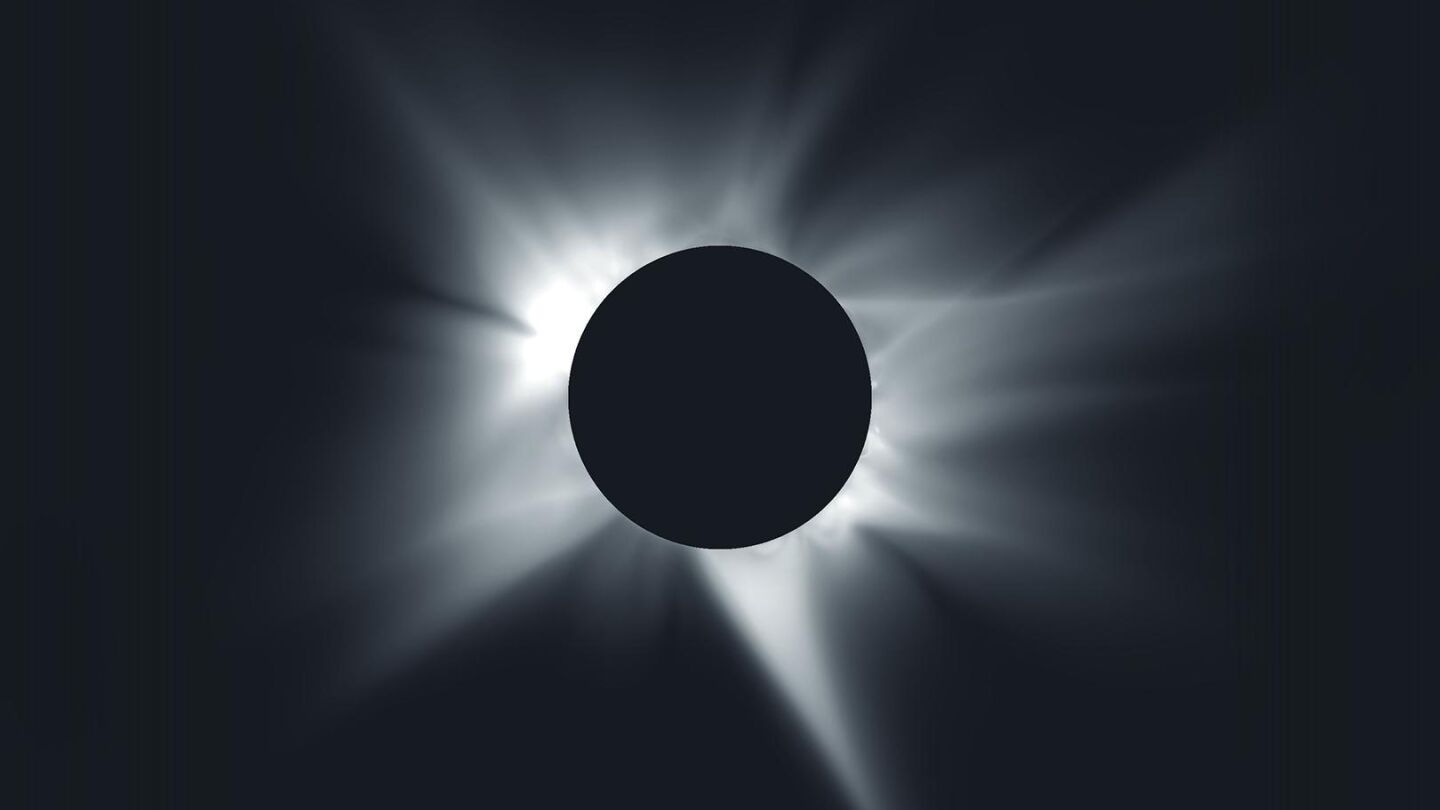
During totality, observers can view the Sun's outermost atmosphere, known as the corona. The corona remains invisible under normal daylight conditions because it is obscured by the intense brightness of the photosphere.
While the visible surface of the Sun maintains a temperature of approximately 5,500 degrees Celsius, the corona reaches temperatures between one million and several million degrees. Astrophysicists spent decades investigating how an outer atmospheric layer could be drastically hotter than the solar surface. Leading scientific hypotheses suggest the heating mechanism involves complex processes related to the solar magnetic field and plasma waves.
Matching apparent sizes in the sky
Total solar eclipses occur on Earth due to a rare astronomical alignment. The Sun has a diameter roughly 400 times larger than that of the Moon, but it is also situated approximately 400 times farther away from Earth.
This spatial relationship causes both celestial bodies to present virtually the same apparent size in the sky, enabling the Moon to cover the solar disc completely. However, this phenomenon has an expiration date. The Moon moves away from Earth at a rate of about 3.8 centimetres each year, meaning total solar eclipses will no longer occur in hundreds of millions of years.
Viewing guidance for totality
Astronomical experts emphasize that a partial eclipse covering 99.9 percent of the Sun does not compare to the experience inside the path of totality on August 12. Spectators intending to travel should leave early and exercise caution, as highways leading into the viewing zone could become saturated.
Positioning closer to the central line of the path of totality increases the duration of the total eclipse, providing the longest possible view of the solar event.