

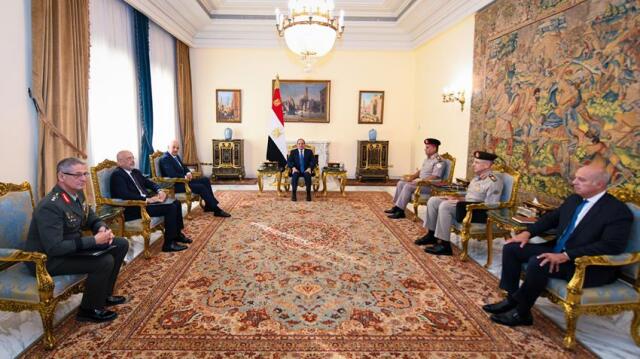
Greek Defence Minister Nikos Dendias met Egyptian President Abdel Fattah al-Sisi in Cairo to reinforce defense cooperation and address security challenges.
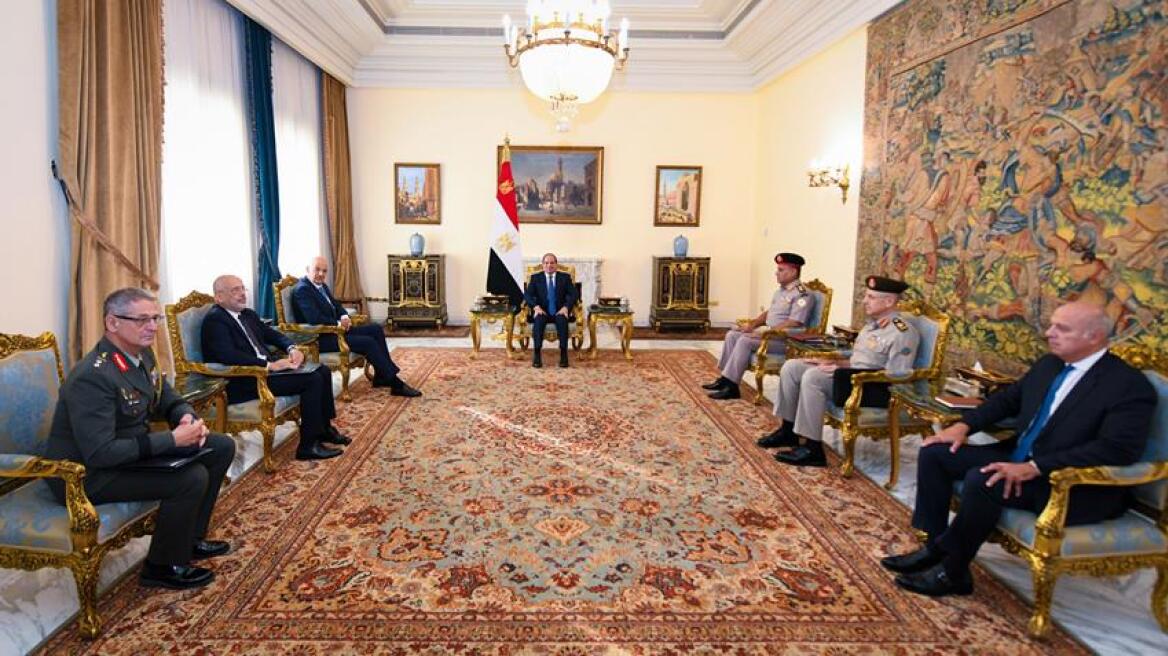
The meeting highlighted the strategic partnership between Athens and Cairo, focusing on expanding joint military initiatives, curbing irregular migration, and combating regional terrorism.
High-level military and diplomatic officials from both nations attended the talks in the Egyptian capital. The Egyptian delegation included Lieutenant General Ashraf Salem Zaher, Chief of Staff of the Egyptian Armed Forces and Minister of Defence and Military Production, alongside Major General Mohamed Adli Abdel Wahed Soliman, Head of the Armament Authority of the Egyptian Armed Forces.
Greece was represented alongside Dendias by Nikolaos Papageorgiou, the Greek ambassador to Cairo, and Major General Ioannis Kouris, Director of the International Relations and Military Strategy Directorate of the Hellenic National Defence General Staff.
Strategic partnership and military cooperation
President al-Sisi welcomed Dendias to Cairo and described the relationship between Greece and Egypt as a pivotal strategic partnership. He emphasized the necessity of deepening bilateral cooperation across multiple sectors, placing particular focus on military and defense collaboration to benefit the people of both nations.
During the discussion, al-Sisi asked the Greek defense minister to convey his personal greetings to Greek Prime Minister Kyriakos Mitsotakis, reaffirming the close ties between the executive leadership of both countries.
Dendias expressed satisfaction with his trip to Egypt and formally delivered greetings from Prime Minister Mitsotakis to the Egyptian president. He underlined that Athens places high value on the historical depth and long tradition of relations connecting Greece and Egypt.
Addressing common security threats, Dendias confirmed the commitment of Athens to strengthen operational coordination with Cairo. He specifically noted ongoing joint efforts to combat terrorism and tackle irregular migration across the Mediterranean basin.
The Greek defense minister expressed formal appreciation for Egypt's pivotal contribution to reducing irregular migration flows toward Europe, recognizing Cairo as an indispensable partner in regional border management.
Trilateral alignment in the Eastern Mediterranean
The leaders also reviewed the trilateral cooperation framework linking Greece, Egypt, and Cyprus. President al-Sisi stated that the tripartite alliance has developed into a successful model for regional coordination aimed at consolidating peace, stability, and mutual economic prosperity across the Eastern Mediterranean.

The Egyptian president stressed the importance of further enhancing trilateral alignment to tackle shared geopolitical challenges while driving sustainable development for all three participating states.
Background on regional security and maritime cooperation
Greece and Egypt have steadily expanded their strategic defense ties in recent years, highlighted by a landmark maritime boundary agreement signed in 2020 that defined exclusive economic zones in the Eastern Mediterranean. Both governments view close security cooperation as essential for maintaining maritime stability, safeguarding offshore energy infrastructure, and balancing regional diplomatic relations.
Egypt plays a central role in Mediterranean migration control, serving as a critical buffer along North African sea routes where European authorities rely on Cairo to prevent irregular departures. In parallel, Egyptian security forces continue extensive counter-terrorism operations, making intelligence sharing and military coordination with Greece a key component of regional defense strategy.
The trilateral alliance between Greece, Egypt, and Cyprus was established to advance energy projects, maritime security dialogues, and defense cooperation across the Levant. Delegations from the Hellenic National Defence General Staff and the Egyptian Armed Forces regularly organize combined military exercises in the Aegean and Eastern Mediterranean, strengthening operational interoperability between the allied forces.


