

The Greek government has launched a dual effort to extinguish remaining wildfire flare-ups in Western Attica while accelerating flood prevention works before autumn rains arrive.
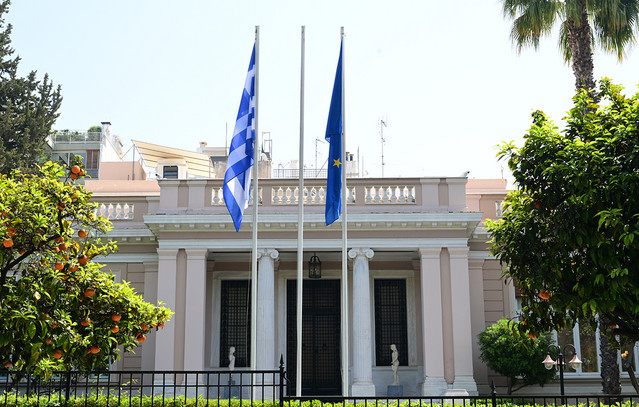
Prime Minister Kyriakos Mitsotakis will chair an interministerial meeting at the Maximos Mansion in Athens at 11 a.m. on Wednesday to coordinate damage restoration and accelerate financial compensation payouts for affected citizens, farmers, and businesses.
State aid measures came into effect on Monday as emergency crews remain on high alert across damaged areas. Government officials noted that extinguishing every active flame will not eliminate danger, as defoliated hillsides present an immediate risk of soil erosion and severe flooding when seasonal rains begin.
Authorities have already begun damage mapping and environmental assessments across burned areas in Western Attica and neighboring Boeotia. Priority is being assigned to high-slope mountainous terrain situated directly above residential communities, roads, and key infrastructure.
Review of firefighting operations
Alongside emergency recovery planning, government officials are evaluating the operational response of the national fire service during the recent blazes. Fierce gale-force winds severely restricted the deployment of firefighting aircraft, preventing airplanes from safely executing water drops or scooping water from the sea.
Helicopters continued to fly under extraordinarily difficult conditions throughout the emergency. Officials confirmed that a fatal collision between two firefighting helicopters, which resulted in the loss of two human lives, is currently under formal investigation as part of the operational review.
The restrictions on aerial support proved particularly critical during the wildfire at Porto Germeno, a coastal town in Western Attica, where fire fronts moved rapidly through steep, inaccessible woodland. With fire engines unable to reach the terrain, the burden of containment fell almost entirely on specialized ground crews and forest firefighters working through dense smoke and sudden wind shifts.
Reflecting on the challenges facing emergency responders, Prime Minister Mitsotakis stated in a public post on Sunday that extreme weather events can overwhelm human planning and operational capabilities. Mitsotakis received detailed updates during multiple visits to the Civil Protection Operations Coordination Center, where officials explained that tactical plans proven effective earlier in the fire season could not be fully executed with aircraft grounded.
The ongoing review is focusing on how command structures adapt when aerial support is compromised by weather. Future planning will emphasize faster ground force deployment, improved access to rugged terrain, rapid creation of defensive firebreaks, and closer coordination with municipal authorities who possess detailed knowledge of local road and forestry networks.
Government sources reaffirmed that protecting human life remains the absolute priority of emergency operations, followed by safeguarding private property and preserving the natural environment. This hierarchy guided critical decision-making during the emergency, including mass evacuation alerts sent via the 112 mobile emergency notification system and door-to-door checks conducted by police officers to confirm residents had evacuated vulnerable areas.
Political debate and fire season readiness
The Maximos Mansion has firmly rejected criticism from opposition parties alleging inadequate seasonal preparation. Government officials pointed to significant investments in Civil Protection in recent years, including an expanded aerial fleet, increased hiring of specialized forest firefighters, the creation of dedicated forestry units, and expanded deployment of early-detection technologies.
Ministers stressed that extreme weather does not invalidate prior planning but highlights how rapidly field conditions can shift during severe events. With August only on its fifth day, officials warned that the risk of further heatwaves and high winds requires firefighting forces to maintain total readiness throughout the remainder of the summer.
The government intends to conduct a detailed post-action review of every major fire front across the country. Data gathered from these investigations will be integrated into updated operational protocols for the rest of the fire season to address operational gaps exposed by recent extreme weather.
Flood prevention and soil conservation
The secondary focus of government planning centers on protecting scorched terrain in Attica and Boeotia from upcoming seasonal rains. Initial discussions regarding post-fire engineering interventions began on Sunday morning during the prime minister's visit to the Civil Protection control center.
The destruction of forest canopy and ground vegetation has exposed vast expanses of soil stripped of roots that naturally bind earth and absorb rainfall. When autumn downpours occur, surface runoff will surge rapidly down bare slopes, carrying soil, rock, and burned debris into stream beds and lower-lying communities.
Engineering and forestry services are mapping damage intensity to prioritize interventions based on terrain risk. Steep slopes situated above populated centers will receive immediate attention, while flat areas far from settlements represent lower risk. Planned works include soil-retention structures, debris barriers, stream bed clearing, and minor technical engineering projects to maintain uninterrupted water flow.
Officials are drawing on lessons learned from the catastrophic 2021 wildfires in Northern Evia, where extensive anti-erosion and flood mitigation projects were successfully deployed across entire river basins. Experience from Evia demonstrated how burned timber can be repurposed on site to build log barriers that stabilize topsoil quickly before heavy rains begin.
While the Northern Evia framework serves as a strategic guide, officials emphasized that interventions in Attica and Boeotia will be tailored specifically to local topography. Regional authorities, municipal councils, forestry departments, and technical services are working to streamline approvals and project timelines, establishing a first line of defense before autumn storms prior to launching long-term environmental restoration efforts.


