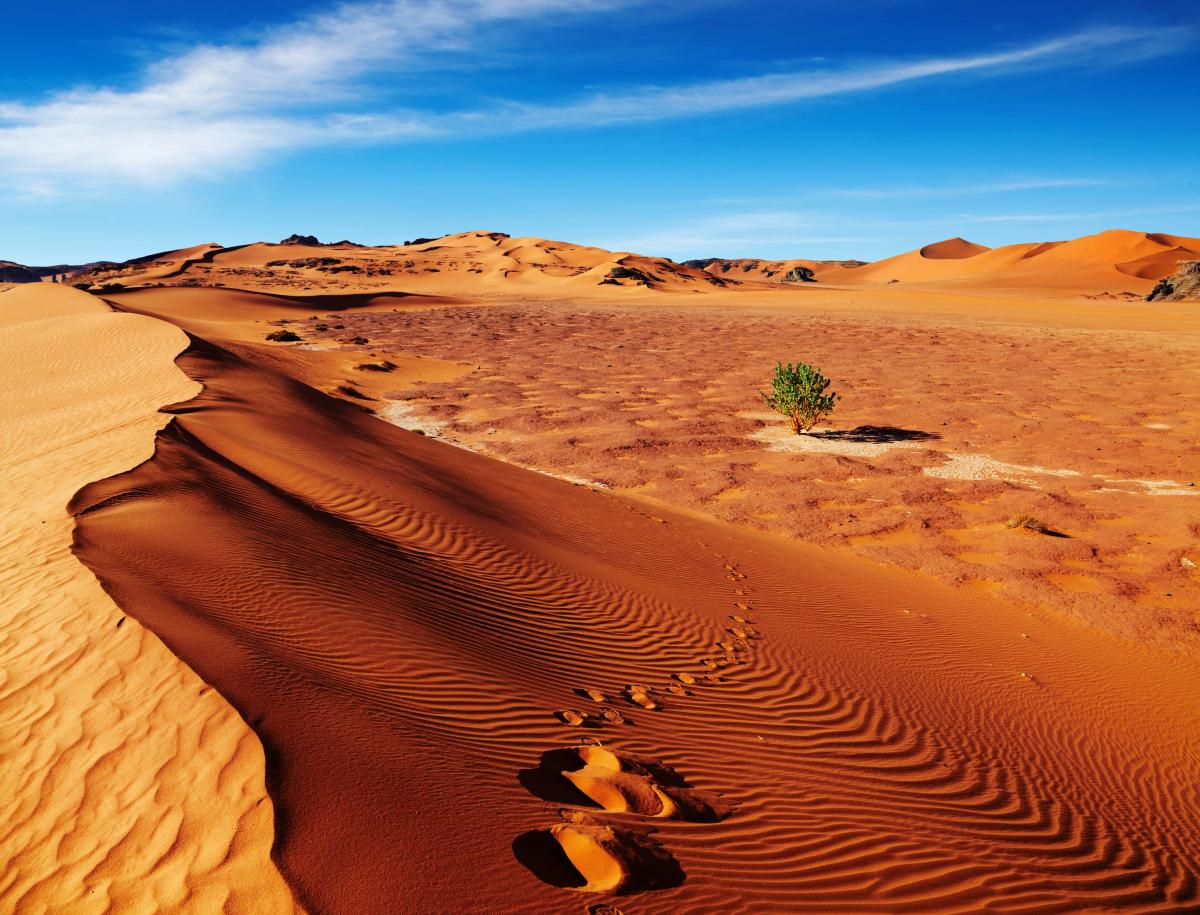
Water rippled across lakes and rivers where the sands of the Sahara now stretch 6,000 years ago, as hippopotamuses grazed and herders drove livestock across a lush savanna, according to a report by Science Blog.
The transformation of the world's largest hot desert was driven by periodic changes in the orbit of Earth, leaving behind lake sediments, ancient DNA, and more than 15,000 prehistoric rock carvings that document a green landscape.
Scientists estimate that the period known as the Green Sahara lasted from roughly 11,000 to 5,000 years ago. During this era, monsoon rains pushed much farther north than their present boundaries, transforming the expanse from Libya to Mali into wooded savannas, seasonal wetlands, and an extensive network of rivers and lakes.
Geological and biological evidence provides a complete picture of the ancient ecosystem. Marine sediments recovered off the coast of West Africa recorded a sharp drop in wind-blown dust from the continent, proving that dense plant life covered the soil instead of arid sand.
Layers of sediment at the bottom of dried lakes retained pollen from grasses and trees that cannot survive in the modern dry climate. In addition, dried riverbeds, known as wadis, contained the fossilised remains of hippopotamuses and crocodiles.
Orbital cycles behind the greening
Researchers have determined that the greening of the Sahara was a recurring phenomenon. Scientists have counted more than 230 green episodes over the past eight million years, repeating approximately every 21,000 years.
The periodic transformation was driven by Milankovitch cycles, specifically the precession or slow wobble of the axis of Earth. Every 21,000 years, this axial movement brings the Northern Hemisphere closer to the Sun during the summer months.
Warmer summer air absorbs greater moisture, which intensifies the West African monsoon and shifts the rain belt northward, bringing lush vegetation across the region.
A second condition was required for the greening to occur. The wet phases never coincided with glacial epochs, when massive ice sheets cooled the atmosphere and blocked seasonal monsoon rains, meaning the shape of Earth's orbit strictly regulated the conditions for plant growth.
Prehistoric rock art and population isolation
Prehistoric rock paintings on the mountain plateau of Tassili n'Ajjer preserve a visual record of ancient wildlife and human activity, depicting hunters, figures in festive clothing, and livestock herders. Tassili n'Ajjer is a mountain range in the Sahara Desert known for its ancient artwork.
The sequence of the artwork demonstrates how hunting activities were gradually replaced by cattle herding as local populations domesticated animals.
The genetic origin of these ancient communities remained unknown for decades because intense heat rapidly degrades ancient DNA. A breakthrough occurred in 2025 when a research team led by Nada Salem from the Max Planck Institute for Evolutionary Anthropology decoded the first complete genomes of Green Sahara inhabitants.
The Max Planck Institute for Evolutionary Anthropology, based in Leipzig, Germany, specializes in ancient genetic research. Salem's team extracted DNA from two individuals buried in the Takarkori rock shelter in south-western Libya roughly 7,000 years ago.
The genetic analysis showed that the buried individuals belonged to an indigenous North African lineage that had lived in isolation from populations in southern Africa for thousands of years. The discovery disproved a long-held hypothesis that the Sahara functioned as an open migration corridor where human groups freely mixed.
Abrupt climate collapse and human impact
Researchers were struck by the speed of the ecological collapse. The transition from a fertile savanna into a dry desert occurred rapidly within the span of a few generations rather than over thousands of years.
The collapse was triggered by an irreversible chain reaction. As orbital summer heating began to weaken, the monsoon system retreated southward.
Vegetation died off as rainfall declined, exposing bare soil that reflected more solar radiation and held less moisture. This land surface change further weakened the monsoon rains, starving the region of water.
The role of human activity in the crisis remains a subject of scientific debate. In 2017, archaeologist David Wright argued that early livestock herders accelerated desertification by burning grass and overgrazing pastureland.
Conversely, a 2018 study published in the journal Nature Communications concluded that controlled livestock herding actually slowed the collapse of the ecosystem. Leading specialists now agree that orbital mechanics were the primary cause of the collapse, with human influence playing a minor secondary role.
Future climate outlook and ocean reptile discovery
Satellite monitoring has recently recorded localized increases in vegetation along the southern margin of the desert in the Sahel region, while climate models suggest global warming could increase rainfall. The Sahel is the semi-arid transition zone directly south of the Sahara.
Specialists emphasize that these modern changes represent short-term local fluctuations rather than a revival of the green ecosystem. A full return of the Green Sahara will only occur when long-term cosmic cycles align in the distant future.
The report also detailed a separate paleontological discovery involving an ancient fossil found 9,000 kilometres from its original habitat. Paleontologists identified a new species of ichthyosaur, named Jabalisaurus tethyensis, which had been misclassified in German museum collections for more than a century.
Ichthyosaurs were large prehistoric marine reptiles that inhabited ancient oceans. The nearest known relatives of Jabalisaurus tethyensis were found in Mexico, proving that these marine reptiles ranged much farther across the prehistoric Tethys Ocean than scientists previously believed.