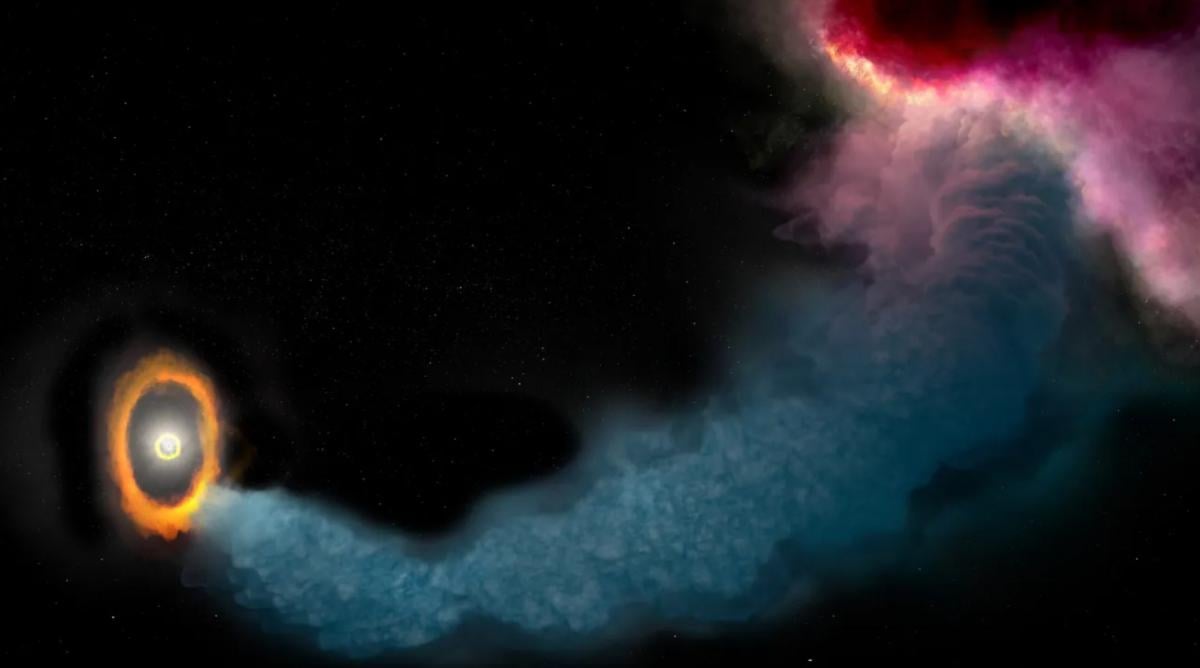
A vast stream of cosmic gas stretching between 1.6 trillion and 1.9 trillion kilometres has shifted the orientation of matter around a triple star system in the constellation of Orion, according to a report by g4media.ro.
The discovery was made using the Atacama Large Millimeter/submillimeter Array (ALMA) radio observatory in Chile. Scientists said the interaction could help explain why some distant exoplanets orbit their host stars on sharply tilted planes.
The system, known as GW Orion, is located approximately 1,300 light-years from Earth in the constellation of Orion. It consists of three very young stars in the process of formation, surrounded by a broad protoplanetary disk of gas and dust from which new planets can form.
GW Orion is unusual because its planet-forming disk is split into three separate rings. These rings sit at radii of 6.7 billion, 28 billion, and 51 billion kilometres from the system center. Previous studies revealed that the inner, middle, and outer rings are misaligned, with each ring tilted at a different angle relative to the others.
Origins of ring misalignment
Astronomers previously hypothesized that a massive object, such as an undiscovered gas giant planet, might have created the gaps between the rings and disrupted their alignment. However, new radio observations indicate a different mechanism is at work.
Researchers identified a huge cosmic gas flow originating from a surrounding molecular cloud and extending into the protoplanetary disk. The gas stream spans roughly 0.2 light-years, or about 1.9 trillion kilometres. As the stream feeds into the disk, it interacts directly with the outer ring and alters its angular momentum, modifying the rotational motion of the matter and causing the ring to deform and tilt over time.
Mechanisms behind tilted exoplanet orbits
In the Solar System, planets revolve around the Sun within nearly the same flat plane, known as the ecliptic, aligned closely with the solar equator and the direction of solar rotation. In contrast, astronomers have identified numerous exoplanets with orbits that are steeply inclined or retrograde compared to their parent star rotation.
While the exact processes driving such extreme orbital tilts remain incompletely understood, researchers suggest that gas streams flowing into protoplanetary disks during stellar formation could account for these unusual planetary alignments.
In related astronomical findings noted by the source, scientists previously identified the fastest known star in the Milky Way galaxy. That star orbits the supermassive black hole at the center of the galaxy at approximately 25,000 kilometres per second, moving roughly 100,000 times faster than a commercial aircraft.