Aerospace startup Hop Aero is developing an autonomous container-launched rocket designed to deliver 250 kilograms of urgent cargo across distances of up to 750 kilometers in roughly 15 minutes.
The unmanned vehicle, named Rook, launches directly from a standard 40-foot shipping container, eliminating the requirement for a conventional airfield or runway.
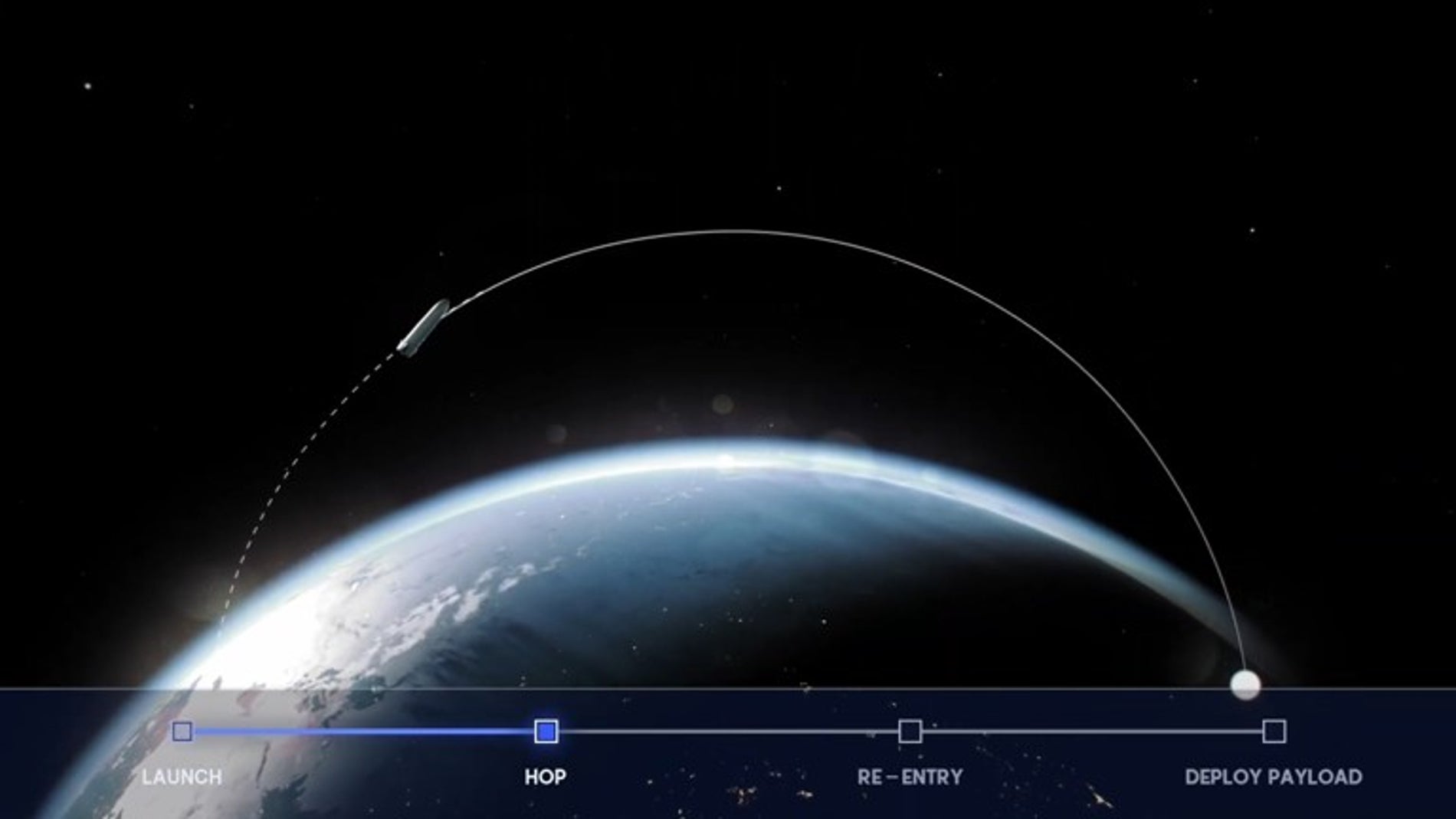
According to Silicon Valley startup accelerator Y Combinator, the rocket ascends into space, re-enters the Earth atmosphere at hypersonic speeds, and executes precise autonomous landings on unprepared terrain.
Hop Aero illustrates the speed of the vehicle by citing a potential flight from Okinawa, Japan, across the East China Sea to Taiwan, a distance of around 750 kilometers that Rook would cover in approximately 15 minutes.
Military contract and battlefield deployment
The company secured its initial major funding through a 1.25 million dollar contract with the U.S. Air Force, highlighting immediate military interest in rapid point-to-point logistics when no runway is available near the destination.
Chief executive officer Matija Milenovic described the project as building rockets that deliver cargo anywhere on Earth in minutes, including active battlefields.
Milenovic also outlined plans to deploy unmanned systems directly to combat zones, with Rook completing the flight and landing autonomously.
Container launch and propulsion testing
Rook operates autonomously using hopOS, a proprietary control system developed by Hop Aero to manage flight navigation and engine operations.
Engineers at the company have already used hopOS to perform initial test firings of both the rocket engine and its ignition system.
Hop Aero has also completed its first physical tethered test at the Oklahoma Air and Space Port in Burns Flat, Oklahoma, marking an initial hardware milestone, although extensive flight testing remains ahead.
By launching directly out of a standard 40-foot intermodal freight container, the system avoids specialized launchpad infrastructure and can be transported using standard commercial freight networks.
Preventing multi-million dollar industrial delays
Hop Aero is positioning Rook for emergency logistics where waiting several hours for conventional transport costs significantly more than the flight itself.
The system is designed for regional cargo movement spanning hundreds of kilometers, distinguishing it from last-mile delivery concepts like Amazon testing electric bicycles or humanoid robots to drop packages at consumer doorsteps.
According to Hop Aero calculations, supply chain disruptions can cost up to 2 million dollars per hour in downtime for manufacturing, automotive, aerospace, offshore oil, and pharmaceutical operations when vital components fail to arrive on time.
By bypassing traditional airport handling, runway congestion, and cargo transfers, Rook is intended to deliver emergency spare parts directly to industrial sites or offshore facilities.
Space logistics origin story
The concept for Rook emerged after Milenovic was forced to personally carry satellite hardware aboard a commercial flight.
During his return flight, he concluded that existing aviation networks were inefficient for urgent component transport and began designing a rocket-based alternative.
Milenovic previously founded porkchop, a space propulsion company focused on electric thrusters for small satellites.
He stated that he built a prospective sales pipeline exceeding 400 million dollars at porkchop before selling the company's intellectual property assets.
Milenovic subsequently worked on supersonic aerial vehicles and increased loitering munition production in Ukraine from 10 units per month to more than 100 units per month.
Veteran aerospace leadership
Hop Aero's chief technology officer, identified as Jacob, brings extensive experience from military service and commercial rocket developments.
Jacob served in the U.S. Marine Corps before taking technical roles at SpaceX, Virgin Orbit, Masten Space Systems, and SpinLaunch.
During his time at SpaceX, Jacob worked on the Falcon 9 and Falcon Heavy launch vehicles and created the original booster refurbishment program that enabled routine rocket reusability.
Together, the founders combine direct background in operational rocketry, defense logistics, and hypersonic flight systems as they move Rook toward full operational flight testing.