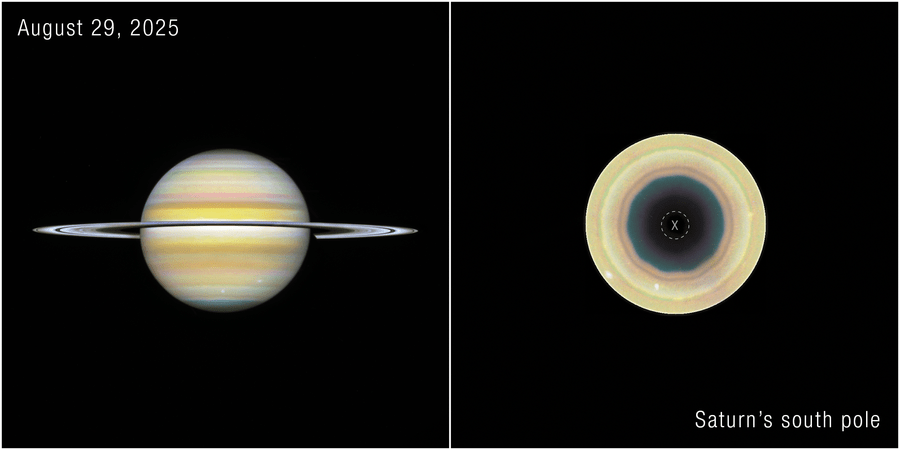
NASA's Hubble Space Telescope has revealed a giant, evolving 10-sided atmospheric wave encircling Saturn's south pole, according to a study published Wednesday in the journal Science Advances. The structure is not a shallow, surface-level feature but extends vertically through multiple layers of the giant planet's atmosphere.
It is the first time a regular jet pattern with defined sides has been observed in Saturn's southern hemisphere. The shape resembles Saturn's famous hexagon-shaped jet stream at the north pole, but researchers say the new decagon is distinctly different, suggesting scientists may be watching the birth of an entirely new atmospheric phenomenon.
A pattern unlike the familiar northern hexagon
Saturn's north polar hexagon is one of the solar system's most recognizable weather features, a six-sided jet stream that has persisted around the planet's north pole for decades. Its apparent symmetry with the newly spotted southern feature had led astronomers to search for a southern counterpart for years.
The study's co-author and principal investigator of the Hubble program that captured the images said she had never seen anything like it in the southern hemisphere. She said the northern hexagon has been present every time it has been observed over more than 40 years, but that this new formation is different and appears to be intensifying, giving scientists a rare chance to watch a giant atmospheric pattern develop in real time.
Years of Hubble observations made the discovery possible
The observations were made as part of Hubble's Outer Planet Atmospheres Legacy (OPAL) program, which has photographed the solar system's outer planets every year for more than a decade.
Co-author Mike Wong highlighted the program's key role in the discovery. Rather than simply capturing isolated snapshots at a single moment, he said, OPAL allows scientists to track the evolution of both short-lived storms and phenomena that unfold over long timescales. He said the consistency of these observations year after year is what makes major, unexpected discoveries like this one possible.
Ground-based astronomers spotted it first
The discovery was made possible by a change of seasons on Saturn, which exposed the planet's south pole to view from Earth again. The wave was first identified by astronomers who collectively examine ground-based images of Saturn.
The first to notice the anomaly were astronomers Trevor Barry and Jean-Paul Oger, along with researcher Agustin Sanchez-Lavega, the lead author of the new study and a researcher at the University of the Basque Country. The university runs a website called the Virtual Planetary Observatory Laboratory, which collects ground-based images of solar system planets sent in by observers around the world. It was in those images, initially in 2024, that astronomers noticed a subtle, wavy band running along Saturn's south pole.
Confirming the wave with Hubble
To confirm their suspicions, the astronomers needed Hubble. Viewing Saturn from space gives the telescope unmatched image sharpness and spatial resolution across full rotations of the planet, without the blurring caused by Earth's atmosphere.
Sanchez-Lavega said that given the symmetry of Saturn's north-south jet system, scientists had been searching for a counterpart to the north hexagon at the south pole in Hubble images since 1990. He said images from NASA's Cassini probe, which orbited Saturn between 2004 and 2017, had also shown no sign of a long-lasting formation at the south pole. He said Hubble data confirmed the structure had been present through at least 2023.
What happens next
The team will continue observing Saturn to determine whether the decagon settles into a permanent configuration or keeps changing shape. Future observations may also help scientists work out what drives the wave, what it reveals about atmospheric dynamics on giant planets across the solar system, and how such phenomena might relate to weather patterns observed on Earth.