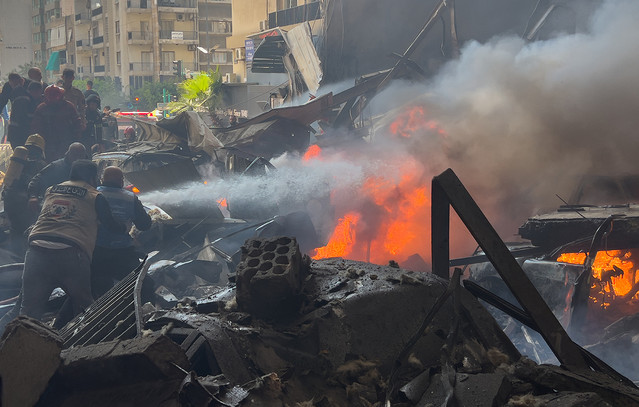
Israeli strikes killed one person and damaged an ambulance in southern Lebanon after targeting rescuers who responded to an initial vehicle attack in Nabatieh. The official Lebanese news agency ANI reported that one of two injured victims died from their wounds following two consecutive strikes. The first strike hit a vehicle in the southern city of Nabatieh.
According to the Lebanese Ministry of Health, the Israeli army then launched a second strike against rescuers from the Risala emergency response organization. Risala is affiliated with the Amal movement, an ally of the Shiite armed movement Hezbollah which is aligned with Iran. Lebanese media reported that emergency workers had rushed to the scene of the first strike when the second attack occurred, damaging their ambulance.
Lebanon's Ministry of Health denounced the attack as a continuation of Israeli forces targeting rescue crews. Beirut reiterated its condemnation of the enemy's continued targeting of rescue teams, calling it an unacceptable violation of international humanitarian law and international rules. The strikes occurred despite a theoretical ceasefire being in place.
Drone Attack and Artillery Fire
In a separate incident in Nabatieh province, Lebanese civil defense announced that a drone targeted one of its workers trying to put out a fire in low vegetation. No workers were injured, but the civil defense team was forced to leave the area. ANI also reported an explosion and Israeli artillery fire in other southern sectors.
Ceasefire Framework and Conflict History
Hezbollah was accused of dragging Lebanon into the Middle East war in March by firing rockets at Israel. The rocket attacks followed the death of Iranian Supreme Leader Ali Khamenei on Feb. 28, the first day of a joint US and Israeli attack on Iran. Israel retaliated with broad airstrikes and a ground invasion of southern Lebanon, which Beirut authorities said killed more than 4,300 people.
Violence eased after the presidents of the United States and Iran signed the Islamabad memorandum of understanding in the middle of June, followed by a framework agreement between Lebanon and Israel. The agreement calls for Hezbollah to disarm, Israeli troops to withdraw gradually from occupied southern areas, and the Lebanese army to deploy starting in pilot zones. However, Hezbollah categorically rejects the agreement and disarming, while Beirut continues to report sporadic Israeli attacks.