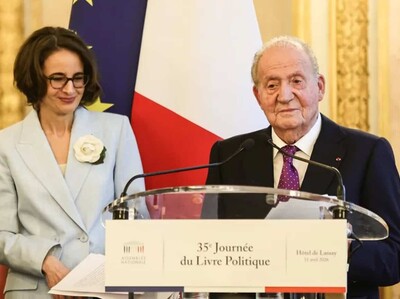
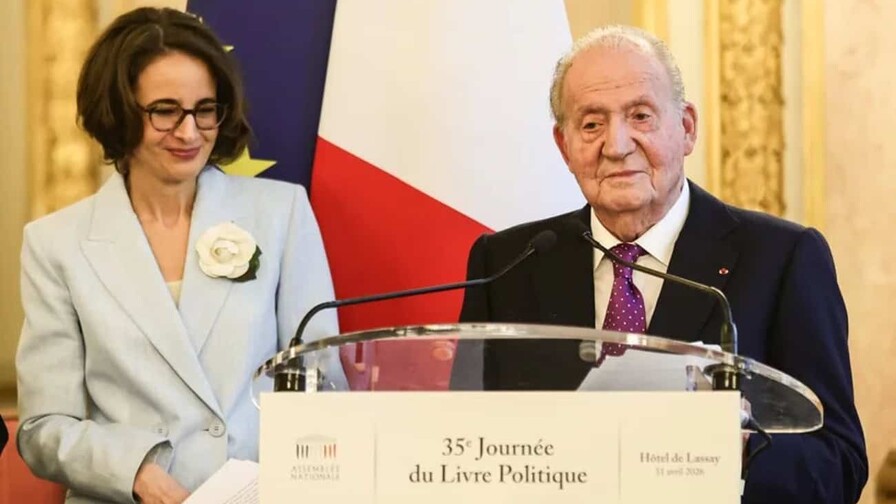
Former King Juan Carlos I of Spain presented his memoirs as a final legacy to the Spanish people on Sunday during an award ceremony in the French town of La Ferté-Vidame.
The 88-year-old former monarch accepted the Saint-Simon Prize for Reconciliation for his book, titled Reconciliación, which he co-wrote with French author Laurence Debray.
Speaking at the ceremony in the department of Eure-et-Loir, about 135 kilometres from Paris, Juan Carlos described his decision to write down his memories as more reckless than prudent. He said that his goal was to record his own version of the truth with authenticity and sincerity, alongside the democratic institutions that he credited with allowing Spaniards to live in peace for the last 50 years.
The former monarch added in a relaxed tone that the award confirmed his place among men who chose to give testimony rather than remain silent, driven by a mission to write for posterity. He joked with attendees that their recognition had invested him as a memoirist king.
Juan Carlos was accompanied at the French ceremony by his eldest daughter, Infanta Elena, as well as his granddaughters Victoria de Marichalar and Irene Urdangarin.
Royal legacy and French literary prize
The Saint-Simon Prize is a notable French literary award named after Louis de Rouvroy, the Duke of Saint-Simon, who was famous for his detailed memoirs of life at the French royal court under King Louis XIV. The prize is presented annually in La Ferté-Vidame, where the Duke wrote much of his historic work at his local estate.
Juan Carlos I reigned as King of Spain for 39 years from November 1975 until his abdication in June 2014 in favour of his son, King Felipe VI. Co-author Laurence Debray is a French writer and historian who previously authored a biography of Juan Carlos and produced a television documentary about his reign.
During his reign, Juan Carlos played a central role in guiding Spain from dictatorship to a constitutional parliamentary monarchy following the death of General Francisco Franco in 1975. In August 2020, six years after his abdication, the former king relocated his residence from Spain to Abu Dhabi in the United Arab Emirates.
His family members at the event included Infanta Elena, Duchess of Lugo, who is the eldest child of Juan Carlos and Queen Sofía. She was joined by her daughter Victoria de Marichalar and her niece Irene Urdangarin, who is the daughter of Infanta Cristina and former handball player Iñaki Urdangarin.
Reflection on reign and personal errors
The presentation of the memoir follows an interview Juan Carlos gave the previous year to French broadcaster France 3 with journalist Stéphane Bern upon the publication of the book. In that broadcast, the former king acknowledged that he committed errors during his nearly four decades on the Spanish throne, but stated that he held no regrets or remorse about his past.
Juan Carlos said during the interview that if he could turn back time, he would act with greater care. He expressed his wish that the Spanish people would understand his actions and forgive him for his mistakes.
Reflecting on his personal life and public duties, the former monarch acknowledged that while he had genuinely served Spain and its citizens, he had sometimes failed to pay sufficient attention to his own family.
During his discussion with Bern, a prominent French broadcaster known for his coverage of European royalty, Juan Carlos addressed his historical role in Spain's transition to democracy. He detailed his complex relationships with Franco, his father Juan de Borbón, the Count of Barcelona, and his son King Felipe VI, while also responding to questions regarding the financial and romantic scandals that marked the final stage of his reign.
When asked directly by the interviewer whether he regretted any of his past actions, the former monarch answered flatly that he did not. Pressed on whether he felt remorse, he replied that he tried not to hold any.