

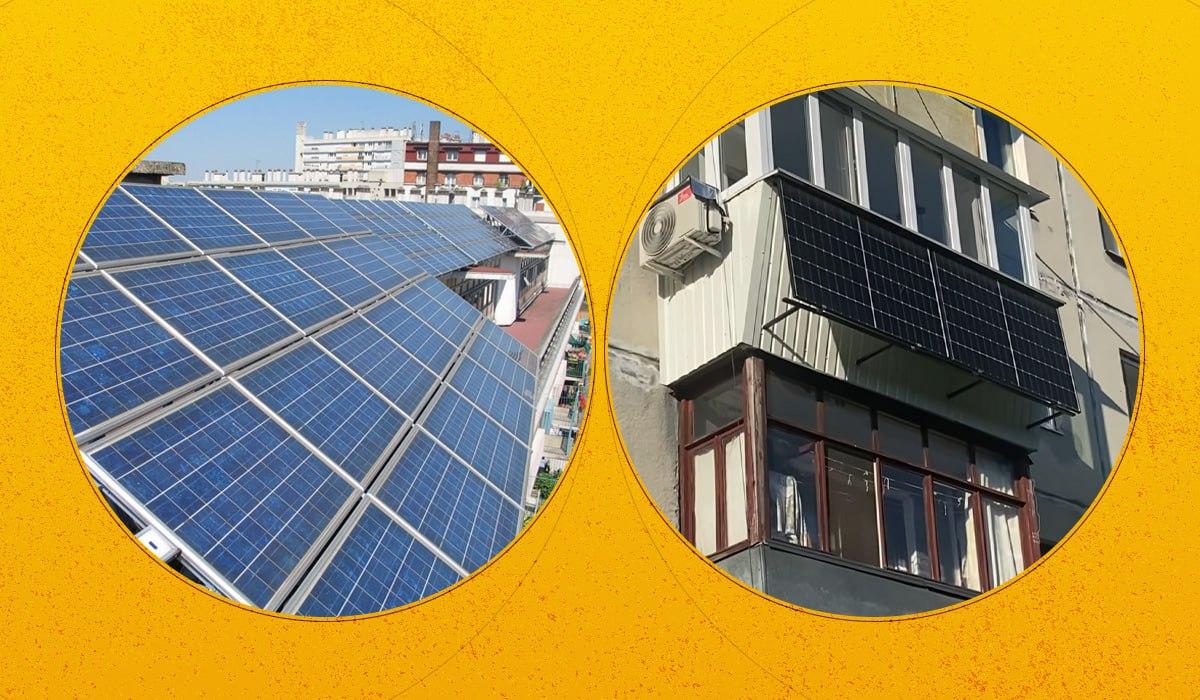
Kyiv apartment owners facing frequent power blackouts can install balcony solar panels, expert Pavlo Kastorskyi of the Solar Energy Association of Ukraine said.
Kastorskyi explained that residents in high-rise buildings have several options ranging from shared rooftop equipment to simple balcony systems, as regular power outages force city dwellers to search for alternative electricity sources.
The simplest option for an individual flat involves placing one or more solar panels on a balcony, connected to a portable charging station or a system with a battery and inverter. Kastorskyi noted that such setups should not be viewed as a full grid replacement for an entire apartment, but they can support basic needs including lighting, Wi-Fi routers, laptops, gadget charging, and select home appliances depending on system capacity.
Compact apartment systems combining an inverter and a battery are becoming increasingly available on the market. Kastorskyi highlighted the FOX ESS Avocado Orbit Master, which offers a base battery capacity of 2.11 kilowatt-hours that can expand up to 10.55 kilowatt-hours. For households requiring higher power consumption, larger configurations like the Avocado feature a 10-kilowatt inverter alongside a 10-kilowatt-hour battery, allowing residents to tailor their backup setup to specific appliances and outage durations.
Balcony and building facade systems equipped with one or two solar panels typically output between 1 and 2 kilowatts. Kastorskyi said these panels generate electricity to recharge battery banks or power stations, which then run essential equipment during blackouts. He cautioned that a few balcony panels cannot fully power a whole apartment, which would require significantly higher capacity.

Rooftop and facade solar options
High-rise residents can also pursue shared solar power stations installed by condominium co-owners associations, known as OSBBs, using shared funds or state support schemes. Under the GreenDIM program run by the Energy Efficiency Fund, OSBBs previously received partial reimbursement for equipment purchase and installation costs. Kastorskyi noted that electricity generated through GreenDIM powered shared building facilities, including stairwell and courtyard lighting, elevators, security cameras, pumps, and gates, rather than supplying individual flats directly.
The GreenDIM program is currently suspended pending additional financing, with no set date for its resumption. Kastorskyi said OSBBs funding solar installations independently without state compensation have greater flexibility, allowing systems to be engineered to supply either shared building needs or individual apartments based on owner budgets and building requirements.
Apartment owners who wish to install solar panels on a shared roof or outer facade for personal use must obtain formal approval from their OSBB. Approval requires a vote in accordance with the association charter and internal procedures, as roofs and building facades constitute shared property. Kastorskyi stated that such installations are technically far more complex than balcony units, requiring assessments of building structural integrity, mounting security, wind resistance, cable layout, and often specialized high-altitude lifting equipment.
Costs and payback periods
Costs for apartment energy systems vary according to performance requirements. A basic setup featuring an inverter and battery without solar panels, providing 1 to 2 kilowatts of output, ranges from 50,000 to 100,000 Ukrainian hryvnias. Kastorskyi compared these entry-level systems to portable power stations, storing grid electricity for use during blackouts. Larger systems rated at 5 kilowatts or higher, capable of meeting a substantial portion of household energy demands, start at 100,000 hryvnias depending on battery capacity and component quality.
Adding two solar panels to a balcony or building facade increases the project cost by approximately 15,000 to 20,000 hryvnias including mounting work. Total expenses rise with additional panels. Kastorskyi pointed out that in high-rise buildings, installation expenses often form a major share of the budget due to the need for specialized lifting platforms, cradles, and certified high-altitude labor.
Evaluating financial payback for a small apartment system comes down to emergency reliability rather than quick monetary returns. Kastorskyi said the main value of an apartment installation lies in maintaining continuous operation for critical devices and indoor lighting during blackout periods.
Kyiv weather conditions and safety rules
Balcony and facade panels in Kyiv produce energy even during overcast winter weather, though generation levels depend heavily on apartment orientation, seasonal changes, and shading from nearby structures or trees. Kastorskyi explained that solar panels perform best on sunny building sides without constant shade, whereas winter days yield significantly reduced output. He advised treating apartment solar panels as a supplementary power source to recharge batteries rather than a full grid substitute, noting that investing heavily in large arrays on heavily shaded balconies is impractical.
Kastorskyi warned against amateur DIY mounting on building exteriors, noting that facade installations present serious safety hazards if mismanaged. Even for one or two panels, high-altitude mounting must be performed by experienced technicians while securing a safe perimeter on the ground to protect pedestrians below. Outer panels require secure structural mountings, precise facade fittings, and safe electrical connections.
The expert recommended that flat owners first evaluate their emergency backup needs and purchase a suitable battery and inverter system, before consulting specialists about adding solar panels. Kastorskyi serves as key account manager at solar company iSolar and is a member of the Solar Energy Association of Ukraine, an industry organization representing solar sector professionals across the country.


