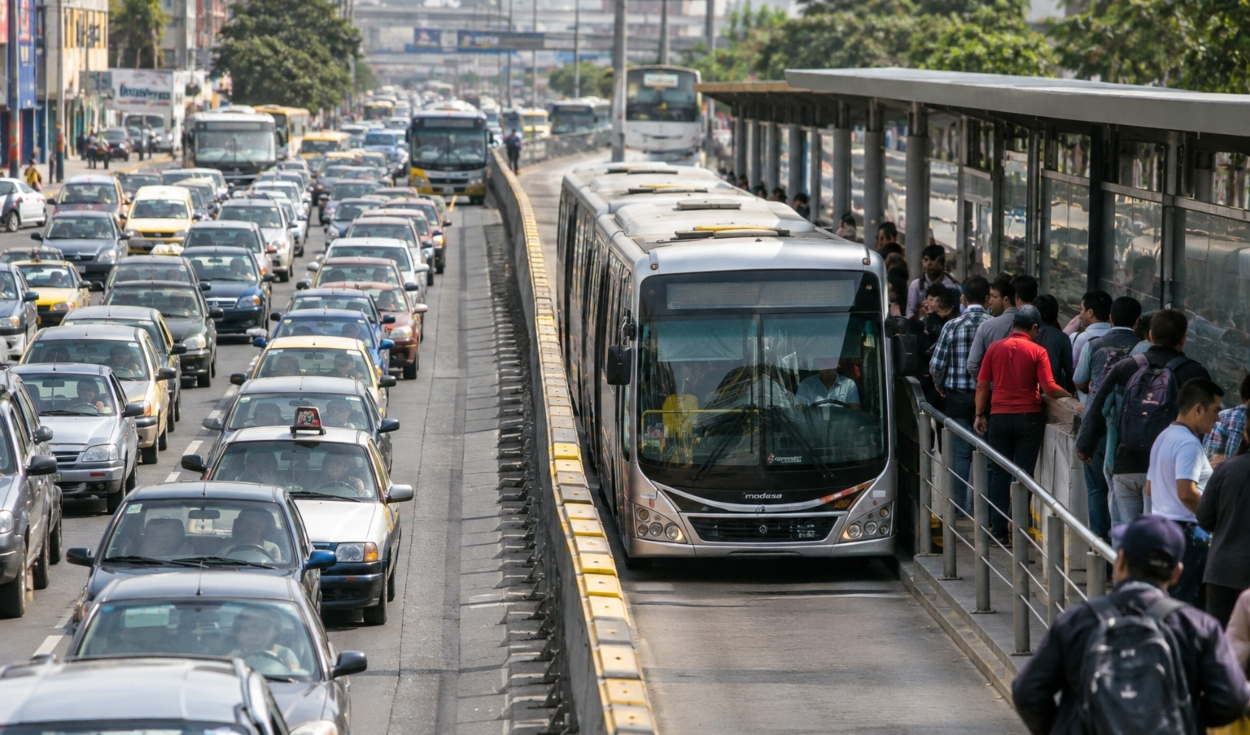
Urban transport in Lima and Callao is undermining Peru's economy, as congestion, informality and delays in mass-transit projects push up travel times and costs for workers and businesses, according to urban mobility specialists.
Millions of commuters spend hours each day on buses, minivans or taxis to reach their jobs, and specialists warn that the cost of failing to invest in mass-transit infrastructure in time could end up far higher than the cost of building new metro lines or expanding existing systems.
The warning came in the latest episode of a podcast produced by the Instituto Peruano de Economía (Peruvian Economic Institute, IPE), featuring David Hernández, chairman of the governing board of the Autoridad de Transporte Urbano para Lima y Callao (Urban Transport Authority for Lima and Callao, ATU), and Roberto Vélez, general manager of the Asociación A Movernos, a transport industry group.
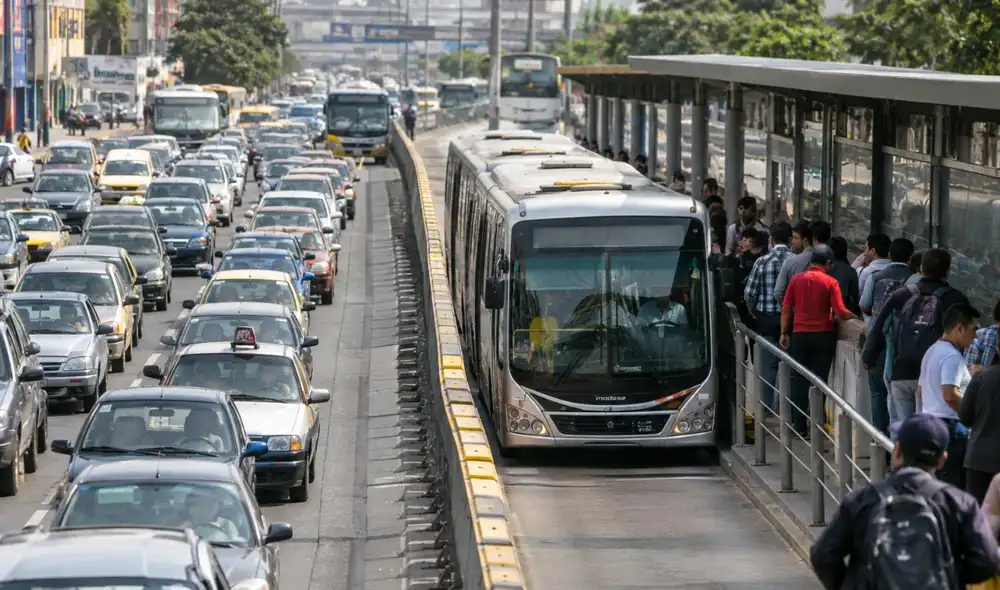
Both agreed that the problems facing the Metropolitano bus rapid transit system and its feeder corridors go beyond a shortage of buses or infrastructure, pointing also to management shortcomings and persistent informality in public transport.
The cost of delay
Hernández said a metro line could require an investment of close to $10 billion, but that the economic losses from not having that infrastructure could grow even larger over time.
The warning matters in a city where travel time has become an economic problem. According to the World Bank, cities with inefficient transport systems see productivity fall because of longer travel times, higher fuel consumption and pollution.
Commutes of more than 90 minutes
The Lima Cómo Vamos survey has found in its most recent reports that a significant share of Lima residents spend more than 90 minutes a day travelling between home and work or school. In some outlying districts, one-way trips exceed two hours.
That leaves less time for work, study, rest or family life, and it raises transport costs for households, particularly lower-income ones that tend to live farther from major job centers.
The Organisation for Economic Co-operation and Development (OECD) has said in studies on urban mobility that congestion can cause losses equivalent to between 2% and 4% of a city or metropolitan region's gross domestic product, depending on how severe the problem is and how dependent the area is on motorized transport. Because Lima's economic output accounts for a substantial share of Peru's economy, even a 2% loss would amount to billions of soles a year.
Short-term permits, long-term problems
Vélez said a fleet of about 30 buses can require an investment of close to $6 million. The problem, he said, is that many operators receive operating authorizations for very short periods, sometimes just six months or a year, which makes it difficult to secure financing or justify long-term investment.
That contrasts with mass-transit schemes in other Latin American cities, where concessions are typically granted for 10, 15 or even 20 years, allowing operators to pay off vehicle purchases and guarantee service standards.
The lack of regulatory stability affects not only operators but also passengers, since it delays the introduction of newer, less polluting buses with better accessibility.
Metro and Metropolitano under strain
The Inter-American Development Bank (IDB) has said investment in urban mobility brings benefits beyond transport itself, lowering logistics costs, improving access to jobs and boosting cities' competitiveness.
The push to expand mass transit comes as Lima Metro's Line 1 operates under heavy passenger demand, while Line 2 remains under construction. Line 2 is designed to connect the district of Ate with Callao through a high-capacity underground system.
Progress on transport projects, however, has been marked by delays and cost overruns. Specialists said each year of delay leaves millions of people stuck in a saturated system that depends on informal vehicles.
The Metropolitano, meanwhile, faces overcrowding at peak hours, a shortage of buses and operational limits at key stations. The complementary corridors have also failed to fully replace traditional informal transport routes.
Informality and urban disorder
The ATU estimates that a significant share of urban trips in Lima and Callao are still made through informal services or vehicles operating outside required standards.
Informality carries direct economic costs: it creates unfair competition for formal operators, complicates route planning, adds to congestion and reduces tax revenue from the transport sector. It also complicates fare and technology integration between the Metro, the Metropolitano and the corridors, one of the outstanding goals for building a genuinely integrated transport system.
The specialists agreed the challenge will not be solved simply by building new metro lines or buying more buses.
Hernández called for strengthening system management, improving coordination between the different modes of transport and creating stable conditions to attract long-term private investment.
Vélez added that organizing operations is as important as expanding infrastructure. Without clear rules and contractual predictability, he said, operators will struggle to modernize their fleets and raise service quality.
An economy-wide problem
The impact of poor transport is not limited to passengers. Businesses also face higher costs from tardiness, difficulty hiring staff who live far from workplaces, and lost efficiency in distributing goods and services.
The Comisión Económica para América Latina y el Caribe (Economic Commission for Latin America and the Caribbean, ECLAC) has warned that large Latin American metropolitan areas need to prioritize high-capacity public transport systems to prevent urban expansion from widening territorial inequality and economic costs linked to congestion.
More than 10 million people live in Lima, where mobility has become a structural issue for economic development. The capital concentrates a significant share of the country's formal employment, business activity and public services.