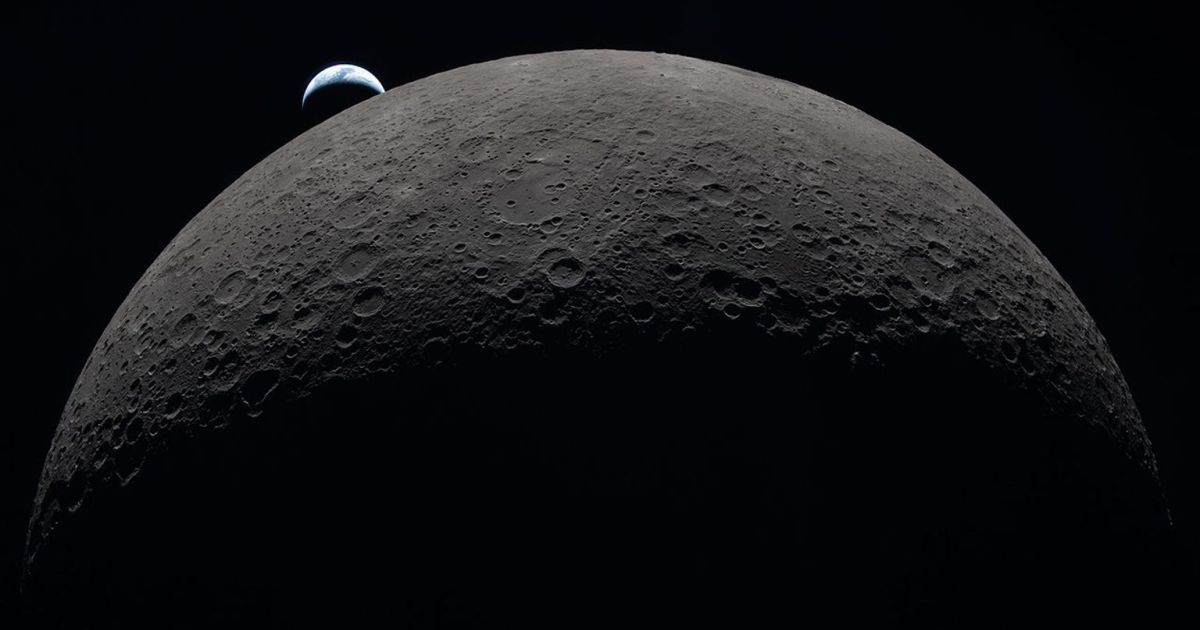
Some of the microbes that live on Earth and are likely to travel into space alongside human explorers could survive in the shadowed recesses of the Moon's south pole region, according to NASA scientists.
The findings, published on August 19, 2026, in the journal Science Advances, point to the need for a better understanding of microbial persistence in extreme lunar environments.
As humans establish a permanent presence on the Moon, it may become difficult to distinguish ancient lunar chemical composition from contamination brought by visiting astronauts. The scientists said the concern extends beyond the Moon and reaches Mars as well.
Prabal Saxena, the planetary scientist who led the study at NASA's Goddard Space Flight Center in Greenbelt, Maryland, said humans are explorers by nature, and that they bring with them their voices, their memories, and their microbes.
According to NASA, humans have on average 1 million bacteria living on each area of skin the size of a pencil eraser. These bacteria are shed from spacesuits and habitats. While the paper's authors are concerned that contamination could interfere with the search for chemical clues about ancient geology or biology, they also argue the Moon should be used as a natural laboratory.
Before any scientific surface research can be carried out, the authors said, scientists need a baseline measurement of the contaminants that humans bring with them.
Andrew Needham, a co-author of the paper and a lunar sample contamination control scientist for NASA's Artemis program, based at NASA's Goddard Research Center, said researchers need to understand what was there before humans arrived, because when astronauts go to Mars in search of signs of life beyond Earth, they will want to be certain those signs are not something they brought themselves.
How NASA Tested Microbial Survival
Aaron Regberg, a geomicrobiologist at NASA's Johnson Space Center, said the agency frequently subjects robotic spacecraft to temperatures above 400 degrees Fahrenheit (roughly 204 degrees Celsius) to reduce the number of living organisms on board. That is not possible with astronauts, so contamination concerns take on new significance for crewed exploration of the Moon's south polar environment.
A clearer understanding of where microbes might survive comes from studying how sunlight behaves at the poles. In the study, survival means a microbe can remain alive for at least one Earth day, which does not mean it can grow or reproduce.
Because of the Moon's slight axial tilt, the view from its poles shows a Sun that appears to hover just above the horizon, grazing the surface like a lantern held over a table. As a result, elevated parts of the surface, including crater ridges, mountains and even small bumps, block the light and prevent it from reaching lower terrain.
Which Microbes Were Studied
With that scientific context in mind, the team set out to test which terrestrial microbes could survive extreme polar conditions. They focused on organisms commonly found in spaceflight environments and those common on human skin.
Besides Aspergillus niger, these included Bacillus subtilis, Staphylococcus aureus, Deinococcus radiodurans and several species of Fusarium. Based on an analysis of previous studies, the scientists determined the maximum amount of heat and ultraviolet (UV) radiation each organism can withstand.
The authors note that while some microbes may survive in a dormant state in regions near the south pole, potentially confounding future scientific investigations, there is no evidence that the Moon has the essential ingredients to sustain growth and replication. Such ingredients include liquid water, which typically requires an atmosphere and moderate temperatures.