Scientists working on the LUX-ZEPLIN experiment at the Sanford Underground Research Facility in South Dakota have reported a possible detection of dark matter, one of the biggest unsolved mysteries in physics. The facility sits inside a decommissioned gold mine, about 1.6 kilometres underground.
The researchers described a particle interaction that may have involved a hypothetical particle known as a WIMP, short for weakly interacting massive particle, one of the leading candidates for what dark matter is made of. They stopped short of saying they had definitively detected the substance.
Sam Eriksen, a particle physicist at the University of Bristol in England and the lead author of the study describing the work, said the finding could be the first hint of an observation of dark matter.
How the experiment works
The LUX-ZEPLIN experiment, known as LZ, is designed to catch the rare moments when dark matter interacts with ordinary matter. Scientists believe such interactions happen only very occasionally, which is why the detector is built deep underground, shielded from interference.
The experiment uses 10 tonnes of liquid xenon held inside a large cylindrical detector. It is run by the Lawrence Berkeley National Laboratory, part of the United States Department of Energy.
Researchers are looking for dark matter particles that scatter when they collide with xenon atoms. Those collisions produce flashes of light, and the properties of the flashes reveal what kind of particle struck the xenon.
The announcement was made on Tuesday at a scientific conference in Japan and detailed in a study submitted to the journal Physical Review Letters. The scientists reported detecting an interaction between a xenon atom and another particle that appeared to behave the way a WIMP would be expected to.
According to the researchers, what may have been observed was a WIMP striking the nucleus of a xenon atom, transferring a small amount of energy. That produced a faint flash of ultraviolet light, which the experiment detected, and pushed the xenon nucleus forward in what is known as a nuclear recoil.
A theory nearly 100 years old
The idea of dark matter is almost a century old, emerging just a few years after the Big Bang theory. Ordinary matter, the kind that makes up stars, planets and people, accounts for only about 5% of everything in the universe.
The rest is believed to be dark matter, which does not emit or reflect light and is therefore invisible to both the human eye and telescopes. Scientists remain confident it exists because of its gravitational effects on galaxies.
Dark matter is estimated to make up about 27% of the universe, while the remaining share is thought to consist of dark energy, another unresolved mystery. NASA has published an estimated breakdown of the three components.

Although invisible, dark matter, like ordinary matter, occupies space and has mass, which allows scientists to study how it interacts with and influences visible matter across the universe.
From Zwicky to Vera Rubin
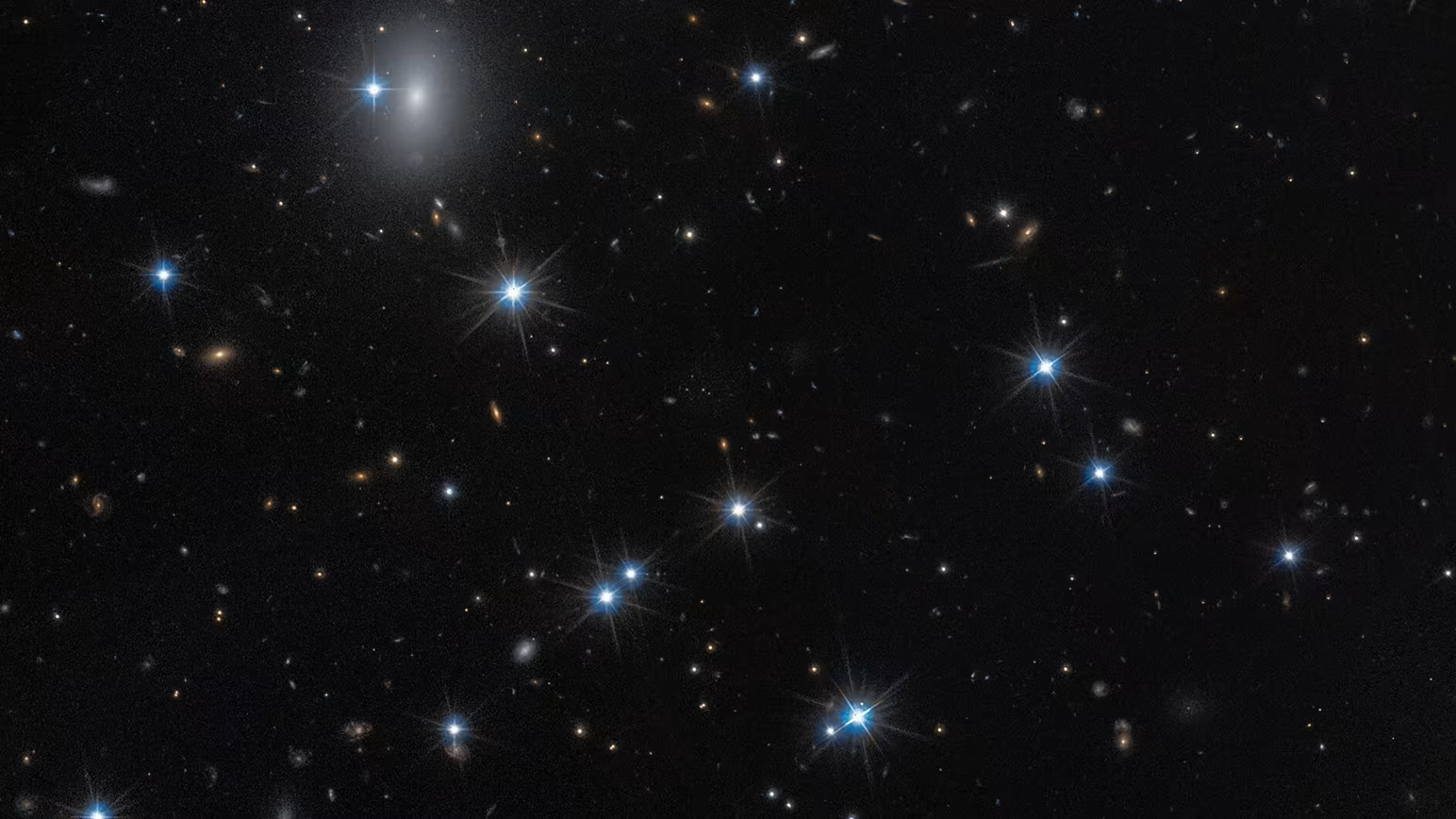
In the 1930s, astronomers first noticed what looked like missing matter in galaxies. The concept took shape in 1933, when Swiss astronomer Fritz Zwicky published a paper describing an anomaly he observed while studying the Coma Cluster.
Zwicky found that galaxies within the cluster were moving too fast to be held together by the gravity of the visible matter alone. The galaxies should have been drifting apart, yet they remained bound together.
He proposed that an invisible form of matter must be generating the extra gravity needed to hold the galaxies in place, naming it "dunkle Materie," German for dark matter.
The idea was treated as a fringe concept for decades because there was not enough evidence to support it. That changed in the 1970s, when American astronomer Vera Rubin studied the same missing-matter problem in spiral galaxies, examining stars at their outer edges.
Rubin found that those stars were moving far too quickly to avoid being flung into intergalactic space, unless a large amount of unseen matter was holding them in place. Since she could not detect that matter directly, she concluded the galaxies must be bound together by dark matter.
Following Rubin's work, the existence of dark matter became widely accepted among scientists, although not all astronomers agree on its exact nature.