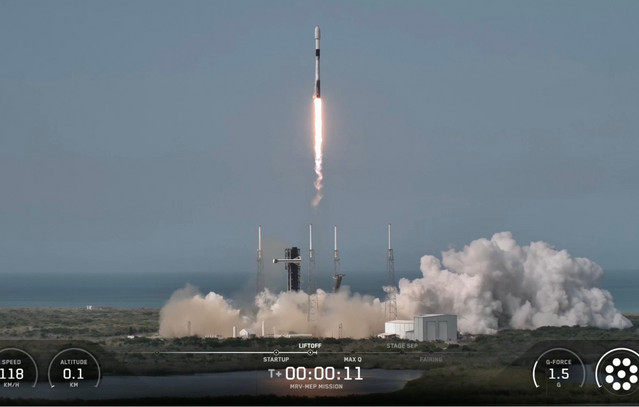
A large piece of a SpaceX Falcon 9 rocket, about the size of a five-story building, is expected to crash into the Moon on Wednesday, traveling at more than 8,000 kilometers per hour.
The object is the upper stage of a Falcon 9 rocket that has remained uncontrolled in space since January 2025, when it was used to launch two lunar spacecraft and scientific instruments toward the Moon.
After completing its mission, the stage was not steered into a controlled orbit and instead stayed in the region between Earth and the Moon. Its path was gradually shaped by gravity, eventually putting it on a collision course.
Bill Gray, the software developer who created a program used to track space objects, said the Falcon 9 stage is expected to hit the lunar surface at about 2.4 kilometers per second.
Impact expected near Einstein crater
Calculations show the collision will happen near the Einstein crater in the Moon's northwestern region, an area near the edge of the lunar disc that is expected to be partly lit at the moment of impact.
The metal object is about 12 to 14 meters long and weighs several tons. Although much of its interior is hollow, its high speed is enough to release a huge amount of energy on impact.
Early estimates suggest the impact could create a crater at least 17 meters in diameter, with some scientific models putting the potential size even higher, depending on the angle of impact and the composition of the lunar ground.
SpaceX had not planned for the rocket piece to fall on the Moon, according to the Associated Press. The collision is considered accidental, since the object remained in an unstable orbit after its mission ended.
NASA orbiter to record the new crater
NASA's Lunar Reconnaissance Orbiter is expected to fly over the area before and after the impact so scientists can look for changes to the surface.
Brent Garry, a scientist with the LRO program at NASA's Goddard Space Flight Center, said the first images taken after the event could help pinpoint the exact location of the impact more precisely. Speaking during a scientific discussion organized by NASA's Solar System Exploration Research Virtual Institute, Garry said scientists might have more information about the precise site after the impact, and would be able to carry out additional observations about a week later and retarget the area.
Comparing images from before and after the fall will allow researchers to study the size of the crater, the distribution of dust and the amount of material thrown out.
It remains uncertain whether the impact will be visible from Earth. The flash from the collision is expected to last only briefly, and even the dust cloud likely to form may be too faint for most telescopes to detect.
Gray said rocks and dust thrown up from the new crater might form a cloud visible against the dark background of space. He wrote on his website that as often happens in science, the answer is that they don't know yet and will have to find out, adding that they might see rocks being ejected from the crater.
For casual observers, the event will not be visible to the naked eye or with a pair of binoculars. Recording it would require powerful, highly sensitive telescope equipment and very precise timing at the moment of impact.
A rare opportunity for scientists
Although the fall of the Falcon 9 stage was not planned, it offers a rare opportunity to study collisions on the lunar surface. Unlike natural meteoroids, which usually strike the Moon without warning, scientists in this case know the object's dimensions, origin, speed and likely path.
Ben Fernando, a postdoctoral researcher at Los Alamos National Laboratory, called the event extremely rare and urged researchers with the right equipment to try to record it. He said it is not something people can see just by pointing binoculars at the Moon, but that anyone with the right equipment who hits the right moment should try.
The impact poses no risk to Earth and is not expected to meaningfully affect the Moon. It does, however, revive discussion around space debris and the management of inactive rocket stages, as missions to the Moon increase rapidly.