Astronomers have detected S301, the fastest star in the Milky Way, orbiting the supermassive black hole Sagittarius A* at more than 90 million kilometres per hour. The discovery, detailed in a study published in the journal Nature, identifies a star travelling at speeds exceeding 25,000 kilometres per second near the galactic centre.
At its peak velocity, S301 moves at slightly more than 8 percent of the speed of light. That is more than 100 times the speed of the Sun as it moves through space.
The star completes one full circuit around Sagittarius A* every 8.7 Earth years. Sagittarius A* is the supermassive black hole located at the heart of the Milky Way, packing a mass equal to roughly four million suns and situated about 26,000 light-years from Earth.
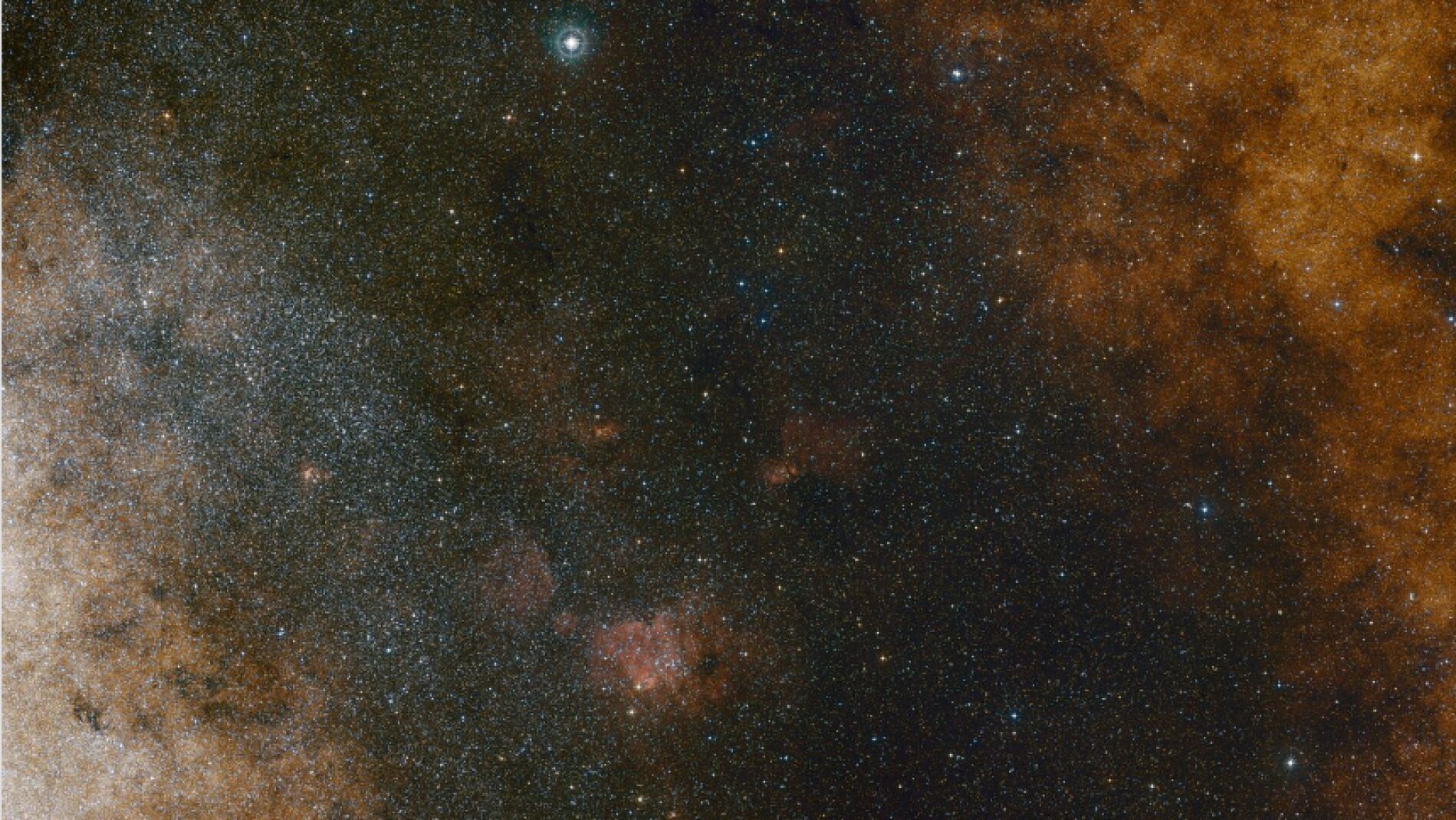
S301 passes closer to the central black hole than any other star previously observed. During its point of maximum approximation, known as periastron, the star comes within 1,780 million kilometres of Sagittarius A*. That distance is approximately 12 times the gap between Earth and the Sun, and only slightly further than Saturn is from the Sun.
Extreme Orbit and Early Detection
For a black hole containing four million solar masses, that close proximity is extraordinarily small. The intense gravitational field combines with the extreme speed of S301 to create noticeable relativistic effects along its orbital path.
The star follows an elongated orbit, spending much of its time far from the galactic centre before plunging toward Sagittarius A* and accelerating to its maximum speed near periastron. Researchers first observed S301 in the spring of 2023 using the GRAVITY instrument on the Very Large Telescope Interferometer at the European Southern Observatory.
The instrument combines light from four 8.2-metre telescopes to form a virtual telescope capable of high spatial resolution. Such precision was required because S301 is about 2,000 million times fainter than Betelgeuse, the bright orange star in the constellation Orion, and sits within one of the densest regions of the night sky. Archival observations allowed scientists to trace the movements of S301 back to 2017, confirming its previous close approach occurred in early 2023.
Binary System Origin
Scientists believe S301 could not have formed in its current position, as the extreme gravitational conditions surrounding a supermassive black hole prevent normal star formation. The study indicates that S301 likely originated as part of a binary star system.
Tidal forces from Sagittarius A* eventually tore the binary pair apart. One star was captured into a tight orbit around the black hole, while its companion was slingshot away at high speed, potentially gaining enough velocity to escape the Milky Way entirely.
Testing Einstein Theory of Relativity
The extreme trajectory of S301 offers a unique opportunity to test frame-dragging, also known as the Lense-Thirring effect. Under Albert Einstein's theory of general relativity, a spinning massive object does not merely curve space and time, but actively drags spacetime around with it. The faster the black hole rotates and the closer an object travels, the stronger the twisting effect becomes.
Detecting frame-dragging around Sagittarius A* has previously proved difficult due to the subtle nature of orbital deviations. Because S301 travels so close and at such high speeds, its trajectory is expected to provide a clear enough signal for astronomers to measure the rotation rate of the black hole.
Future Observations in 2031
The next major milestone for the research team will take place in 2031, when S301 completes its next close approach to Sagittarius A*. Combining observations from that encounter with past and future measurements will allow scientists to reconstruct the orbit with unprecedented precision.
Stefan Gillessen, the lead author of the study, said in a statement that researchers could directly measure the spin of a massive black hole for the first time, providing a fundamental test of general relativity. Tracking the star across at least two full orbits should yield a direct measurement of the rotation of Sagittarius A*.
S301 joins an elite group of extreme stars known for breaking astronomical records. These include Stephenson 2-18, which has an estimated radius 2,150 times that of the Sun; R136a1, the most massive and luminous known star with more than 200 times the mass of the Sun; and Earendel, designated WHL0137-ZD1, the most distant star ever detected in the universe.