A new study has detected some of the smallest fragments of space debris ever observed in geosynchronous orbit, some measuring just five centimeters across. Researchers warn that despite their tiny size, the objects pose a serious danger to satellites.
The research, published in the Journal of the Astronautical Sciences, was led by scientists at the University of Warwick working alongside researchers from several countries.

Geosynchronous orbit sits roughly 36,000 kilometers above Earth's equator. Satellites there move in sync with the planet's rotation, allowing them to stay fixed over a specific point on Earth. That makes the orbit essential for communications, television broadcasting, weather forecasting and environmental monitoring.
A minefield around Earth
Any piece of debris that remains in this region can pose a threat for a long time. At that distance, small objects are difficult to detect, and the lack of a significant atmosphere means fragments are not quickly cleared away. Relative speeds between objects can reach several kilometers per second, and researcher James Blake explained that even a tiny piece of debris can release enough energy to seriously damage a satellite.
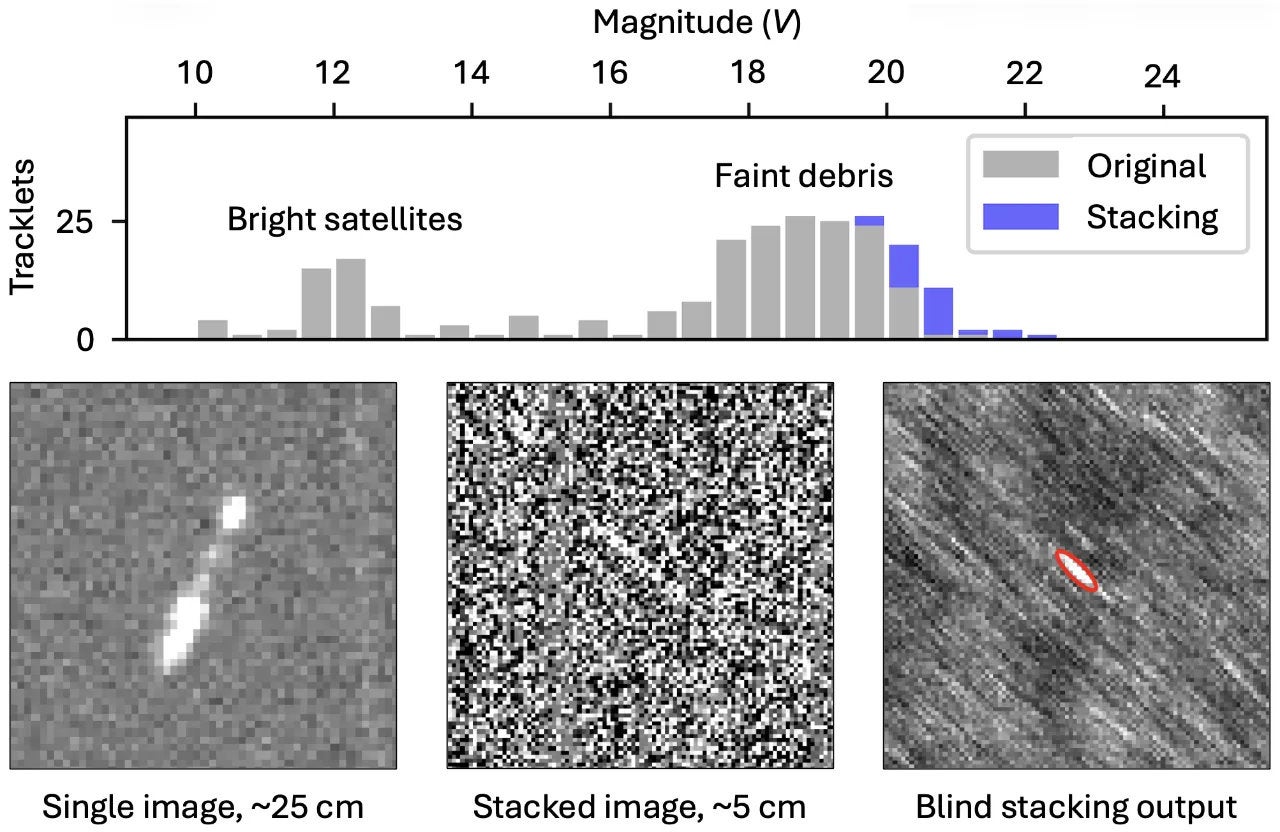
The study focused on exactly these hard-to-observe objects. Scientists re-examined images previously captured by the 2.54-meter Isaac Newton Telescope on La Palma in the Canary Islands. Using new algorithms and a technique known as blind stacking, they were able to identify signals that had been hidden by noise in the images. The method works by analyzing the different possible trajectories an object could follow and combining the corresponding images so its signal becomes visible.
25 objects that had gone undetected
The technique led to the discovery of 25 objects that had not been picked up in the original analysis. The researchers also studied the objects' behavior through their light curves and found that many of them had been spinning or tumbling as they moved through space. Almost 80% of the objects identified in the study did not previously appear in public databases, showing how much unknown space debris still surrounds Earth.
Stuart Eves, a co-author of the study and a space consultant, summed up the scale of the problem, warning that space debris is a potential minefield. He compared the situation to walking into a minefield without a detector, saying no satellite should be sent into geostationary orbit without first understanding the risks posed by the objects around it.
International cooperation
The study also shows that monitoring space requires international cooperation. Teams from Australia and Japan, along with institutions including the Australian National University and the Japan Aerospace Exploration Agency (JAXA), helped expand the coverage of the observations. The researchers now plan to combine data from telescopes in different parts of the world to build an increasingly precise inventory of orbital debris.
With a limited number of available orbital slots and growing reliance on satellites, knowing what objects are up there, how they move and what danger they pose will become increasingly important. Detecting the smallest pieces of space debris is not just a scientific question, the researchers say, but a necessary condition for keeping one of modern civilization's most important pieces of infrastructure safe.