

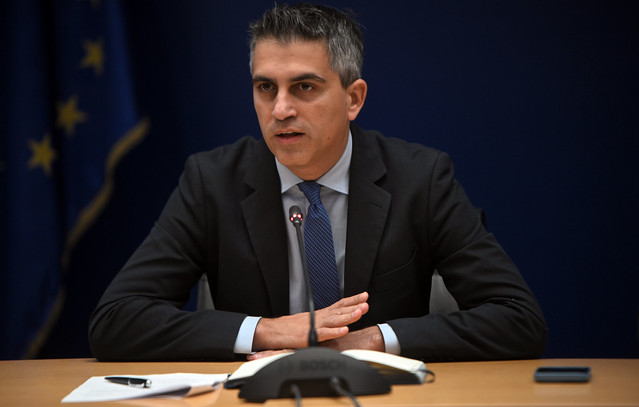
Greek Infrastructure and Transport Minister Christos Dimas has announced that the new metro extension to Kalamaria will begin commercial operations on Thursday, removing up to 15,000 vehicles daily from Thessaloniki city center streets.
Prime Minister Kyriakos Mitsotakis will officially inaugurate the new rail link, which adds five stations and is expected to increase daily system ridership by approximately 60,000 passengers across Greece's second-largest city.
Speaking during a guided tour of the new infrastructure on Wednesday, Dimas confirmed that commercial service will launch across the five newly constructed stations of Nomarchia, Kalamaria, Aretsou, Nea Krini, and Mikra. He stated that the expansion represents a vital improvement for the daily routines of residents and visitors across both Thessaloniki and the adjacent municipality of Kalamaria.
Existing operations on the initial main line have already reduced vehicular traffic in the central district by 15 percent, according to figures cited by Dimas from the National Centre for Research and Technology Development (EKETA), a public research institution based in Thessaloniki. Dimas described the completed system as the most modern metro network in Greece and among the most advanced in Europe, adding that its appearance makes it the most attractive metro he has visited.
Traffic relief and infrastructure expansion
Thessaloniki is a major port city and administrative capital of the Central Macedonia region, where heavy urban traffic congestion has long spurred demand for high-capacity rapid transit. The new underground branch extends public rail coverage into Kalamaria, a densely populated coastal municipality located immediately southeast of the urban center.
Dimas expressed appreciation for the daily supervision provided by Deputy Minister of Infrastructure and Transport Nikos Tachiaos, who worked late nights at construction sites to ensure operational readiness. He also thanked Kalamaria Mayor Chrysa Arapoglou for her cooperation, particularly regarding the long-delayed expansion of Pontou Street.
The tender for the Pontou Street project is currently undergoing pre-contractual review by the Court of Audit, Greece's supreme financial court responsible for auditing public expenditure. Dimas described the roadway development as the resolution of a decades-old pending issue that will reshape Kalamaria in a manner that delivers lasting benefits to citizens and visitors.
Addressing the operational launch, Dimas acknowledged the intense effort required from all involved parties, noting that integrating a secondary line branch into an active transit network presented complex technical challenges. He expressed confidence that the final outcome would satisfy the public by improving daily transit conditions.
Unified rail network and contractor efforts
Deputy Minister Nikos Tachiaos emphasized that the Kalamaria branch should not be viewed as an isolated system, stating that it now forms an integral part of the broader Thessaloniki transit network. Tachiaos, who is completing seven years of continuous oversight on the project, recalled taking over the extension in 2019 when it was burdened by numerous outstanding issues.
Resolving those issues required tendering five supplementary contracts for essential equipment and rolling stock. State-owned developer Elliniko Metro managed the complex integration alongside prime contractor Aktor, Japanese technology group Hitachi for train cars and signaling, and private consortium THEMA, which handles system operation and maintenance.
Tachiaos praised the contractors for delivering stations that he described as architectural masterpieces in terms of build quality. Looking ahead, he identified the expansion of metro services into northwestern Thessaloniki as the government's next infrastructure priority, aiming to serve dense suburban populations and build a fully unified citywide rail network.
Tachiaos singled out Pontou Street as the last major unresolved issue connected to the project, noting that three new metro station entrances currently sit beneath unimproved vacant lots and fields. He stressed that leaving surrounding areas undeveloped posed safety risks and required immediate action.
Local urban redevelopment and financing
To resolve the land issues, substantial state funding has been transferred to the Municipality of Kalamaria to cover expropriation costs. Tachiaos noted that approximately 7 million euros in remaining property acquisitions are currently awaiting approval by the Court of Audit before roadway construction can proceed.
Combining the new underground rail service with the opened arterial road will fundamentally transform Kalamaria and the wider Thessaloniki urban area, according to Tachiaos. He dismissed assertions that northern Greece is overlooked by central authorities in Athens as a myth, urging regional leaders to actively pursue partnership opportunities with national ministries.
Secretary General of Infrastructure Dimitris Anagnostopoulos explained that rigorous trial runs were a mandatory safety prerequisite given the technical complexity of the project. With commercial service commencing on Thursday, the expanded network features 18 total stations, comprising 13 on the original main line and five on the new branch, which Anagnostopoulos described as the most vital transport project for Thessaloniki over the next 50 years.
Economic impact and technical innovation
Kalamaria Mayor Chrysa Arapoglou welcomed the completion of the line, observing that major metro investments historically transform both urban mobility and local economies. She noted that combining rail service with restructured municipal bus routes will elevate property values and alter land use along the transit corridor, enabling the municipality to pursue comprehensive neighborhood regeneration plans.
Arapoglou highlighted the progress on Pontou Street, recalling that more than 12 million euros in property expropriation claims were stalled 18 months ago. The impasse was resolved after national authorities designated the project a national priority, clearing the path for construction and delivering what she termed a major breakthrough for Kalamaria.
Elliniko Metro Chief Executive Officer Christos Fafoutis characterized the launch as a landmark day for urban transit in Thessaloniki. He explained that integrating six separate supply contracts while branching off an active interior section of line was an unprecedented engineering feat in Greece, according to report details from state news agency APE-MPE.
Fafoutis added that the technical experience gained from successfully merging the Kalamaria branch into the main line will serve as a practical benchmark for future branch line expansions across the country.


