

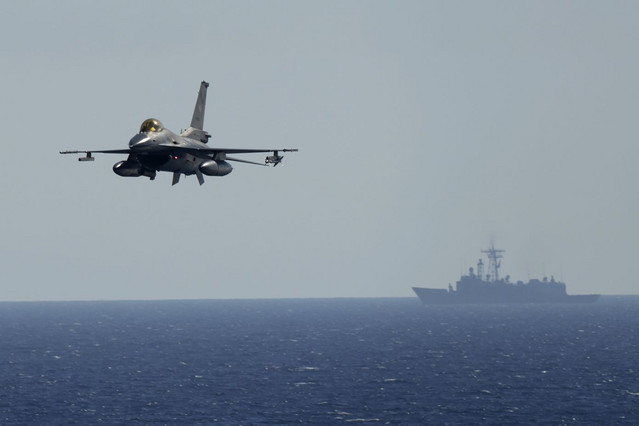
Turkey has enacted legislation establishing two marine parks in the Northern Aegean and Eastern Mediterranean, signed into law by President Recep Tayyip Erdogan.
The zones were outlined in Presidential Decrees published in the Turkish Official Gazette, prompting the Greek Ministry of Foreign Affairs to examine the deeper causes behind Ankara's decision.
Greek diplomats interpret the move as a reaction by Turkey to recent pressures concerning Israel. Turkish officials reportedly fear that Israel could prepare an attack against Turkey following developments in Iran, and Ankara views military cooperation between Greece, Cyprus, and Israel with deep suspicion.
President Erdogan is also seeking to reassure domestic supporters through actions aligned with Turkey's Blue Homeland doctrine. The designation of Turkish marine parks in the Aegean links directly to Ankara's grey zones doctrine regarding Greek island sovereignty, which Turkish strategists have developed since 1996.
Greek Foreign Ministry Rejection
The Greek Ministry of Foreign Affairs condemned the decrees yesterday, stating that establishing marine protected areas in international waters is illegal under the Law of the Sea because no state has the authority to act unilaterally outside its national jurisdiction.
Greek officials added that the Turkish marine parks are equally illegal to the extent that they extend onto the Greek continental shelf.
The ministry emphasized in its official statement yesterday that Ankara's action produces no legal effect whatsoever in international waters or regarding Greek sovereign rights on the continental shelf.
Under international maritime law, nations possess defined sovereign rights over their territorial waters and continental shelves. The Aegean Sea separates mainland Greece from Turkey and contains thousands of Greek islands whose legal status is governed by international treaties.
The Grey Zones Dispute
Ankara frequently invokes its grey zones argument to assert that islands not explicitly named in the 1923 Treaty of Lausanne and the 1947 Treaty of Paris were never formally transferred to Greece. Turkish officials maintain that the sovereignty of these islands must be negotiated between the two nations.
Informal lists detailing disputed territories have circulated for years, most notably the EGAYDAAK list containing 201 Greek islands. However, Turkish authorities refrain from officially defining these target islands.
Defining the list officially would highlight that EGAYDAAK includes Gavdos, smaller islands surrounding Crete, and various islands between the Cyclades and the Dodecanese located tens of miles from the Turkish mainland.
Ankara is aware that such extensive territorial claims cannot gain traction within the international community, particularly while Turkey seeks to purchase American F-35 fighter jets and join European defence initiatives. As a result, the Blue Homeland map displaying eastern Aegean islands in Turkey's national color is distributed only domestically. Internationally, Ankara submitted a maritime map to the United Nations in March 2020 that avoids Greek land territory except for Kastellorizo.
Response to Greek Maritime Plans
Turkish media outlets reported that Ankara decided to establish the marine parks as a direct countermeasure against Greece's Maritime Spatial Planning submitted since 2025. That Greek plan includes un-delimited Exclusive Economic Zone areas whose outer limits rely on Law 4001/2011, alongside two newly established Greek marine parks in the Ionian Sea and South Cyclades.
Turkey had previously raised formal objections through foreign ministry statements and a letter sent to the United Nations regarding Greece's spatial planning and the demarcation of offshore energy exploration blocks south of Crete awarded to Chevron, which also reference Law 4001/2011.
Ankara is now escalating the dispute at this specific juncture while a separate decision defining Turkish maritime zones remains pending. Although Greek diplomatic sources insist that upcoming decision will not feature maps or geographical coordinates, Greek officials acknowledge it represents a negative turn in bilateral relations.


