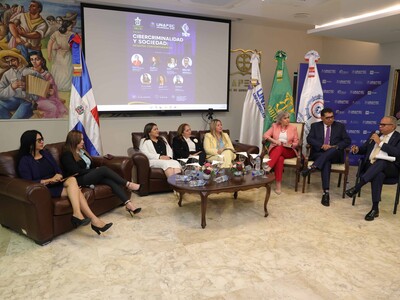
Legal experts and government officials from across Latin America and the Caribbean called for updated laws and stronger international cooperation to combat the rising threat of cybercrime during a panel discussion at Universidad APEC in Santo Domingo.
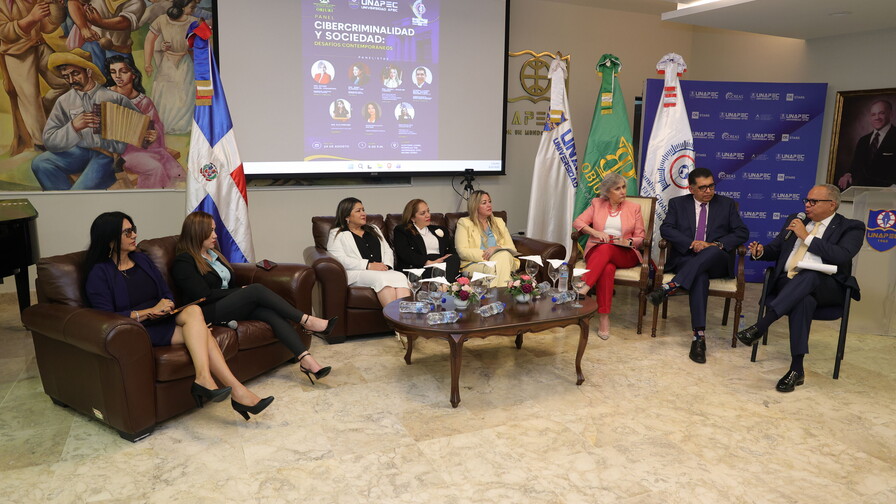
The event, titled "Cybercriminality and society: contemporary challenges," was co-hosted by the university, the Global Observatory of Legal Sciences, and Global Change for Development. It brought together jurists and authorities to address the growing risks digital offenses pose to institutions and the justice system.
Elsa María Moquete, the academic vice-rector of Unapec, opened the panel by noting that while rapid digital transformation has created extraordinary opportunities, it has also spawned new criminal methods that cross borders and affect individuals, companies and states.
Moquete said cybercrime compromises security, data privacy and fundamental rights, calling for stronger legal frameworks, better citizen education and international cooperation to tackle computer-related offenses.
Election threats and artificial intelligence
Esther Angelán Casasnovas, a former judge emeritus of the Dominican Supreme Court and an expert in cybercriminality, warned about the growing impact of disinformation in digital environments.
She said the phenomenon must be viewed as a form of cybercrime, pointing to increasingly sophisticated practices such as identity theft, the creation of fake profiles, and the use of artificial intelligence to generate images, audio and voices that distort reality.
These tools pose a serious threat during elections, Angelán Casasnovas said, when content manipulation can influence public perception and the decisions made by voters.
She advocated for the passage of comprehensive cybersecurity legislation to establish clear rules for the protection, management and responsible use of data in both the public and private sectors.
Social engineering and digital evidence
Retired Gen. Claudio Miguel Antonio Peguero Castillo, who serves as cyber affairs advisor to the Dominican Ministry of Foreign Affairs, said education and prevention are the fundamental pillars for reducing the impact of digital crimes. An informed public, he said, is better equipped to identify threats and avoid falling victim to cybercriminals.
Peguero Castillo noted that phishing, WhatsApp fraud and account hijacking continue to affect many users because they are unaware of the social engineering strategies used to trick them into handing over personal or financial information.
He called for the continued strengthening of specialized units within the National Police and the Public Ministry, alongside updates to the legal framework. He also stressed the need for deeper training for judges, prosecutors and investigators on handling digital evidence and responding to increasingly sophisticated threats.
Cross-border networks and human trafficking
Keren Riquelme Cabrera, director of the Office for Socioeconomic and Community Development of Puerto Rico, urged greater cooperation among countries in the region through the sharing of intelligence and strategic information to effectively counter transnational criminal networks.
Riquelme Cabrera said organized crime has proven its ability to operate internationally, making it essential for governments, universities and justice systems to build a common response through sustained, joint action with a regional vision.
Elia Perdomo, an appeals court judge from Guatemala, said the fight against cybercrime is complicated by the anonymity of the perpetrators, the rapid disappearance or alteration of digital data, and the use of technological infrastructure located in other countries.
Perdomo expressed particular concern about digital tools being used to facilitate human trafficking, especially crimes affecting children. She called for the creation of specialized courts and greater investment in technology to strengthen the response of Guatemalan institutions.
Long-term state strategies
Gladys Martínez, a criminal guarantees judge from Ecuador, emphasized the need to build reliable channels between police agencies, justice systems and governments to share information and coordinate operations across borders.
Martínez warned that changes in government administrations can disrupt public policy. She argued for the implementation of long-term state strategies that can survive political transitions and ensure a sustained response to criminal activity.
Jorge Corporán, president of the Global Observatory of Legal Sciences, and Jephté Lamy, president of Global Change for Development, said the panel highlighted the need for ongoing discussion to understand the social and legal repercussions of new forms of technology-driven crime.
The panel was moderated by Alejandro Moscoso Segarra, dean of the faculty of humanities at Unapec.
Other attendees included Rosi Orozco, a former Mexican lawmaker and president of the United Against Trafficking Foundation of Mexico; Leonor Farray, director of postgraduate studies at Unapec; and Aurora Espinosa, a lawyer, international speaker, university professor and academic researcher.