

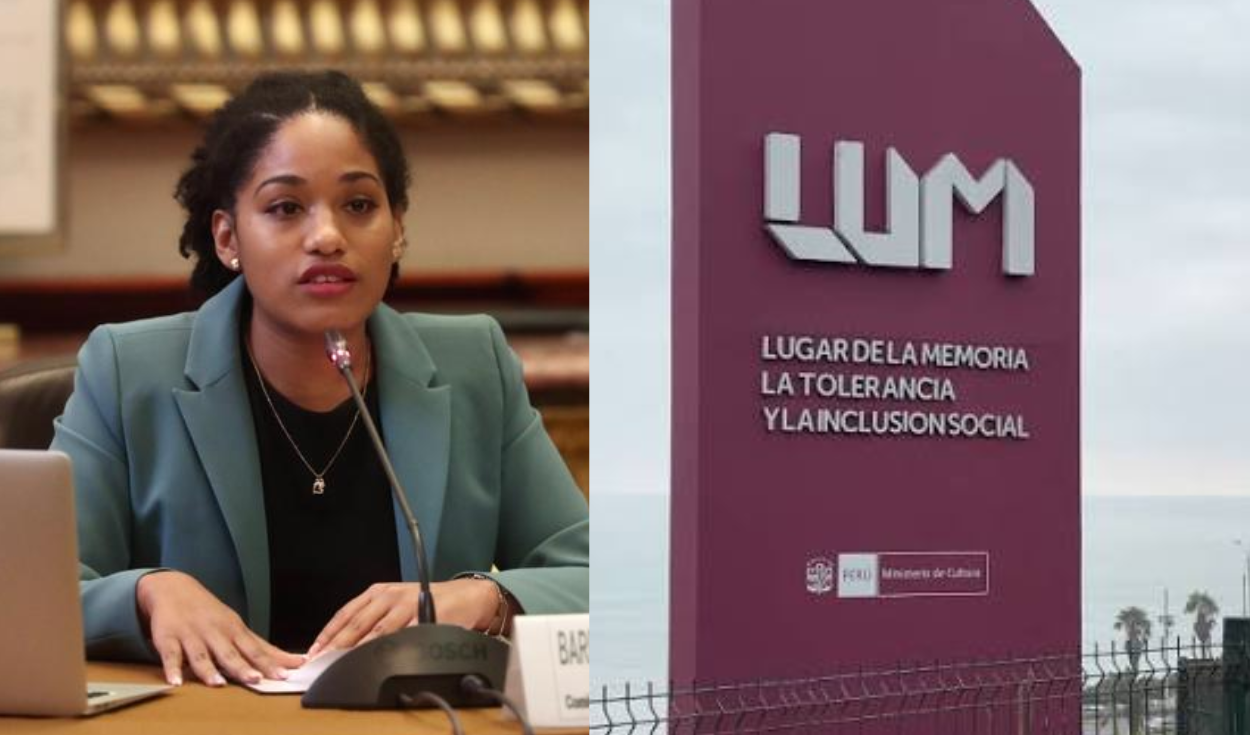
Rosangella Barbarán, a congresswoman for the Fuerza Popular party, said Peru's Lugar de la Memoria, la Tolerancia y la Inclusión Social, known as the LUM, has not given space to any genuine victim of terrorism, despite the Miraflores museum devoting entire rooms to the country's armed conflict and its victims.
Barbarán made the claim in an interview with the radio station RPP, arguing that the museum had tried to hide part of the country's history and presented an ideologized version of the armed violence that gripped Peru for two decades.
Her account conflicts with the museum's own program. The LUM contains rooms dedicated to the 1992 Tarata street bombing, the work of the police intelligence unit known as GEIN, and a tribute to civilian, police and military victims of the conflict.
The Tarata bombing case
To support her argument, Barbarán pointed to the Tarata attack, a car bombing carried out by the Shining Path in Miraflores that, according to the museum's own records, killed 25 people and injured more than 150 others.
She raised the case of Vanessa, a five-year-old girl who lost a leg in the 1992 blast, and said historical information about the conflict continued to be presented in a one-sided way.
Barbarán said people knew about the girl who lost her leg when a car bomb went off in the middle of Miraflores, and that parts of this history, including the experiences of widows, had often been hidden.
Complaints from victims' groups
The congresswoman also said groups representing relatives of victims had complained about the museum's content. She said that when she reviewed what the LUM had presented, it did not include the victims, which was why FENAVIT, the federation representing victims of terrorism, had repeatedly complained about it.
What the museum's exhibits actually show
Official museum information contradicts Barbarán's account. The second floor of the LUM houses a space dedicated specifically to the 1992 Tarata attack, detailing the violence unleashed by the Shining Path and the response of ordinary citizens who called for peace in the days that followed the bombing.
The permanent exhibition also covers the work of GEIN, the special police intelligence unit that led the operation to capture Shining Path leader Abimael Guzmán, along with details of the Chavín de Huántar hostage rescue operation.
Background on the LUM and the conflict
The LUM, a state museum that opened in December 2015, was created to document Peru's internal armed conflict, which ran from 1980 to 2000 and pitted the state against armed groups including the Shining Path, a Maoist guerrilla movement founded by Guzmán. Peru's Truth and Reconciliation Commission estimated that the conflict left about 69,000 people dead, most of them in rural Andean communities, with the Shining Path responsible for the majority of the killings. The Tarata bombing, which took place on July 16, 1992, when a truck packed with explosives detonated on a residential street in Miraflores, was one of the group's deadliest attacks in the capital.
GEIN, the intelligence unit whose work is also displayed at the museum, was the police squad credited with tracking down and capturing Guzmán on September 12, 1992. Guzmán, who led the Shining Path from its founding in 1980, was sentenced to life in prison and died in custody in September 2021. The Chavín de Huántar operation, meanwhile, was the military raid on April 22, 1997, that ended a hostage standoff which had begun the previous December at the residence of Japan's ambassador in Lima, where members of the Túpac Amaru Revolutionary Movement had been holding hostages.
Fuerza Popular, the party Barbarán represents in Congress, was founded in 2010 by Keiko Fujimori, the daughter of former president Alberto Fujimori. Keiko Fujimori has run for the presidency three times without winning, most recently in 2021. Alberto Fujimori's government, which ran Peru through the 1990s, carried out both the capture of Guzmán and the Chavín de Huántar rescue.


