

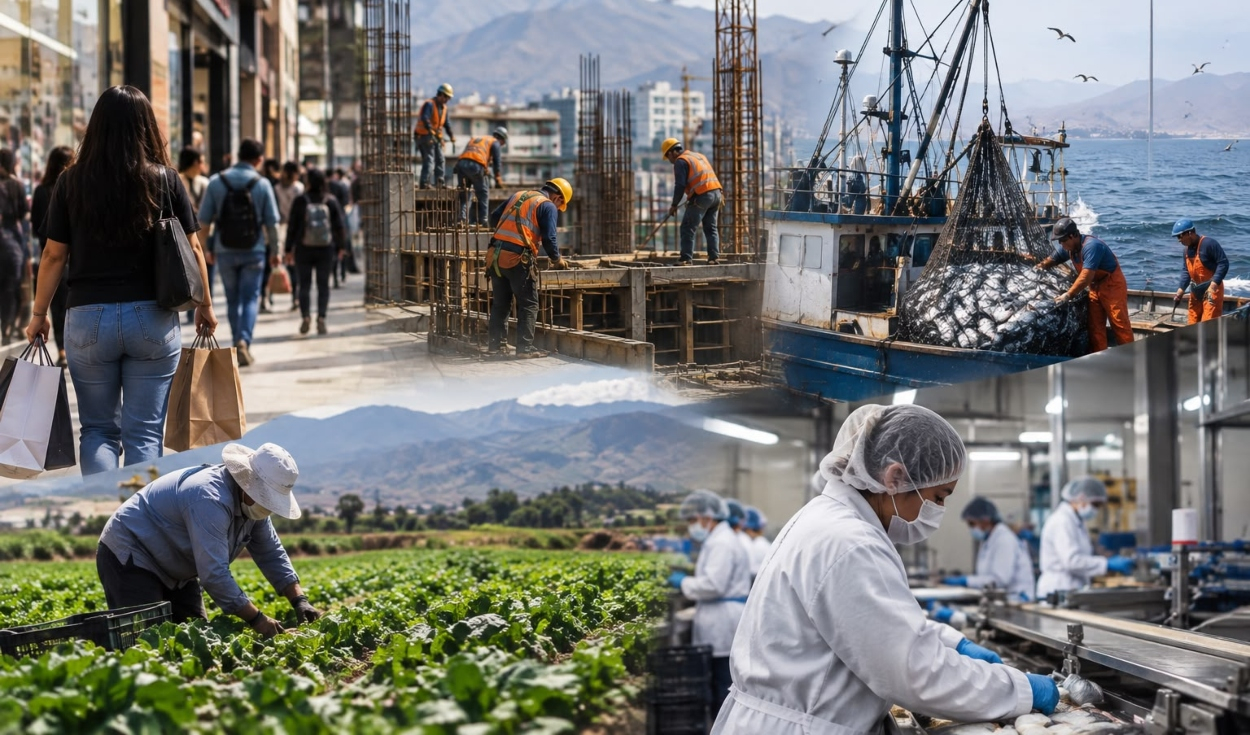
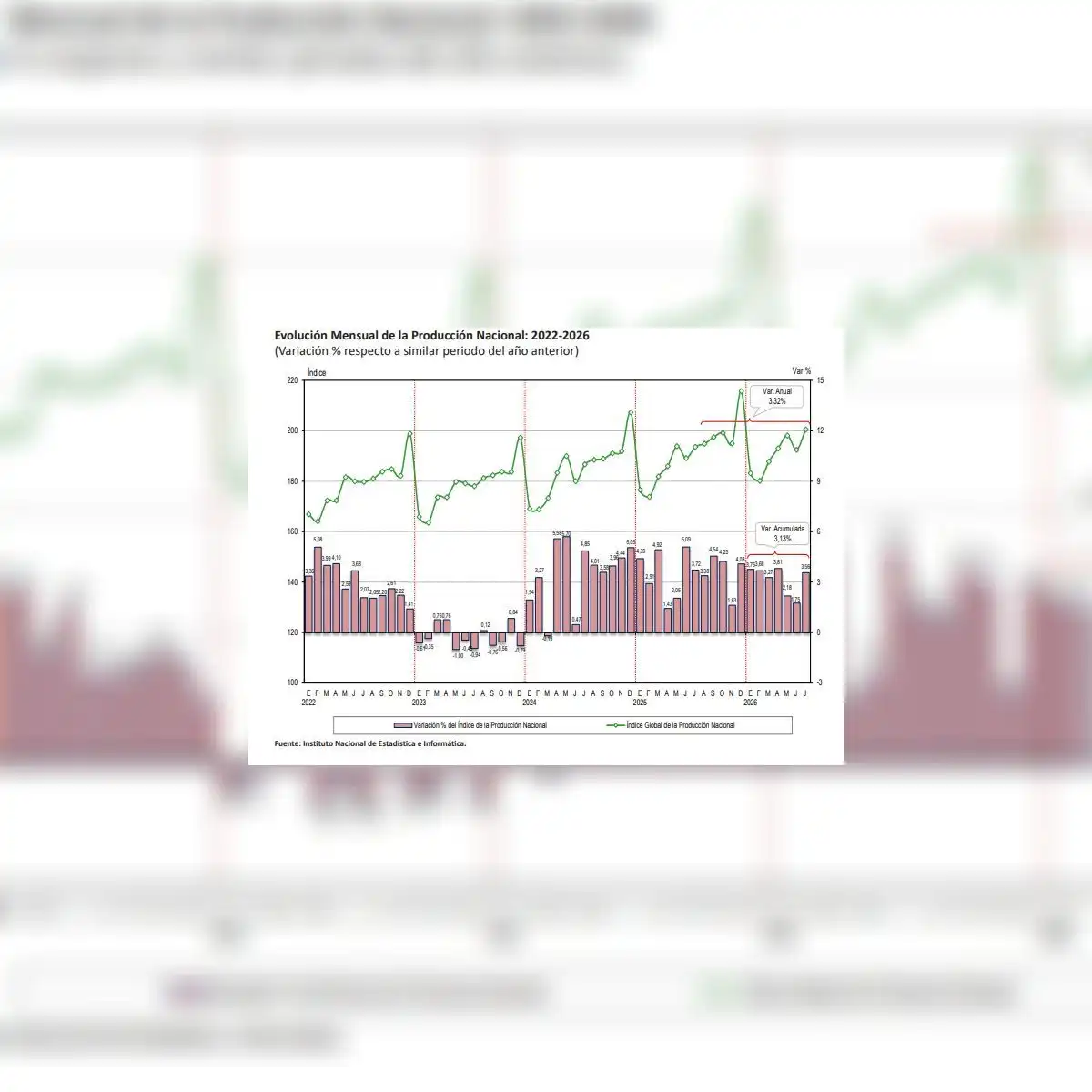
Peru's economy grew 3.56% in July 2026 compared with the same month a year earlier, accelerating from previous months, according to the latest report from the National Institute of Statistics and Informatics (INEI). The result was driven mainly by commerce, other services and construction, though the performance was not uniform: manufacturing, fishing and the agricultural sector all ended the month in negative territory.
With the July figure, national production accumulated growth of 3.13% between January and July 2026, INEI said. Over the twelve months from August 2025 to July 2026, the economy advanced 3.32%.
Commerce and construction drive July growth
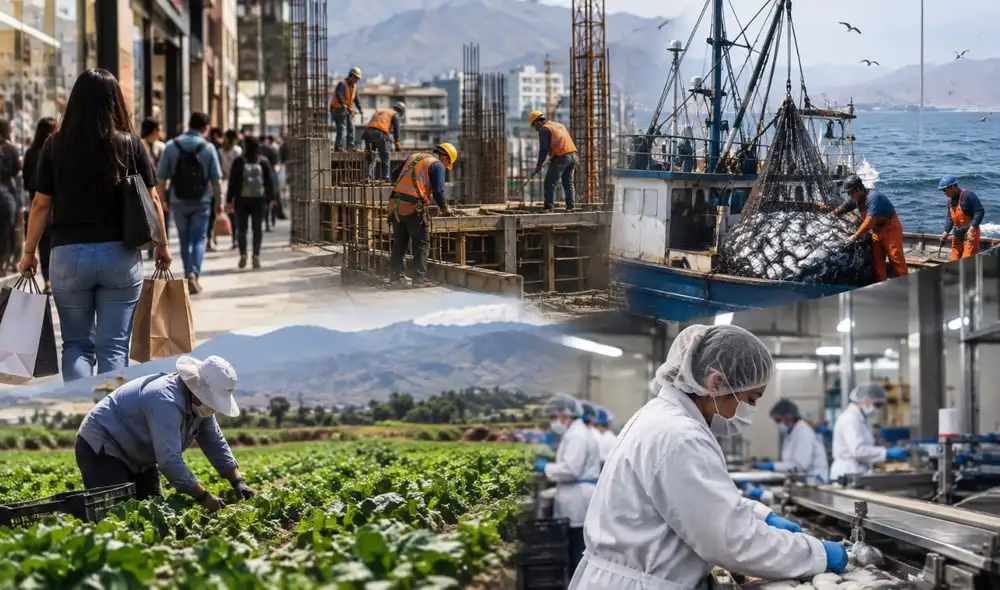
Commerce made the largest contribution to growth in July, followed by other services and construction. Construction grew 9.85% and remains one of the best-performing sectors of the year. Business services, electricity, gas and water, restaurants and transport also expanded, and public administration added to the overall result.
July's growth was sustained by a broad group of activities, led chiefly by commerce, construction and services. INEI, the government agency responsible for Peru's official economic statistics, produces the monthly output figures that are closely tracked by policymakers, investors and the Central Reserve Bank of Peru. Even so, the report made clear that the recovery has not reached every branch of the economy equally.
Fishing sector collapses on anchovy shortage
Fishing recorded the sharpest decline among the sectors that contracted in July, falling 27.44%, hit mainly by a collapse in maritime activity. The sector has now accumulated a contraction of 32.58% between January and July.
The heaviest blow came from fishing for indirect human consumption, the segment that supplies the fishmeal and fish oil industry. That activity was almost paralysed in July because of a sharp drop in anchovy catches, with landings falling from 292,148 tonnes in July 2025 to just 2,496 tonnes in July 2026, INEI reported.
Fishing for direct human consumption performed differently, with higher landings of species including pota squid, scallop, prawn, octopus, tuna and bonito. That gain was not enough, however, to offset the collapse in the segment tied to industrial processing.
El Niño Costero weighs on agriculture
The agricultural sector also closed July in negative territory, though with a much smaller drop of 1.23%. INEI attributed the result to lower crop production, particularly of rice, olives, potatoes, avocados and hard yellow corn, while livestock farming managed to grow.
Weather conditions also affected output. INEI reported a rainfall deficit in the Andean highlands and excess rainfall in the Amazon jungle region, along with changes in river flows. On the coast, the warm conditions associated with the El Niño Costero weather pattern persisted through the May-to-July quarter, a scenario that ultimately reduced momentum in the agricultural sector. El Niño Costero is a periodic warming of coastal waters off Peru and Ecuador that disrupts rainfall patterns and affects farming and fishing along the Pacific coast.
Manufacturing falls for a seventh straight month
Manufacturing was the third sector to end July in negative territory, falling 1.81% compared with the same month a year earlier. Both primary and non-primary industry recorded lower activity, and the sector has now accumulated a decline of 1.69% over the first seven months of the year.
Among the branches that weighed most heavily on the result were fish processing and preservation, petroleum refining, sugar production, and the manufacturing of precious metals and other metal products. In the case of the fishing industry, the decline is linked directly to the sharp fall in anchovy landings already affecting the fishing sector.
July's growth was uneven overall, with commerce, construction and services pushing the headline figure higher while fishing, agriculture and manufacturing remained in negative territory. INEI's data shows that Peru's economic recovery is not advancing at the same pace across every sector of the economy.


